IP Addressing and Network Management

Aligned to the AQA 7517 specification
- Level
- Intermediate
- Reading time
- 5 min
- Published
- 13 June 2026
- Updated
- 16 August 2026
On this page
Key takeaways
- An IP address is divided into a network identifier and a host identifier; routers use the network part to route packets to the correct network, and the host part identifies the specific device.
- A subnet mask is a 32-bit value that identifies which bits are the network part; ANDing the IP address with the subnet mask extracts the network address.
- IPv4 uses 32-bit addresses giving 2³² ≈ 4.3 billion addresses, whereas IPv6 uses 128-bit addresses giving 2¹²⁸; IPv6 was introduced because of IPv4 address space exhaustion.
- Private IP addresses are not globally unique and are not routable on the Internet; multiple private networks worldwide reuse the same ranges, and NAT translates them to a globally unique public IP.
- DHCP automatically assigns four things to a joining device: an IP address, subnet mask, default gateway, and DNS server address, for the duration of the lease.
Want more lessons like this one?
Generate lessons on anything you study. Free account, no card needed.
DHCP, NAT, and Port Forwarding
DHCP (Dynamic Host Configuration Protocol)
DHCP automatically assigns configuration to devices joining a network. When a device connects:
- Device broadcasts a DHCP request
- DHCP server responds with: IP address, subnet mask, default gateway, DNS server address
- Device configures itself using these values for the duration of the lease
Without DHCP, every device would need a manually configured static IP address.
NAT (Network Address Translation)
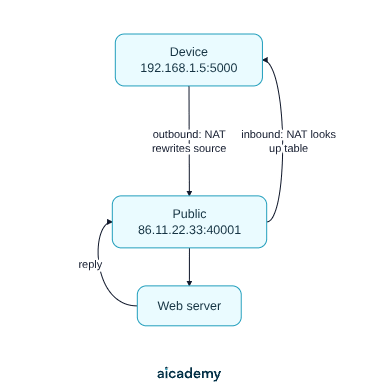
NAT allows multiple devices on a private network to share a single public IP address.
- The router maintains a translation table: maps (private IP + ephemeral port) ↔ (public IP + translated port)
- Outbound: router replaces the source private IP with its public IP in each packet
- Inbound: router uses the translation table to forward the reply to the correct private device
Example:
Port forwarding
Port forwarding allows external devices to initiate connections to a specific internal device through the NAT router.
Configuration: incoming traffic on public IP port 8080 → forward to 192.168.1.10:80 (internal web server).
Without port forwarding, NAT only handles outbound-initiated connections — the router does not know which internal device should receive an unsolicited inbound connection.
Key terms
- IP address
- A label given to every device on a network, divided into a network identifier and a host identifier.
- Subnet mask
- A 32-bit value that identifies which bits of an IP address are the network part and which are the host part.
- CIDR notation
- A way of writing the network size, where /24 means the first 24 bits are the network part, equivalent to mask 255.255.255.0.
- Subnetting
- Dividing a network into smaller sub-networks, improving security and reducing broadcast traffic within each subnet.
- IPv4
- A 32-bit IP addressing scheme written as 4 octets, providing about 4.3 billion addresses, all of whose public blocks are now allocated.
- IPv6
- A 128-bit IP addressing scheme written as 8 groups of 4 hex digits, providing 2¹²⁸ effectively inexhaustible addresses with built-in auto-configuration.
- Public IP address
- A globally unique, Internet-routable address assigned by ISPs and internet registries and visible to servers on the Internet.
- Private IP address
- An address used within a LAN that is not routable on the Internet and can be reused across different private networks.
- DHCP
- Dynamic Host Configuration Protocol: automatically assigns an IP address, subnet mask, default gateway, and DNS server address to devices joining a network.
- NAT
- Network Address Translation: lets multiple devices on a private network share a single public IP address using a translation table maintained by the router.
- Port forwarding
- A configuration that lets external devices initiate connections to a specific internal device through the NAT router.
Frequently asked questions
AND the IP address with the subnet mask to extract the network address. For example, 192.168.1.42 AND 255.255.255.0 gives the network address 192.168.1.0, with the host being device .42 on that network.
IPv6 was introduced because of IPv4 address space exhaustion: IPv4's 32-bit addresses provide only about 4.3 billion addresses and all public IPv4 blocks have been allocated. IPv6's 128-bit addresses provide effectively unlimited addresses for every device, including IoT.
No. Private IP addresses are not globally unique and are not routable on the Internet; multiple private networks worldwide use the same ranges (such as 192.168.x.x). They are unique only within their own LAN, and NAT handles translation to a globally unique public IP.
Generate revision on any topic you study
Type any topic you're studying and Aicademy generates a complete lesson, quiz, and flashcard set, personalised to your level.
Lessons on anything
Structured, level-matched lessons on any topic you study
Practice quizzes
Find out what you actually know before the exam does
Flashcard sets
Lock in key concepts with instant revision cards
Ask Aica
Stuck on something? Get a clear explanation, any time
TCP/IP and Application Layer Protocols
Web Technologies and Client Models
Related lessons
6 min
7 min