Track progress, take quizzes and save notes on this lesson.

Free forever · no card needed

Start free
Intermediate

Network Topology and Wireless Networking

4.9.2.1 Network topology·4.9.2.2 Types of networking between hosts·4.9.2.3 Wireless networking

Aligned to the AQA 7517 specification

Level
Intermediate
Reading time
6 min
Published
13 June 2026
Updated
1 July 2026
On this page
  1. 1.Network Topologies
  2. 2.Client-Server vs Peer-to-Peer
  3. 3.WiFi and Wireless Components
  4. 4.Wireless Security
  5. 5.CSMA/CA and RTS/CTS
  6. 6.Common Exam Mistakes

Key takeaways

  • Physical topology is the actual cable or radio connections while logical topology is how data flows; a physical star using a switch often operates as a logical bus, which is how most wired Ethernet LANs work.
  • In client-server, dedicated servers provide services to requesting clients with centralised control, whereas in peer-to-peer all nodes are equal with no dedicated server and no single point of failure.
  • WiFi uses CSMA/CA (Collision Avoidance) rather than CSMA/CD (Collision Detection) because a wireless device cannot simultaneously transmit and listen to the channel.
  • WPA2 encryption is the actual wireless security mechanism; disabling SSID broadcast is only a minor inconvenience because hidden SSIDs are revealed by probe packets and scanning tools.
  • RTS/CTS is an optional handshake that reduces hidden node collisions, where the AP's CTS reply is heard by all in-range devices so they defer transmission during the reserved window.

Network Topologies

Network topology describes how devices are arranged and connected.

Physical star topology

Every device connects directly to a central switch or hub with its own dedicated cable.
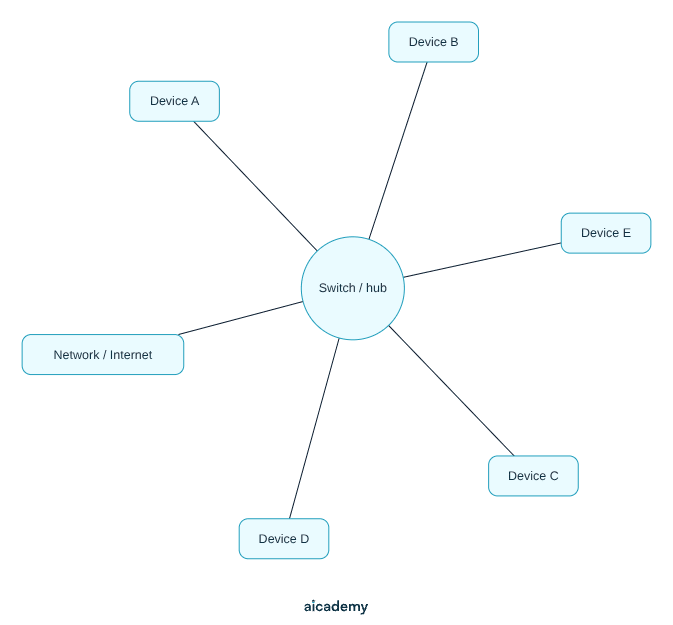
Advantages:

  • Failure of one link affects only that device — others remain connected
  • Centralised management at the switch
  • Easy to add or remove devices

Disadvantage: if the central switch fails, the entire network goes down.

Logical bus topology

All devices share a single communication channel. Data transmitted by one device is visible to all others; each device checks whether the data is addressed to it.

Key distinction: physical and logical topologies can differ. A physical star network using a switch can operate as a logical bus — the switch receives data on one port and broadcasts or forwards it, so the logical channel is shared. This is how most wired Ethernet LANs work: physical star wiring with logical bus behaviour via the switch.

Client-Server vs Peer-to-Peer

Client-server

  • Dedicated servers provide services (web, email, file, database)
  • Clients request services; servers respond
  • Servers have more powerful hardware and dedicated roles
  • Centralised control — easy to manage permissions, security, backups

Examples: web browsing (browser=client, web server), email (email client + mail server), corporate file sharing.

Peer-to-peer (P2P)

  • All nodes are equal — each can act as both client and server
  • No dedicated server — resources shared directly between peers
  • Decentralised — no single point of failure for the network
  • Harder to manage security and access control

Examples: BitTorrent file sharing, some VoIP systems (Skype originally), blockchain networks.

Client-serverPeer-to-peer
StructureDedicated servers + clientsAll nodes equal
ManagementCentralised, easierDecentralised, harder
SecurityEasier to enforceHarder to control
ScalabilityAdd more serversScales naturally with nodes
Single point of failureServer is a riskNo single point of failure

WiFi and Wireless Components

WiFi is a family of wireless LAN standards based on IEEE 802.11.

Components:

  • Wireless network adapter (client): hardware in a device (laptop, phone) that transmits and receives radio signals
  • Wireless access point (WAP): connects the wireless network to the wired network (and Internet); manages wireless communication

Devices connect to a WAP by discovering and joining an available network identified by its SSID.

SSID (Service Set Identifier): the human-readable name of a wireless network (e.g. "HomeNetwork", "CoffeeShop_WiFi"). Devices scan for SSID broadcasts to discover available networks.

Wireless Security

Wireless signals travel through the air — any device in range can attempt to receive them. Security measures are therefore critical.

MeasureHow it worksWhat it protects against
WPA/WPA2Encrypts all wireless traffic using a shared key (WPA-PSK) or enterprise authenticationEavesdropping; prevents reading intercepted traffic
SSID broadcast disabledAP stops advertising its network nameHides the network from casual discovery — not strong security alone
MAC address allow listsAP only allows connections from devices whose MAC addresses are pre-registeredRestricts which hardware can connect

WPA2 (Wi-Fi Protected Access 2) uses AES encryption and is the current standard for home/office networks.

How much of this have you taken in?

Quiz yourself on this section, free, no card needed.

Test myself

CSMA/CA and RTS/CTS

Wireless networks cannot use collision detection (CSMA/CD used in wired Ethernet) because a transmitting device cannot simultaneously listen to the channel. Instead, WiFi uses CSMA/CA (Carrier Sense Multiple Access with Collision Avoidance).

CSMA/CA process

  1. Device listens to the channel before transmitting (carrier sense)
  2. If the channel is busy, wait a random backoff period before retrying
  3. If the channel is free, transmit

The random backoff reduces the chance that two devices, both waiting, transmit at exactly the same time.

RTS/CTS (Request to Send / Clear to Send) handshake

An optional enhancement to reduce hidden node collisions (two devices out of range of each other but both in range of the AP):

  1. Device sends a short RTS (Request to Send) frame to the AP
  2. AP replies with CTS (Clear to Send), heard by all devices in range
  3. All other devices defer transmission during the reserved time window
  4. Transmitting device sends data

RTS/CTS adds overhead but significantly reduces collisions in congested or complex wireless environments.

Common Exam Mistakes

1. Confusing physical and logical topology

Physical topology = actual cable/radio connections. Logical topology = how data flows. A physical star (all cables to a switch) is often a logical bus (switch broadcasts, so all nodes share a channel). You must state both if asked to describe a network.

2. Claiming disabling SSID broadcast makes a network secure

SSID hiding is a minor inconvenience, not real security. The SSID is still visible in probe packets from connecting devices, and network scanning tools reveal hidden SSIDs easily. WPA2 encryption is the actual security mechanism.

3. Confusing CSMA/CA with CSMA/CD

CSMA/CD (Collision Detection) is used in wired Ethernet: a device detects a collision while transmitting and stops. CSMA/CA (Collision Avoidance) is used in WiFi: collisions are avoided by listening first and using random backoff, because radio transmission makes detection during transmission impossible.

4. Omitting RTS/CTS details when asked to explain CSMA/CA fully

If asked to explain how collisions are avoided in WiFi, describe CSMA/CA and then mention RTS/CTS as the optional handshake mechanism. Exam questions worth 4+ marks expect both.

Key terms

Network topology
The way devices on a network are arranged and connected.
Physical star topology
A topology where every device connects directly to a central switch or hub with its own dedicated cable.
Logical bus topology
A topology where all devices share a single communication channel and each checks whether transmitted data is addressed to it.
Client-server
A model where dedicated servers provide services and clients request them, giving centralised control over permissions, security, and backups.
Peer-to-peer (P2P)
A model where all nodes are equal, each acting as both client and server, with no dedicated server and no single point of failure.
Wireless access point (WAP)
Hardware that connects the wireless network to the wired network and Internet and manages wireless communication.
SSID
Service Set Identifier: the human-readable name of a wireless network that devices scan for to discover available networks.
WPA2
Wi-Fi Protected Access 2: the current home/office wireless security standard, which uses AES encryption to encrypt wireless traffic.
CSMA/CA
Carrier Sense Multiple Access with Collision Avoidance: the WiFi method of listening before transmitting and using random backoff to avoid collisions.
RTS/CTS
An optional Request to Send / Clear to Send handshake that reserves the channel to reduce hidden node collisions.
Hidden node
Two devices out of range of each other but both in range of the access point, which RTS/CTS helps avoid colliding.

Frequently asked questions

Physical topology is the actual cable or radio connections, such as all devices cabled to a central switch in a star. Logical topology is how data flows; a physical star using a switch often behaves as a logical bus because the switch broadcasts or forwards data so all nodes share a channel.

WiFi uses CSMA/CA (Collision Avoidance) because a transmitting wireless device cannot simultaneously listen to the channel, making collision detection impossible. Collisions are avoided by listening first (carrier sense) and using a random backoff period if the channel is busy.

No. Disabling SSID broadcast is a minor inconvenience, not real security: the SSID is still visible in probe packets from connecting devices and network scanning tools reveal hidden SSIDs easily. WPA2 encryption is the actual security mechanism.

Generate revision on any topic you study

Type any topic you're studying and Aicademy generates a complete lesson, quiz, and flashcard set, personalised to your level.

Lessons on anything

Structured, level-matched lessons on any topic you study

Practice quizzes

Find out what you actually know before the exam does

Flashcard sets

Lock in key concepts with instant revision cards

Ask Aica

Stuck on something? Get a clear explanation, any time

Prev

Communication Methods

Next

The Internet and DNS

Related lessons

6 min

6 min

Top students don’t revise more. They revise what counts.

Start revising free

Free to start. No card needed.