CPU Architecture and the Stored Program Concept

Aligned to the AQA 7517 specification
- Level
- Intermediate
- Reading time
- 6 min
- Published
- 13 June 2026
- Updated
- 16 August 2026
On this page
Key takeaways
- The address bus is unidirectional and carries memory addresses from the CPU; an n-bit address bus can address 2ⁿ locations.
- The data bus is bidirectional and carries the data being read or written; its width sets how much data moves per cycle, so a 64-bit bus transfers 8 bytes per cycle.
- Von Neumann architecture stores instructions and data in the same memory over the same buses, causing the bottleneck where the CPU cannot fetch an instruction and access data in one cycle; Harvard uses separate memories and buses so both can be fetched simultaneously.
- The stored program concept states that machine code instructions are stored in main memory and the processor fetches and executes them serially unless a branch redirects execution.
- The key insight of the stored program concept is that instructions are data and can be treated as such, making reprogramming possible without rewiring or replacing hardware.
Von Neumann Architecture
Von Neumann architecture stores both program instructions and data in the same main memory, accessed over the same buses.
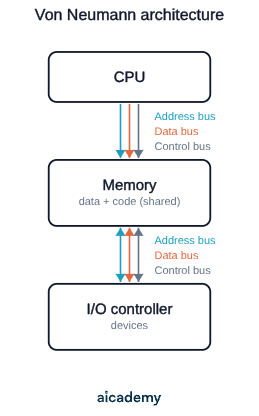
Von Neumann bottleneck: instructions and data share the same bus to the same memory. The processor can either fetch an instruction or fetch/store data in one cycle — not both. This limits performance. Modern CPUs use caching to mitigate it.
Advantages:
- Single unified memory is simpler to design and program
- Memory can be dynamically allocated between code and data
Harvard Architecture
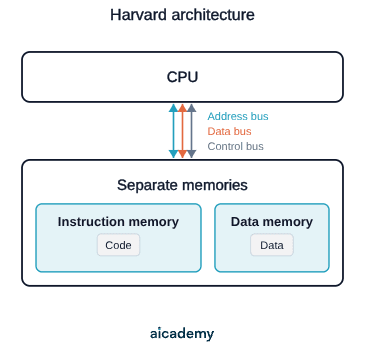
Harvard architecture uses separate memory stores and buses for instructions and data.
Advantages:
- Instructions and data can be fetched simultaneously (no bottleneck)
- Higher throughput for predictable workloads
Used in: digital signal processors (DSPs), microcontrollers, and embedded systems where deterministic performance matters.
Disadvantage: separate memories are less flexible — code space and data space are fixed; you cannot dynamically reallocate between them.
Studying this for an exam?
Generate a personalised learning path for this subject. Free to get started.
Key terms
- Bus
- A shared communication pathway: multiple components connected to the same set of wires.
- Address bus
- A unidirectional bus that carries memory addresses from the CPU; an n-bit address bus can address 2ⁿ locations.
- Data bus
- A bidirectional bus that carries data between CPU, memory, and I/O; its width sets how much data transfers per cycle.
- Control bus
- A bidirectional bus carrying control signals such as read/write, memory request, interrupt request, bus grant, clock, and reset.
- Von Neumann architecture
- An architecture that stores both program instructions and data in the same main memory, accessed over the same buses.
- Von Neumann bottleneck
- The performance limit caused by instructions and data sharing one bus to one memory, so the CPU cannot fetch an instruction and access data in the same cycle.
- Harvard architecture
- An architecture using separate memory stores and buses for instructions and data, allowing both to be fetched simultaneously.
- Word length
- How much data is read or written per memory access; equivalent to the data bus width and independent of address bus width.
- Addressable memory
- Memory where each location has a unique integer address the processor uses to identify which byte or word to read or write.
- Stored program concept
- The principle, credited to von Neumann, that machine code instructions are stored in main memory and executed serially, with instructions treated as data.
Frequently asked questions
The address bus carries where to read or write (the memory address) and is unidirectional; the data bus carries what is being read or written (the actual value) and is bidirectional. Address bus width determines the addressable memory range, while data bus width determines how much data is transferred per cycle.
In von Neumann architecture, instructions and data share the same bus to the same memory, so the processor can either fetch an instruction or fetch/store data in one cycle, but not both. This limits performance, and modern CPUs use caching to mitigate it.
It means machine code instructions are stored in main memory and the processor fetches and executes them serially, one at a time, unless a branch instruction redirects execution. The key insight is that instructions are data and can be loaded, moved, and modified like any other data, allowing reprogramming without hardware changes.
Generate revision on any topic you study
Type any topic you're studying and Aicademy generates a complete lesson, quiz, and flashcard set, personalised to your level.
Lessons on anything
Structured, level-matched lessons on any topic you study
Practice quizzes
Find out what you actually know before the exam does
Flashcard sets
Lock in key concepts with instant revision cards
Ask Aica
Stuck on something? Get a clear explanation, any time
Boolean Algebra
Processor Components and the Fetch-Execute Cycle
Related lessons
6 min
Processor Components and the Fetch-Execute Cycle
A-Level Computer Science · AQA 7517
4 months ago
5 min
Software, Operating Systems and System Software
A-Level Computer Science · AQA 7517
4 months ago
7 min