Guide
How to revise for GCSE Biology (AQA)
GCSE Biology is huge, and half the marks are in the detail. Here is how to revise the AQA topics that lose marks, the required practicals, and a plan that sticks.

GCSE & A-level tutor, Aicademy contributor
9 min read
GCSE Biology is one of the most content-heavy subjects you will sit, and that is exactly why students revise it badly. There is so much to cover that it is tempting to just re-read the textbook, feel familiar with it, and move on. Then the exam asks for the precise steps of the cardiac cycle, or the exact method of a required practical, and the rough idea is not enough. The good news: Biology rewards the students who test themselves, and that is a habit anyone can build.
This guide is written around AQA’s 8461 specification, the most widely taught GCSE Biology course, and most of it applies to Combined Science (8464) too. It covers what the papers test, the topics students lose marks on, the required practicals examiners love, the exam technique that earns marks, and a weekly plan you can start this week.
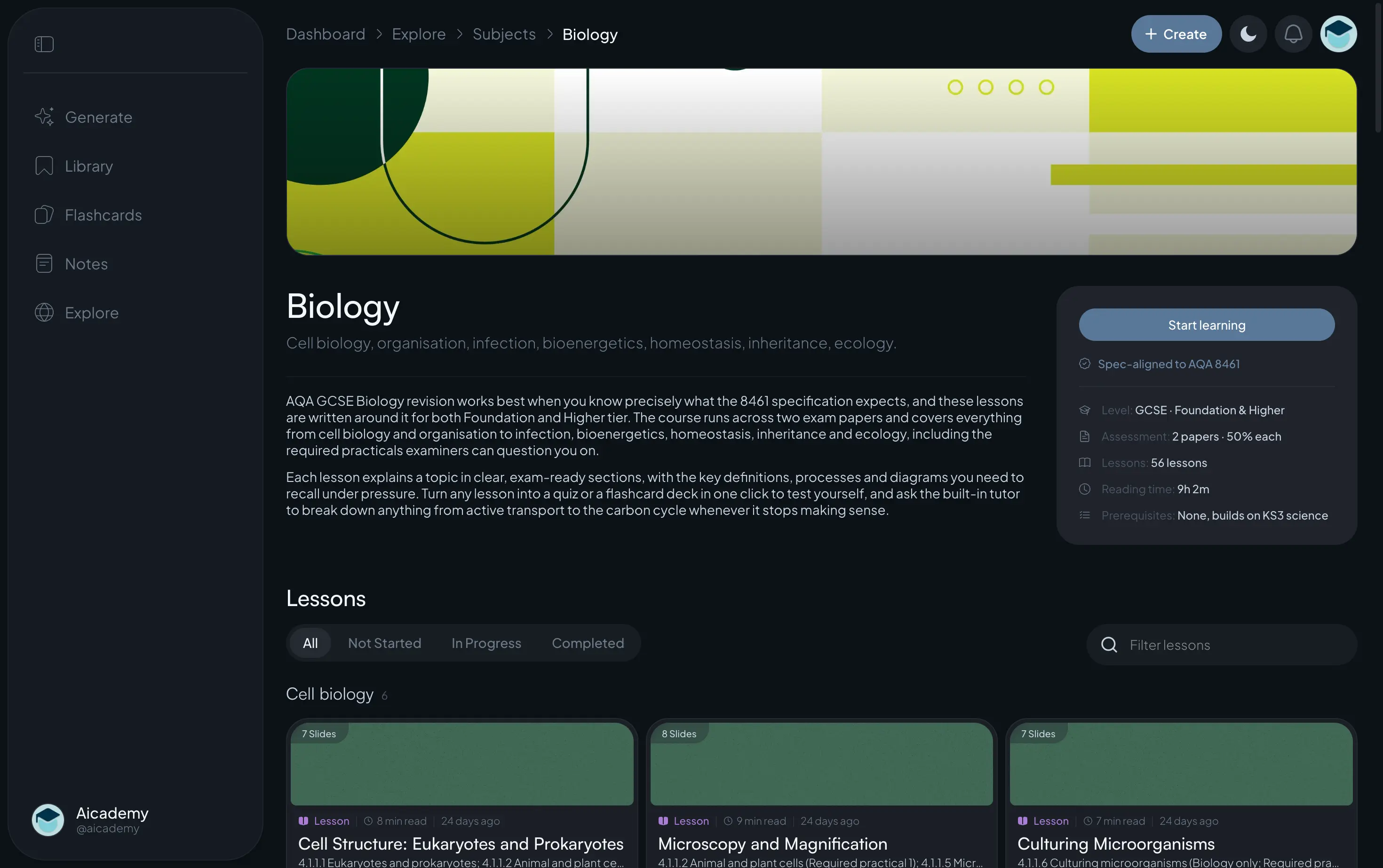
What AQA Biology tests
The course is two equally weighted exams, and the content splits into seven topic areas. Knowing where a topic sits helps you spot how it is usually questioned.
- Paper 1: cell biology, organisation, infection and response, and bioenergetics.
- Paper 2: homeostasis and response, inheritance, variation and evolution, and ecology.
Separate Biology (8461) has more depth and a few extra topics, such as monoclonal antibodies, the brain and the eye, and plant hormones, than Combined Science. Check which one you are sitting so you are not revising content you will never be examined on, or missing content you will.
The topics that lose the most marks
After marking a lot of mock papers, the same topics come up as the ones that decide grades. They are almost all process or detail heavy, which is exactly why retrieval practice beats re-reading here.
Cell biology and transport. Know the difference between diffusion, osmosis and active transport precisely, including which need energy and which move down a gradient. Mitosis and the cell cycle, and stem cells, come up constantly and are easy marks once the sequence is solid.
Infection and response. Pathogens, the body’s defences, vaccination, antibiotics and, for separate Biology, monoclonal antibodies. Be able to explain why antibiotics do not work on viruses, and the stages of the immune response, as ordered points.
Bioenergetics. Photosynthesis and respiration, the rate of photosynthesis and limiting factors, and reading rate graphs. Practise the maths: rates, inverse-square-law questions on light, and “using the graph” answers.
Homeostasis and inheritance. The nervous and endocrine systems, control of blood glucose, and genetic inheritance, where genetic diagrams and probability trip people up. Draw Punnett squares out until they are automatic.
Inheritance, variation and ecology. Selective breeding, genetic engineering and cloning, evolution, and ecology (trophic levels, biomass, cycles). These reward precise definitions and worked examples rather than vague description.
The required practicals: guaranteed marks
This is where a lot of students quietly lose marks, because they treat practicals as lab days rather than examinable content. AQA sets ten required practicals for separate Biology (a subset for Combined Science), and the exam can ask about the method, the variables and the results directly. Learn them like topics:
- Microscopy and the magnification calculation.
- Osmosis in plant tissue and food tests(Benedict’s, iodine, Biuret).
- Enzymes (effect of pH on amylase) and photosynthesis (effect of light intensity).
- Reaction time and, for Biology only, culturing microorganisms with aseptic technique.
- Field sampling with quadrats and transects, and the maths that goes with it.
For each, be able to state the independent, dependent and control variables, and what the results show. This is some of the most predictable content on the paper.
Nail the exam command words
A huge number of marks are lost not to missing knowledge but to answering the wrong question. Before you write, underline the command word:
- Describe — say what happens. No reasons needed.
- Explain — say how or why, usually with a “because”. If you only describe, you cap your marks.
- Calculate — always show your working; method marks are available even if the final number is wrong.
- Using the graph / information — quote actual figures from the data, do not answer from memory.
- Evaluate / the 6-markers — give both sides and a short conclusion, and write in clear, linked points.
Match the number of points to the marks: a 4-mark question wants about four distinct creditable points.
The method that actually works
The evidence is consistent: re-reading and highlighting feel productive but barely help. Two things do, and they suit Biology perfectly.
- Active recall for the content: close the book and retrieve definitions, processes and key numbers from memory. Good flashcards are ideal for the sheer volume of facts.
- Spaced repetition so topics learned in autumn do not evaporate by summer. Short, frequent reviews beat one long session, and here is why it works.
- Past papers for application. Do them timed, then mark against the official mark scheme so you learn exactly what earns marks, especially on the 6-markers and required-practical questions.
A weekly plan you can start now
- Daily (10–15 minutes): flashcards, mixing new definitions with older ones due for review.
- Two or three short sessions: one topic each (transport one day, infection the next), retrieving the process from blank, then checking.
- One longer session: a timed past-paper section, then mark it and note the two topics you were weakest on.
- Feed the weak topics back in: next week’s flashcards and practice come from exactly what you got wrong.
Resources
Work from the official AQA 8461 specification and past papers so you revise the right detail, and use free GCSE revision sites for notes and questions. Our own GCSE Biology lessons break the tricky topics, from active transport to the required practicals, into short, testable chunks.
If you want practice built around your specific weak spots, Aicademy can generate a lesson, a quiz and spaced-repetition flashcards on any biology topic, so if osmosis or genetic diagrams keep catching you out, you can drill exactly those. It is free to start.
Frequently asked questions
Split it into three jobs. Recall the facts with active recall and spaced repetition (flashcards on definitions, processes and key numbers). Learn the required practicals in detail, because examiners question them directly. Then practise applying it with timed past papers, marking against the mark scheme so you learn what the command words actually want. Re-reading the textbook feels productive but barely moves your grade.
Most students find the process-heavy topics hardest: protein synthesis and inheritance (genetic diagrams and probability), the nervous and endocrine systems, and the detail of the required practicals. They are hard because they need precise, ordered detail under time pressure rather than a rough idea. The fix is retrieval practice on the exact steps, plus past-paper questions on each.
AQA sets ten required practicals for separate Biology (a subset appear in Combined Science). The ones students meet most are microscopy, osmosis, food tests, the effect of pH on enzyme (amylase) activity, the effect of light intensity on photosynthesis, reaction time, culturing microorganisms (Biology only) and field sampling with quadrats and transects. Examiners can ask about the method, variables and results directly, so learn them like content, not just as lab days.
Turn each fact, definition or process into a question and test yourself from memory, then space those tests out over days so they stick. Flashcards are ideal for definitions, key numbers and the steps of a process. For ordered processes like the cardiac cycle or protein synthesis, practise writing the steps out from blank until you can do it without looking.
Start light retrieval and past-paper practice at least six to eight weeks out, and ideally keep flashcards ticking over all year so earlier topics do not fade. Biology is content-heavy, so spacing your revision across weeks beats cramming: short, frequent sessions retain far more than one long push.
Describe means say what happens; explain means say how or why, usually with a because. A lot of marks are lost by describing when the question said explain. Underline the command word first, and for calculate or 'using the graph' questions always show your working, because method marks are available even if the final answer is wrong.
Sources
- AQA — GCSE Biology 8461 specification (aqa.org.uk)
- AQA — 8461 past papers and mark schemes (aqa.org.uk)
- Education Endowment Foundation — evidence on retrieval practice and spaced learning (educationendowmentfoundation.org.uk)
Prices and features were checked as of the date shown and can change. Where a figure could not be confirmed from a primary source, we say so in the text.
GCSE & A-level tutor, Aicademy contributor
Liba is a first-class Computer Science graduate from the University of Birmingham who tutors GCSE and A-level students. She writes about revision technique and exam prep.
Disclosure: Aicademy is the study app made by the team that publishes this blog. We compare it fairly against other tools and cite our sources so you can check everything yourself.
Keep reading
How to revise for GCSEs: a method that actually works
Evidence-based GCSE revision: retrieval practice, spaced repetition and past papers, turned into a simple weekly plan that actually sticks.
Active recall and spaced repetition: the study methods that actually work
Why re-reading fails, and how active recall and spaced repetition — the two most evidence-backed study methods — turn revision into long-term memory.
The 8 best free GCSE revision websites and apps
The best genuinely free GCSE revision websites and apps in 2026, what each is best for, and where the free tier quietly ends.
Study with more than flashcards
Aicademy generates personalised lessons, quizzes and flashcards from any topic or your own notes, with spaced-repetition revision and an AI tutor.
Lessons on anything
Structured, level-matched lessons on any topic you study
Practice quizzes
Find out what you actually know before the exam does
Flashcard sets
Lock in key concepts with instant revision cards
Ask Aica
Stuck on something? Get a clear explanation, any time
Upgrade to Pro whenever you're ready