Roundup
The 7 best GCSE Science revision websites and apps
Biology, Chemistry and Physics fail in different ways, so the same site rarely fixes all three. Here is what to use for learning topics, practising questions and the required practicals.
Study content creator, Aicademy contributor
11 min read
Biology, Chemistry and Physics share one word on your timetable and then behave nothing like each other. Biology is a volume of recall. Chemistry falls over on the calculations. Physics is equations, units and rearranging. The site that explains electrolysis beautifully is rarely the one that hands you forty past-paper questions on it.
So this guide is grouped by job rather than by site: somewhere to learn a topic, somewhere to practise questions and past papers, something that covers the required practicals properly, and one habit that stops older topics leaking away. Seven resources, and most people need three of them.
Everything here is free or has a free tier worth using, and every price was checked against the vendor in September 2026.
The short answer: the stack most students need
Learn topics from Cognito’s free videos. Practise with past papers and topic questions from Physics & Maths Tutor, which is free and needs no account. Revise the required practicals from the practical-skills notes on PMT plus your own class method sheets. Then keep recall alive with a small flashcard habit, and use something that can generate questions on the one topic that keeps beating you.
- Learning a topic from scratch: Cognito, then BBC Bitesize for a quick, calm overview.
- Exam practice and past papers: PMT, free; or Save My Exams if you want examiner-written model answers and are willing to pay.
- Required practicals: the per-practical notes and flashcards on PMT, checked against the spec for your own board.
- Low-effort recall on a bad day: the free courses on Seneca.
- The one topic you keep failing: Aicademy, which generates fresh questions and explanations on that exact thing.
Where the marks actually go
There is one public dataset worth looking at first. GCSEPod analysed six million questions answered by 80,000 Key Stage 4 students on its own platform in 2022/23, so it shows where GCSEPod users struggled on GCSEPod questions rather than where GCSE students in general struggle. Read it with that in mind.
Its Combined Science finding is that errors cluster on equations and data rather than on the science. Students were not mostly forgetting what conservation of energy is; they were failing to recall the right equation, apply it in an unfamiliar context and process the numbers. The highest error rates were on the simple model of the atom, relative atomic mass and isotopes (83.7%), communicable diseases (80.5%), the particle model (70.1%) and conservation of energy (67.3%).
If that sounds like you, the fix is not another set of notes. It is more question practice with numbers in it, and time on the handful of equations and definitions that keep getting mixed up. Relative atomic mass versus relative formula mass came up as a specific repeated confusion, and that is an hour’s work to clear up rather than a term’s.
The resources, by job
1. Cognito — best free video teaching
If a lesson did not land and you need the topic taught again, Cognito is the first place to go. Its video lessons are short, unfussy and mapped to the specification rather than to a general idea of science, and it covers AQA, Edexcel and OCR across its GCSE courses. The teaching is genuinely excellent, and it is free.
Cognito Pro is £9.99 a month, or £6 a month billed yearly at £72, with a 14-day money-back guarantee, as of September 2026. Pro adds unlimited questions, flashcards and exam-style questions. The free plan keeps the videos, which is the part most people come for.
Best for: learning a topic properly when the lesson did not land · Free videos; Pro £9.99/mo, or £6/mo billed yearly
2. Physics & Maths Tutor — best free exam practice
PMT is the most useful free thing on the UK internet for exam practice, and it is not close. Past papers and mark schemes by board and paper, topic-by-topic question banks, summary notes, and no account required for any of it. For science specifically it also has the thing almost nobody else does properly: a practical-skills section with summary notes and flashcards for each required practical, organised per board.
The online notes and papers are free as of September 2026. PMT also sells printed revision resources, revision courses and tutoring, but none of that gates the part of the site you came for.
Best for: past papers, topic questions and required-practical notes, for free · Free online; printed resources and courses sold separately
3. BBC Bitesize — best free first pass
Bitesize is free, needs no account, and is the calmest place to meet a topic for the first time. Short pages, clear diagrams, a quiz at the end. Good for getting the rough shape of a topic in ten minutes when the alternative is staring at a textbook chapter.
Where it runs out is depth. For grade 7 to 9 answers, particularly in Chemistry calculations and the longer six-mark Physics questions, you will need something that goes further. Use it as a starting point, not as your only source.
Best for: a quick, low-pressure first pass on an unfamiliar topic · Free
4. Seneca — best free interactive recall
Seneca gives you unlimited access to its core courses for free, which most sites do not. Its short question-and-answer format is the easiest way to do something useful on a low-energy evening, and for science it works well as a first pass and as light retrieval practice on topics you have already covered.
As of September 2026, the paid Supreme tier is £19.99 a month, £9.99 a month on the four-month seasonal plan, or £6.99 a month billed annually. Amelia, its AI assistant, is on the top tier at £39.99 a month or £14.99 billed annually. The small numbers are the annual prices, so paying month to month costs roughly three times more. Our Seneca alternatives piece goes through the tiers in more detail.
Best for: light interactive recall on topics you have already covered · Free core courses; Supreme from £6.99/mo billed annually
5. Save My Exams — best examiner-written notes and answers
Save My Exams is concise, spec-tagged revision notes with worked model answers, written by teachers and examiners, plus topic questions, past papers and mark schemes. For a student who wants to see exactly what a full-mark answer looks like, it is the best-shaped thing here.
There is a free plan. Save My Exams describes it as sample notes, a limited selection of topic questions, a small range of past papers and one or two subjects unlocked, without putting numbers to any of it, so how much of your subject you get is hard to judge before you sign up. Paid, as of September 2026, Essential is £12 a month, £10 on the three-month plan, or £4 billed annually; Premium is £25, £20 or £8 on the same three bases. See our Save My Exams alternatives for how it compares to the free options.
Best for: model answers and mark schemes when you keep losing marks on wording · Free tier; Essential from £4/mo billed annually
6. Aicademy — best for the topic that will not stick
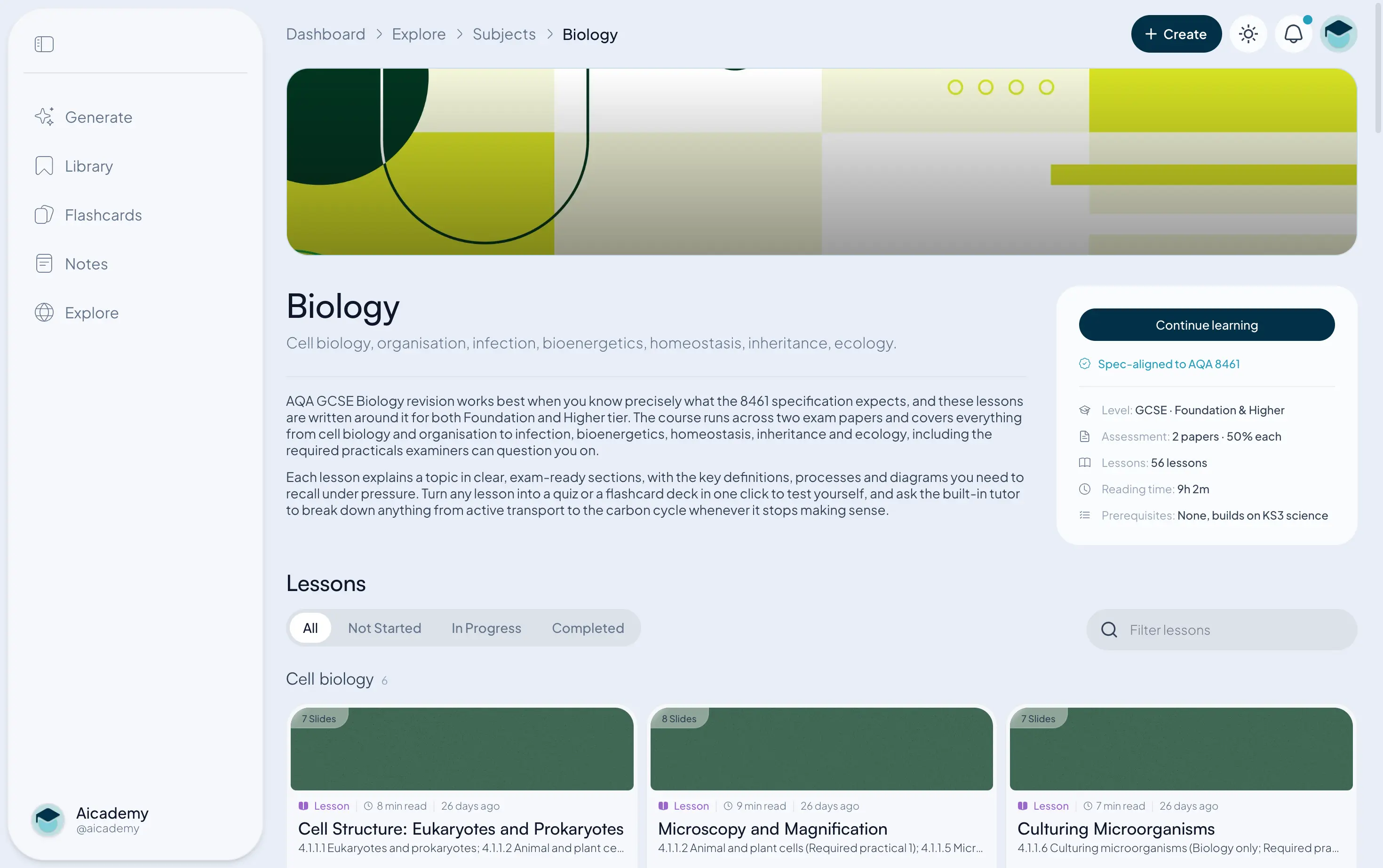
Aicademy is the one to reach for when the others have run out: you have watched the video, read the notes, done the four questions that exist on that subtopic, and it still has not stuck.
Enter the topic and it works out what that actually needs — a single lesson if it is one idea, a full learning path if the gap is wider than that, with quizzes and flashcards along the way. Both come back on a schedule, so the thing you got wrong on Tuesday returns while it still matters and the thing you already know stops eating your evening. Get a question wrong and it names the misconception you picked rather than just marking it, with a tutor on the slide to take the follow-up.
Over 170 of its lessons cover AQA Biology, Chemistry, Physics and Combined Science: Trilogy, each locked to the specification, and they are free to read with no account. A free account adds 10 creation credits a month to generate your own lessons, quizzes, paths and flashcard decks with, and Pro makes them unlimited at £9.99 a month or £5.00 a month billed annually.
Best for: generating fresh questions and explanations on the exact topic you are stuck on · Free tier; Pro £9.99/mo, or £5.00/mo billed annually
7. Anki or Quizlet — best for keeping recall alive
Science has a lot of small facts that decay quickly: definitions, units, equations, the colour of the precipitate. A ten-minute daily card habit handles those far better than another read-through. Anki is free on desktop, web and Android, with a one-off £24.99 iOS app, and has the best scheduling there is. Quizlet is friendlier and has the biggest library of ready-made sets.
As of September 2026 Quizlet Plus is £7.99 a month, or £2.99 a month billed annually, and Plus Unlimited is £9.99 or £3.75. The gap between them is small but it is the one that matters: Plus is capped at three practice tests and twenty rounds of Learn a month, and Plus Unlimited is the tier that removes those caps.
Best for: keeping definitions, units and equations from decaying · Anki free (£24.99 one-off on iOS); Quizlet Plus from £2.99/mo billed annually
Also worth knowing about
Three more that come up constantly and that plenty of students rate. Primrose Kitten has free teaching videos across the three sciences on YouTube, KayScience runs short teaching videos with questions attached, and Oxford Revise is a well-regarded print revision guide series. We have not verified their current pricing first-hand, so they are named here rather than ranked and priced. Check the cost yourself before subscribing to any of them.
| Resource | Free tier | Past papers | Req. practicals | From |
|---|---|---|---|---|
| Cognito | Yes | Partial | Partial | Free; Pro £9.99/mo |
| Physics & Maths Tutor | Yes | Yes | Yes | Free |
| BBC Bitesize | Yes | No | Partial | Free |
| Seneca | Yes | No | Partial | Free; paid from £6.99/mo |
| Save My Exams | Partial | Yes | Partial | Free tier; from £4/mo |
| Aicademy | Yes | No | Yes | Free; Pro £9.99/mo |
| Anki or Quizlet | Yes | No | No | Free; Quizlet from £2.99/mo |
Prices checked against each vendor’s own pricing page as of September 2026 and linked in Sources. “Req. practicals” is marked in full only where we found dedicated required-practical material; “partial” means the practicals are covered inside ordinary topic pages. Aicademy’s is generated on request rather than a fixed library.
Biology, Chemistry and Physics need different things
Treating “science” as one subject is the most common planning mistake at GCSE, and it is why students end up using the same method on three problems that are not alike.
Biology is a volume problem
Nothing in GCSE Biology is conceptually brutal. There is just a great deal of it, and it decays. So the method is frequency, not intensity: short retrieval sessions, flashcards for the fact-heavy topics, and the process topics (protein synthesis, the cardiac cycle, inheritance diagrams) practised as sequences rather than read as prose. Notice that communicable diseases showed up at 80.5% incorrect in that GCSEPod data, which is a recall-volume topic, not a hard one. How to revise for GCSE Biology goes deeper, and there is a full AQA GCSE Biology subject hub here.
Chemistry is calculations plus mechanism
Chemistry splits cleanly in two. There is the part you have to be able to do, which is moles, concentrations, titration arithmetic, percentage yield and relative formula mass, and the part you have to be able to explain, which is bonding, structure and the reasoning behind electrolysis and rates. Reading covers neither. The calculations need repetition with a pen, and the explanations need writing out and comparing to a mark scheme. Given the atom and relative atomic mass came out as the highest-error area, that is where the first hour should go. There is an AQA GCSE Chemistry hub here too.
Physics is equations and units
Physics lives or dies on equations: which ones you are given, which ones you have to recall, and whether you can rearrange them under pressure with the units intact. Most lost marks in Physics are not conceptual, they are a missing unit, a wrong rearrangement or a failure to convert. Build a single equation sheet, split into “given” and “must learn”, and test yourself on the second list until it is dull. Then do calculation questions, not notes. The AQA GCSE Physics hub has the topics broken down.
The required practicals problem
Required practicals are the most reliably neglected marks in GCSE Science, and it is easy to see why: you did them months ago, in a lab, with a worksheet that is now in the bottom of a bag. They are also worth a lot. AQA states that questions drawing on the required practicals “will count for at least 15% of the overall marks for the qualification”, and it says the same across Biology, Chemistry, Physics and Combined Science.
Here is how many you are actually responsible for on AQA:
| Subject | Combined (8464) | Separate sciences |
|---|---|---|
| Biology | 7 | 10 |
| Chemistry | 6 | 8 |
| Physics | 8 | 10 |
| Total | 21 | 28 |
Twenty-one on Combined Science: Trilogy, split seven Biology, six Chemistry and eight Physics, and twenty-eight if you sit the separate sciences (ten Biology, eight Chemistry, ten Physics). Those numbers come from AQA’s own practical assessment pages, linked at the end, and they are worth checking against your own board if you are on Edexcel or OCR, where the count differs.
Give each one the same five-part shape, because that is broadly the shape the exam questions take:
- What was being measured, and what was controlled. Independent, dependent and control variables, named properly.
- The method, in order. Enough detail that someone else could repeat it.
- The apparatus, and why that apparatus. Why a measuring cylinder and not a beaker.
- What the results look like. The shape of the graph, the direction of the trend, the rough numbers.
- What could go wrong. Sources of error, and one realistic improvement.
For the raw material, PMT’s practical-skills section has summary notes and flashcards for each AQA practical, free, and is the best starting point. Your own class method sheet is worth digging out too, because exam questions frequently describe a slightly altered version of the method and ask you to reason about the change. If a particular practical will not stick, that is a good use of a generated quiz on that single practical, which is one of the few things a fixed catalogue cannot give you.
Combined or Triple: does it change what you use?
Not the websites, but the filter you apply to them. Combined Science: Trilogy covers roughly two thirds of the separate-science content and twenty-one of the twenty-eight practicals, so the risk on a general science site is spending an evening on something that is Triple only and will never appear on your paper. Almost every resource here labels content by course, so use those labels, and check anything unfamiliar against your own specification before committing time to it. We have a topic-by-topic breakdown in Combined vs Triple Science, and a Combined Science hub with the lessons grouped the way the course is.
Putting it together
You need three things, not seven: one place to learn a topic, one place to practise it, and one habit that stops it leaking away. Most students can cover all three without paying anything. Add a paid tool only when you can name the thing it fixes — examiner-written model answers, or unlimited questions on the topic you keep failing — rather than because a free trial ran out. If you want the wider list across every GCSE subject rather than just science, we keep one at best free GCSE revision apps, and the general method is in how to revise for GCSE.
A declaration of interest: Aicademy is ours, and it is the only tool here we have a stake in, so we put free tools we have nothing to do with above it and were straight about what Cognito and PMT do better. We think its entry holds up on the reasoning rather than on who wrote it. Every price on this page is linked, so you can check the lot in about a minute, or try the free tier and generate a lesson on your weakest topic.
Frequently asked questions
There is no single best one, because learning a topic and practising it are different jobs. For learning content, Cognito's free videos are the strongest free science teaching in the UK. For exam practice, Physics & Maths Tutor has free past papers, topic questions and required-practical notes for AQA, Edexcel and OCR. Most students are best served by pairing those two, then adding a tool that generates fresh questions on the specific topic they keep getting wrong, such as Aicademy.
Yes, and the free options are genuinely good. BBC Bitesize and Physics & Maths Tutor are free with no account at all, Cognito's video lessons stay on its free plan, Seneca's core courses are free and unlimited, and Aicademy's AQA science lessons are free to read without an account. You can revise all three sciences to a good standard without paying anything; the paid tools mostly buy you convenience, marking and examiner-written model answers.
Biology is mostly a volume-of-recall problem rather than a difficulty problem, so it responds well to short, frequent retrieval practice. Break each topic into facts, processes and practicals, then test yourself on them in small sessions rather than re-reading. Give the required practicals the same treatment as content, because examiners ask about the method and the variables directly.
How to revise for GCSE BiologyTreat each one as a piece of content with a fixed shape: what was measured, what was controlled, what the method was step by step, what the results looked like and what could have gone wrong. Physics & Maths Tutor has free summary notes and flashcards for every AQA required practical, and your own class method sheets are worth keeping because exam questions often describe a slightly altered version of the method you actually did.
Cognito has a free plan that keeps the video lessons, and Cognito Pro is £9.99 a month or £6 a month billed yearly (£72 a year) as of September 2026, which adds unlimited questions, flashcards and exam-style questions. The free plan is enough for most students who mainly want the teaching.
Not different websites, but different filters. Combined Science: Trilogy has 21 required practicals and roughly two thirds of the separate-science content, while triple sits at 28 practicals and adds whole topics. The risk is revising Triple-only material you will never be asked about, so check anything unfamiliar against your own specification before you spend an evening on it.
Combined vs Triple ScienceSources
- AQA — GCSE Combined Science: Trilogy 8464, required practical activities
- AQA — GCSE Biology 8461, required practical activities
- AQA — GCSE Chemistry 8462, required practical activities
- AQA — GCSE Physics 8463, required practical activities
- Access Education / GCSEPod — Knowledge and Confidence Gap Analysis Report
- Cognito — free plan and Cognito Pro pricing (cognito.org)
- Physics & Maths Tutor — AQA GCSE Biology practical skills (physicsandmathstutor.com)
- Save My Exams — pricing (savemyexams.com)
- Seneca Learning — premium pricing (senecalearning.com)
- BBC Bitesize — GCSE science (bbc.co.uk/bitesize)
Prices and features were checked as of the date shown and can change. Where a figure could not be confirmed from a primary source, we say so in the text.
Study content creator, Aicademy contributor
Kieran, known online as @sturdythoughts, is a study and productivity creator with a large student following. He shares practical advice on study habits, focus and revision.
Disclosure: Aicademy is the study app made by the team that publishes this blog. We compare it fairly against other tools and cite our sources so you can check everything yourself.
Keep reading
Combined vs Triple Science: what is on your spec
A topic-by-topic look at what AQA Combined Science covers versus Triple, which required practicals you sit, what you have to memorise, and how to check anything yourself.
How to revise for GCSE Biology (AQA)
A tutor's guide to revising AQA GCSE Biology: the topics students lose marks on, the required practicals, exam command words, and a weekly method that works.
The 8 best free GCSE revision websites and apps
The best genuinely free GCSE revision websites and apps in 2026, what each is best for, and where the free tier quietly ends.
Study with more than flashcards
Aicademy generates personalised lessons, quizzes and flashcards from any topic or your own notes, with spaced-repetition revision and an AI tutor.
Lessons on anything
Structured, level-matched lessons on any topic you study
Practice quizzes
Find out what you actually know before the exam does
Flashcard sets
Lock in key concepts with instant revision cards
Ask Aica
Stuck on something? Get a clear explanation, any time
Upgrade to Pro whenever you're ready