Mind Mapping

- Level
- Foundational
- Reading time
- 8 min
- Published
- 7 June 2026
- Updated
- 16 August 2026
On this page
Key takeaways
- Mind maps are most effective when built entirely from memory before consulting notes - this transforms the task from copying into retrieval practice and reveals exactly what you have and have not retained.
- The gap between what you produce from memory and what you add after checking notes is your weak-point map and becomes the focused revision target for the next session.
- A complete, colour-coded mind map on your desk tells you nothing about what you actually know - looking at a finished map is passive and does not involve retrieval.
- Mind maps work poorly for step-by-step processes and memorising formulae or definitions - use flowcharts or flashcards for sequential content and precise facts instead.
What Mind Mapping Is
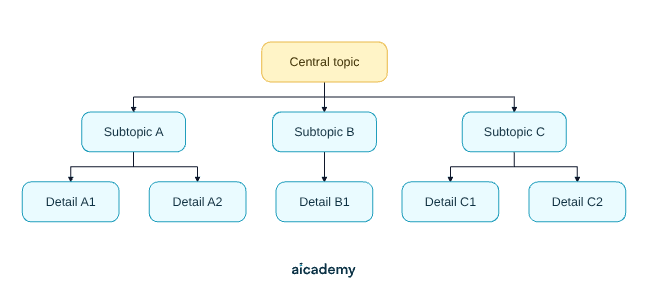
A mind map is a diagram that arranges information visually around a central idea, using branches to show how topics, subtopics, and details connect to each other.
The central topic sits in the middle. Main themes radiate outward as branches. Sub-branches extend further, breaking each theme into detail. The result is a tree-like structure that reflects how ideas relate, rather than the linear sequence of a list.
A standard mind map structure:
Mind maps are a widely used revision tool, but their effectiveness depends entirely on how they are created and used. A mind map drawn passively by copying notes does almost nothing for memory. A mind map built actively — from memory, using your own words — can be genuinely useful.
The format is not what matters. What you do with the format is what matters.
How much of this have you taken in?
Quiz yourself on this section, free, no card needed.
Key terms
- mind map
- A diagram that arranges information visually around a central idea, using radiating branches to show how topics, subtopics, and details relate to each other.
- dual coding
- The cognitive principle that information is better retained when encoded both verbally and visually at the same time, such as combining words with spatial layout or diagrams.
Frequently asked questions
It depends entirely on how you use them. Copying notes into a mind map is re-reading with a different format - it produces no memory benefit. Building a mind map from memory, then checking notes for gaps, is a form of active recall and is genuinely useful for identifying what you do not yet know.
Mind maps fit at specific moments: at the start of a topic to reveal prior knowledge and gaps, mid-revision as blank-page recall checks, before essays to brainstorm points, and just before an exam as a final recall check. They are not suited to daily use for all subject content.
The radial structure of a mind map does not convey order. An algorithm, chemical reaction sequence, or historical timeline needs to show which step comes first and which follows - a numbered list or flowchart communicates this clearly, whereas forcing sequential content into branches can obscure the order.
Generate revision on any topic you study
Type any topic you're studying and Aicademy generates a complete lesson, quiz, and flashcard set, personalised to your level.
Lessons on anything
Structured, level-matched lessons on any topic you study
Practice quizzes
Find out what you actually know before the exam does
Flashcard sets
Lock in key concepts with instant revision cards
Ask Aica
Stuck on something? Get a clear explanation, any time
Managing Cognitive Load During Revision
Spaced Repetition and the Forgetting Curve
Related lessons
9 min
7 min
11 min