Product Decisions

Aligned to the Pearson Edexcel 1BS0 specification
- Level
- Intermediate
- Reading time
- 12 min
- Published
- 14 June 2026
- Updated
- 16 August 2026
On this page
Key takeaways
- The design mix balances three elements - function, aesthetics, and cost - and the right balance depends on the product type and target market; no product maximises all three.
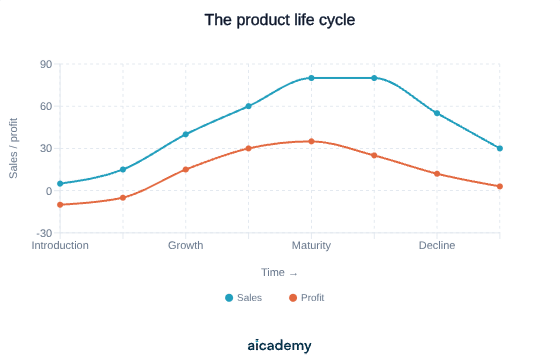
- The product life cycle has four phases: Introduction (low sales, negative profit), Growth (rapid sales rise), Maturity (peak sales, most total profit generated), and Decline (falling sales).
- Extension strategies are deliberate actions taken to prevent a product entering decline - common examples include new packaging, new marketing, new markets, new features, and price reductions.
- An extension strategy extends an existing product's life; it is not a new product launch, which would start a fresh product life cycle.
- Product differentiation allows a business to charge a premium price and build brand loyalty by making a product distinct from rivals on design, quality, features, brand, or customer service.
The Product Life Cycle — Four Phases
The product life cycle (PLC) describes the stages a product passes through from its launch to its eventual withdrawal from the market.
The four phases:
1. Introduction
The product is launched. Sales are low as customers are not yet aware of it. The business typically spends heavily on marketing and distribution to build awareness. Unit costs are high (production volumes are low) and the product often makes a loss in this phase. Cash flow is negative.
2. Growth
Sales rise rapidly as the product gains market acceptance. Competitors notice the opportunity and begin entering the market with rival products. Revenue increases faster than costs, so the business begins to make a profit. Marketing spending may continue at a high level to defend market share.
3. Maturity
Sales reach their peak and stabilise. The market is now well-supplied with competing products. Price competition intensifies. Profit per unit may fall as the business cuts prices to maintain sales volume. This is typically the longest phase of the PLC and where most businesses generate the bulk of their total profit from a product.
4. Decline
Sales fall, either because consumer tastes have changed, because newer, superior products have replaced the product, or because the market has become saturated. The business must decide whether to withdraw the product or implement an extension strategy to prolong its life.
Key term — product life cycle: the stages a product passes through during its time on the market — introduction, growth, maturity, and decline.
The diagram below shows the characteristic shape: sales build slowly, rise rapidly, peak at maturity, then fall. Profit lags behind — it starts as a loss during introduction and only turns positive once sales grow.
Studying this for an exam?
Generate a personalised learning path for this subject. Free to get started.
Key terms
- Design mix
- The balance of function, aesthetics, and cost in product design; the appropriate balance depends on the product type and the target market.
- Function
- Whether a product does what it is supposed to do reliably and safely; considered the non-negotiable baseline for any product.
- Aesthetics
- How a product looks, feels, or is experienced by the customer; can be the primary purchase driver for luxury, fashion, and consumer electronics products.
- Product life cycle
- The stages a product passes through during its time on the market: Introduction, Growth, Maturity, and Decline.
- Extension strategy
- An action taken to extend the life of a product and prevent or delay its entry into the decline phase, such as new packaging, new markets, or a price reduction.
- Product differentiation
- The process of distinguishing a product from competitors' products in the minds of customers, based on real or perceived differences such as design, quality, or brand.
Frequently asked questions
Function (does the product work reliably and safely?), aesthetics (how does it look and feel?), and cost (can it be manufactured at a price that supports a profit margin?). The three are in tension: improving aesthetics or function usually increases cost.
Maturity is typically the longest phase and where most businesses generate the bulk of their total profit from a product. Sales have peaked and stabilised, meaning revenue is high, though profit per unit may decline as price competition intensifies.
An extension strategy prolongs the life of an existing product - for example by adding features, reducing price, or entering new markets. A new product launch is a separate decision and starts a completely new product life cycle.
Generate revision on any topic you study
Type any topic you're studying and Aicademy generates a complete lesson, quiz, and flashcard set, personalised to your level.
Lessons on anything
Structured, level-matched lessons on any topic you study
Practice quizzes
Find out what you actually know before the exam does
Flashcard sets
Lock in key concepts with instant revision cards
Ask Aica
Stuck on something? Get a clear explanation, any time
Ethics and the Environment
Pricing Strategies
Related lessons
10 min
11 min