Growing the Business

Aligned to the Pearson Edexcel 1BS0 specification
- Topic
- Growing the business
- Level
- Intermediate
- Reading time
- 10 min
- Published
- 14 June 2026
- Updated
- 16 August 2026
On this page
Key takeaways
- Internal (organic) growth uses a business's own resources — new products via R&D, or new markets via marketing mix changes, technology, or overseas expansion — and is slower but retains full owner control.
- External (inorganic) growth through mergers or takeovers is faster but riskier, requires large upfront capital, and may dilute or share owner control.
- A public limited company (plc) can sell shares on the stock market to raise very large sums, but this dilutes founders' ownership, risks a hostile takeover, and imposes significant administrative obligations.
- Business objectives evolve as a firm grows — typically: survival, profit, growth, then market dominance — driven by market conditions, technology, performance, legislation, or internal factors.
- A merger is a mutual agreement to combine two businesses; a takeover is when one business buys a controlling stake in another, often without the target's consent — these are distinct concepts in the exam.
Worth saving these ideas?
Turn what you've read into instant revision cards. Free to get started.
How Objectives Change in Practice
When a business's aims shift, this is visible in specific operational decisions.
Common changes in objectives and what they look like in practice:
| Change in objective | What the business actually does |
|---|---|
| Focus on survival | Cuts costs, reduces headcount, delays investment |
| Focus on growth | Enters new markets, launches new products, hires more staff |
| Entering a new market | Adapts marketing mix for new audience; may use a new distribution channel |
| Exiting a market | Discontinues a product range; withdraws from overseas operations |
| Growing the workforce | Recruits, trains, and expands teams |
| Reducing the workforce | Redundancies; may outsource tasks instead |
| Increasing product range | Develops new product lines; may acquire a competitor |
| Decreasing product range | Rationalises to core products; focuses on highest-margin items |
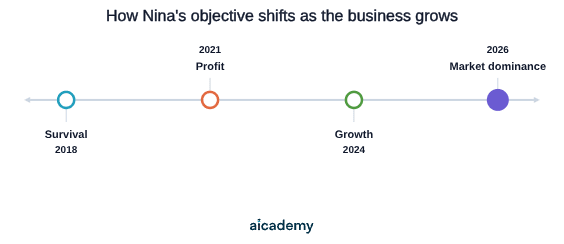
Worked example — Startup to plc: Nina launches a subscription snack box in 2018. In year 1, her objective is survival — breaking even and building a customer base. By 2021, with 10,000 subscribers, her objective shifts to profit maximisation. By 2024, having expanded to Europe, she is focused on market growth and seeks external investors. In 2026, the business floats on the stock market; her objective is now market dominance. At every stage, the marketing mix, staffing levels, and product range decisions reflect the current objective.
Exam tip: When a question describes a business scenario and asks "why might the business change its objective?", identify which of the five drivers (market conditions, technology, performance, legislation, internal reasons) best fits the scenario. Apply it explicitly to the business in the question.
Key terms
- Internal (organic) growth
- Expansion using the business's own resources, such as developing new products through R&D or entering new markets, without combining with another firm.
- External (inorganic) growth
- Expansion achieved by combining with or acquiring another business through a merger or takeover.
- Merger
- When two businesses agree to join together to form a single, larger business, with control typically shared between both sets of owners.
- Takeover
- When one business buys a controlling interest in another business, gaining ownership and control, often without the target firm's agreement.
- Public limited company (plc)
- A company that can sell shares to the general public through a stock market flotation, giving access to large-scale finance but diluting owner control.
- Retained profit
- Profit kept within the business after paying tax and dividends; the cheapest source of finance because no interest is paid and owner control is not diluted.
- Share capital
- Finance raised by selling new shares; raises large sums with no repayment obligation but dilutes existing owners' percentage stake.
Frequently asked questions
Internal growth retains full owner control, is funded from profits, and carries lower risk, but is slow. External growth (mergers or takeovers) is fast and can deliver immediate market share, but requires large capital, risks integration problems and cultural clashes, and may dilute control.
A plc can sell shares on the stock market, raising large sums impossible through loans alone. The main drawbacks are that founders' ownership is diluted, the business becomes vulnerable to hostile takeover, and there are significant regulatory and reporting obligations.
Objectives change in response to five drivers: market conditions, technology, business performance, legislation, and internal reasons such as a change of leadership. A startup focuses on survival; a well-established firm may focus on growth or market dominance.
Generate revision on any topic you study
Type any topic you're studying and Aicademy generates a complete lesson, quiz, and flashcard set, personalised to your level.
Lessons on anything
Structured, level-matched lessons on any topic you study
Practice quizzes
Find out what you actually know before the exam does
Flashcard sets
Lock in key concepts with instant revision cards
Ask Aica
Stuck on something? Get a clear explanation, any time
The Economy and Business
Globalisation
Related lessons
10 min
11 min