Track progress, take quizzes and save notes on this lesson.

Free forever · no card needed

Start free
Intermediate

Appointing Supreme Court Justices

Paper 3A, 4.2 The appointment process for the Supreme Court

Aligned to the Pearson Edexcel 9PL0 specification

Level
Intermediate
Reading time
12 min
Published
9 September 2026
On this page
  1. 1.From Vacancy to Bench: The Constitutional Route
  2. 2.What a President Is Really Choosing
  3. 3.The Senate's Half of the Bargain
  4. 4.The Court as of September 2026
  5. 5.Ideological Balance: Is 6-3 the Right Description?
  6. 6.The Case in Favour of the Process
  7. 7.The Case Against the Process
  8. 8.Exam Focus: Common Mistakes

Key takeaways

  • Article II, Section 2 gives the president the power to nominate Justices and the Senate the power of advice and consent. Confirmation has needed only a simple majority since the 2017 nuclear option.
  • Presidents weigh judicial philosophy, age, professional record, demographic background and confirmability. Younger nominees extend a president's influence for decades.
  • As of September 2026 the Court has a 6-3 Republican-appointed majority, unchanged since Amy Coney Barrett was confirmed in October 2020.
  • Commentators increasingly describe a three-way split: a liberal bloc of Sotomayor, Kagan and Jackson; Roberts and Kavanaugh nearer the centre; and Thomas, Alito, Gorsuch and Barrett to their right.
  • The strongest criticism of the process is that timing is arbitrary. Whether a president gets one vacancy or three depends on chance, yet the appointments last for life.

From Vacancy to Bench: The Constitutional Route

Article II, Section 2 of the Constitution gives the president power to nominate and, "by and with the Advice and Consent of the Senate", to appoint Judges of the Supreme Court. Two elected institutions therefore share control of an unelected one.

A vacancy arises only when a Justice dies, retires or is removed. There is no fixed retirement age and no term limit, so vacancies appear at unpredictable intervals.

StageWho actsWhat happens
1. VacancyA Justice dies or announces retirement
2. ShortlistingPresident and White House staffNames drawn from federal appeals courts, with input from allied legal networks
3. VettingFBI; American Bar AssociationBackground investigation; the ABA rates the nominee well qualified, qualified or not qualified
4. NominationPresidentThe formal nomination goes to the Senate
5. HearingsSenate Judiciary CommitteeDays of televised questioning, then a committee recommendation
6. Floor voteFull SenateSimple majority of senators voting confirms
7. OathChief JusticeThe new Justice takes the judicial oath and sits for life

Confirmation used to require 60 votes to break a filibuster. Senate Democrats removed that threshold for most judicial nominations in 2013, and Senate Republicans extended the change to Supreme Court nominations in April 2017 in order to confirm Neil Gorsuch. A president whose party holds the Senate no longer needs a single opposition vote.

What a President Is Really Choosing

A nomination is one of the most durable decisions a president makes. A Justice confirmed at 48 may still be ruling on American law forty years after the president who chose them has left office. Six factors dominate the choice.

1. Judicial philosophy. The heaviest factor. Presidents look for a record that predicts how a nominee will read the Constitution — originalist or Living Constitution, strict or loose constructionist. Nominees refuse to say how they would rule on future cases, so past judgments and academic writing do the work.

2. Age. Younger nominees extend a president's legacy. Amy Coney Barrett was 48 at confirmation, Neil Gorsuch 49 and Ketanji Brown Jackson 51. Clarence Thomas, confirmed in 1991 at 43, was still sitting 35 years later.

3. Professional record. Almost all modern nominees come from the federal courts of appeals, and eight of the nine sitting Justices hold law degrees from Harvard or Yale. Amy Coney Barrett, a Notre Dame graduate, is the exception.

4. Demographic background. Sandra Day O'Connor (1981) was the first woman on the Court, Thurgood Marshall (1967) the first Black Justice, Sonia Sotomayor (2009) the first Latina and Ketanji Brown Jackson (2022) the first Black woman. Joe Biden committed publicly to nominating a Black woman before choosing Jackson.

5. Confirmability. With a narrow or hostile Senate, a president may trade ideological purity for a nominee who can actually be confirmed.

6. Outside pressure. Interest groups shape the shortlist. Donald Trump's 2016 published list of potential nominees was compiled with conservative legal organisations, and business, religious and civil rights groups lobby heavily on both sides.

The Senate's Half of the Bargain

The Senate's power is real, and four episodes show its range.

Robert Bork, 1987. Ronald Reagan nominated an outspoken conservative theorist. After hostile hearings the Senate rejected him 42 to 58 — the clearest modern example of the Senate blocking a president on ideological grounds.

Harriet Miers, 2005. George W. Bush nominated the White House Counsel, a lawyer with no judicial experience. Criticism of her qualifications came from his own side, and she withdrew before hearings. Professional competence remains a genuine filter.

Merrick Garland, 2016. Antonin Scalia died in February 2016. Barack Obama nominated Garland in March, around ten months before the end of his term. The Republican-controlled Senate refused to hold hearings at all, arguing that the next president should fill the seat. The nomination lapsed.

Amy Coney Barrett, 2020. Ruth Bader Ginsburg died in September 2020. Trump nominated Barrett days later and the Senate confirmed her 52 to 48 on 26 October 2020, eight days before the presidential election. The seat was filled far faster and far closer to an election than Garland's had been.

Garland and Barrett are the pair to use together. The same Senate majority applied opposite reasoning within four years, which is the sharpest available evidence that confirmation is governed by arithmetic rather than principle.

The Court as of September 2026

Section 4.2 requires the current composition and ideological balance, so this must be dated. As of September 2026 the Court has a 6-3 majority of Republican appointees. That balance has been unchanged since Barrett's confirmation in October 2020: the one vacancy since, Stephen Breyer's in 2022, was filled by Ketanji Brown Jackson and so did not alter it.

JusticeAppointed byYearSenate vote
Clarence ThomasGeorge H. W. Bush (R)199152–48
John Roberts (Chief Justice)George W. Bush (R)200578–22
Samuel AlitoGeorge W. Bush (R)200658–42
Sonia SotomayorBarack Obama (D)200968–31
Elena KaganBarack Obama (D)201063–37
Neil GorsuchDonald Trump (R)201754–45
Brett KavanaughDonald Trump (R)201850–48
Amy Coney BarrettDonald Trump (R)202052–48
Ketanji Brown JacksonJoe Biden (D)202253–47

The confirmation margins tell their own story about politicisation.
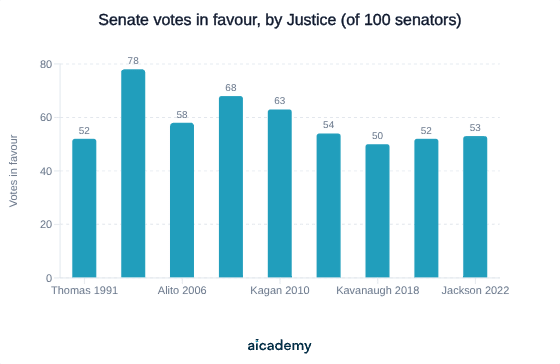
Bar chart of the yes votes each sitting Justice received in the Senate, falling from 78 for Roberts in 2005 and 68 for Sotomayor in 2009 to between 50 and 54 for every Justice confirmed since 2017.

No Justice confirmed since 2017 has reached 55 votes, and Kavanaugh in 2018 and Barrett in 2020 were confirmed by margins of two and four. John Roberts, confirmed with 78 votes in 2005, would be unimaginable today.

How much of this have you taken in?

Quiz yourself on this section, free, no card needed.

Test myself

Ideological Balance: Is 6-3 the Right Description?

A 6-3 count by appointing party is the starting point, not the finish. As of September 2026 commentators increasingly describe a three-way split:

BlocJusticesTendency
LiberalSotomayor, Kagan, JacksonBroad reading of rights; closer to Living Constitution reasoning
Centre-rightRoberts, KavanaughConservative instincts, but institutionally cautious and willing to break with the right
Consistently conservativeThomas, Alito, Gorsuch, BarrettOriginalist reasoning; more willing to overturn precedent

That structure also explains why the swing Justice is harder to identify than it once was. The swing Justice is the one sitting nearest the ideological middle, whose vote settles a case when the other eight divide four against four — the position Sandra Day O'Connor held into the 2000s and Anthony Kennedy held until his retirement in 2018. As of September 2026 no single Justice occupies it: commentators point to Roberts and Kavanaugh together, and a majority against the conservative bloc needs both of them.

Treat the labels carefully. A conservative Justice is conventionally described as giving heavy weight to precedent, yet it was the Court's conservative majority that overturned Roe v Wade in Dobbs (2022). The label describes a method of reading the Constitution, not a guarantee that earlier rulings will survive.

Worked example — the tariffs ruling, February 2026. A six-Justice majority held that President Trump could not use the International Emergency Economic Powers Act 1977 to impose sweeping import levies, because the Constitution reserves taxing powers to Congress. The majority was the three liberals plus Chief Justice Roberts and two Trump appointees, Barrett and Gorsuch. A president lost a case in which he had personally chosen a third of the majority.

The December 2025 ruling that the president could not take control of the Illinois National Guard divided the Court the same way; it is developed in the lessons on the Court's role and on the Court and public policy.

Set against that: of 26 rulings on challenges to Trump administration actions in 2025, the administration won 21. The 2025–26 term also produced ideologically split rulings on the Voting Rights Act and campaign finance.

The safest exam judgement is that appointment predicts a Justice's general outlook but not their vote in any given case. Say that, then show it with the tariffs ruling.

The Case in Favour of the Process

Examiners want strengths argued properly, not conceded in a sentence.

  • Democratic legitimacy at one remove. Neither the president nor the Senate is unelected. Voters who elect a president in the knowledge that Supreme Court vacancies may arise are indirectly shaping the Court, which is the only democratic input a life-tenured judiciary can have.
  • A genuine check. The Senate can and does refuse. Bork was voted down; Miers withdrew; Garland was denied a hearing. A president cannot simply install a loyalist.
  • Rigorous scrutiny. FBI vetting, ABA evaluation and days of televised hearings expose a nominee's record far more thoroughly than most public appointments anywhere.
  • Quality is protected. The Miers episode shows that a nominee without the professional record for the job can be stopped by the president's own party.
  • Transparency. Hearings have been televised since 1981, so voters can watch the reasoning and judge for themselves.
  • Independence once seated. Because a confirmed Justice can be removed only by impeachment, which has never succeeded, and cannot have their pay cut, the political bargaining stops at the point of appointment. The tariffs ruling of February 2026 is direct evidence that appointees are not agents of their patrons.

The Case Against the Process

  • Chance decides how much power a president gets. Trump filled three seats in a single term; Jimmy Carter filled none in four years. Nothing about that distribution reflects electoral support.
  • Confirmation now tracks party control. The Garland and Barrett cases turned on which party held the Senate, and no confirmation since 2017 has attracted more than 54 votes. Since the nuclear option removed the 60-vote threshold, cross-party support has become optional.
  • Hearings reveal less than they appear to. Nominees decline to say how they would rule on issues likely to reach them, so hearings often generate more heat than information.
  • Life tenure with no accountability. A decision taken in one presidency binds the country for decades. Proposals for fixed terms of 18 years, or a retirement age, recur for this reason.
  • A narrow talent pool. Eight of the nine sitting Justices hold Harvard or Yale law degrees, and almost all were federal appeals judges. Whatever its merits, the Court is drawn from a very small professional world.
  • Reputational cost. Confirmation fights such as Bork in 1987 and Kavanaugh in 2018 leave the Court looking like a prize contested between parties, which weakens the perception of impartiality it depends on.

Exam Focus: Common Mistakes

1. Writing about composition without a date

Section 4.2 asks for the current balance, and it changes. Anchor it: "as of September 2026 the Court had a 6-3 Republican-appointed majority, unchanged since October 2020". An undated claim is marked as wrong the moment it ages.

2. Treating 6-3 as a prediction of every ruling

The February 2026 tariffs ruling and the December 2025 National Guard ruling both went against the president who appointed three of the majority. Use the three-way split — liberal bloc, Roberts and Kavanaugh, then Thomas, Alito, Gorsuch and Barrett — to explain why.

3. Confusing the two 60-vote thresholds

Sixty votes has not been needed to confirm a Justice since April 2017. If you write that a nominee must clear a filibuster, you are describing a process that no longer exists.

4. Naming Garland without naming Barrett

The comparison is what earns the analysis mark. Obama's nominee got no hearing around ten months before the end of his term; Barrett was confirmed eight days before a presidential election. Put them side by side and explain what changed.

5. Listing strengths and weaknesses without weighing them

The 30-mark command word is Evaluate, with a third of the marks for AO3. Set out both sides, then state which is stronger and why. Balance without a judgement leaves AO3 marks unclaimed.

6. Ignoring the president's non-ideological motives

Age, confirmability and demographic background all shape a nomination. An answer that reduces the choice to ideology alone misses several of the factors Section 4.2 lists.

Key terms

Advice and consent
The Senate's constitutional role in approving or rejecting a president's nominees, exercised by a confirmation vote after committee hearings.
Nuclear option
A procedural change by which the Senate lowered the votes needed to end debate on nominations, so that a simple majority can now confirm a Justice.
Litmus test
An unstated requirement that a nominee holds a particular view on a defining issue, used by a president to predict how they will rule.
Swing Justice
The Justice sitting closest to the ideological middle of the Court, whose vote decides cases where the other eight divide evenly.
Conservative Justice
A Justice who reads the Constitution narrowly, gives heavy weight to precedent and to the literal wording, and tends to favour a smaller federal government.
Liberal Justice
A Justice who reads the Constitution broadly, treating it as a source of expanding personal freedoms and a route to social change.

Frequently asked questions

The president nominates and the Senate confirms, under Article II, Section 2 of the Constitution. Since the 2017 nuclear option a nominee needs only a simple majority of senators voting, so a president whose party controls the Senate can confirm without opposition support.

As of September 2026 the nine Justices are Roberts, Thomas, Alito, Gorsuch, Kavanaugh and Barrett, appointed by Republican presidents, and Sotomayor, Kagan and Jackson, appointed by Democrats. That 6-3 balance has been unchanged since October 2020.

Senate Republicans refused to hold hearings on Barack Obama's 2016 nominee, arguing the seat should be filled after that year's presidential election. The vacancy had arisen around ten months before the end of Obama's term, and the nomination expired without a vote.

Generate revision on any topic you study

Type any topic you're studying and Aicademy generates a complete lesson, quiz, and flashcard set, personalised to your level.

Lessons on anything

Structured, level-matched lessons on any topic you study

Practice quizzes

Find out what you actually know before the exam does

Flashcard sets

Lock in key concepts with instant revision cards

Ask Aica

Stuck on something? Get a clear explanation, any time

Prev

The US Supreme Court: Role and Judicial Review

Next

The Supreme Court and Public Policy

Related lessons

13 min

19 min

Lesson

The Supreme Court and Public Policy

A-Level Politics · Pearson Edexcel 9PL0

2 hours ago

14 min

Lesson

The Democratic and Republican Parties

A-Level Politics · Pearson Edexcel 9PL0

2 hours ago

Top students don’t revise more. They revise what counts.

Start revising free

Free to start. No card needed.