Track progress, take quizzes and save notes on this lesson.

Free forever · no card needed

Start free
Advanced

Race and Rights in US Politics

Paper 3A, 4.5 Race and rights in contemporary US politics

Aligned to the Pearson Edexcel 9PL0 specification

Level
Advanced
Reading time
15 min
Published
9 September 2026
On this page
  1. 1.The Constitutional Promise and the Century That Followed
  2. 2.Five Methods, Five Different Targets
  3. 3.Worked Case Study: The NAACP and Brown v Board of Education
  4. 4.Worked Case Study: Black Lives Matter Since 2013
  5. 5.Voting Rights: The Contested Front Line
  6. 6.Affirmative Action: Rise, Retreat and Prohibition
  7. 7.Representation: How Far Has It Come?
  8. 8.Exam Focus: Common Mistakes

Key takeaways

  • Racial rights campaigns have used five main methods: strategic litigation, mass direct action, legislative lobbying, electoral mobilisation and decentralised digital organising. Each suits a different target institution.
  • The NAACP's litigation strategy dismantled separate but equal through graduate-school cases before winning Brown v Board of Education in 1954.
  • Shelby County v Holder (2013) disabled the Voting Rights Act's preclearance requirement; Brnovich (2021) narrowed Section 2 claims, while Allen v Milligan (2023) upheld Section 2 in Alabama.
  • Race-conscious university admissions were permitted from Bakke (1978) to Fisher (2016) and prohibited by Students for Fair Admissions in 2023.
  • Descriptive representation has advanced — Obama as president, Harris as vice president, Jackson on the Supreme Court — but campaigners argue substantive policy change has lagged behind it.

The Constitutional Promise and the Century That Followed

The Thirteenth, Fourteenth and Fifteenth Amendments, ratified between 1865 and 1870, abolished slavery, guaranteed equal protection of the laws and barred racial denial of the vote. On paper the question was settled. In practice it took another century, and the story since has moved in both directions.
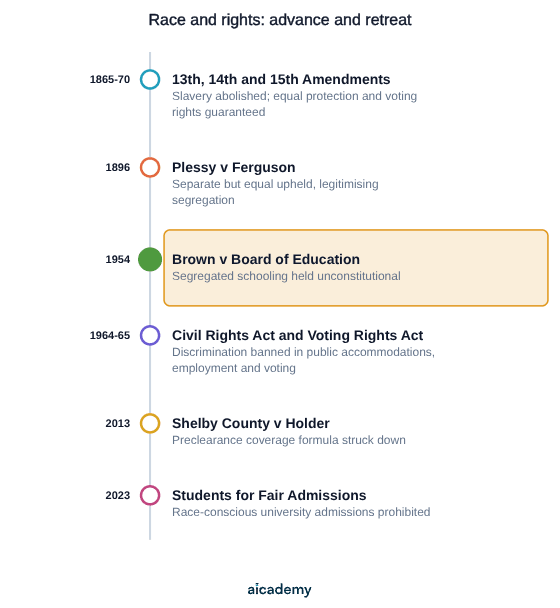
Timeline running from the Thirteenth Amendment in 1865 through Plessy in 1896, Brown in 1954, the Voting Rights Act in 1965, Shelby County in 2013 and Students for Fair Admissions in 2023, showing alternating expansion and restriction of racial rights.

Between 1870 and 1965 southern states rebuilt racial exclusion using devices designed to look race-neutral: literacy tests, poll taxes, grandfather clauses that exempted men whose grandfathers had voted, and white primaries that excluded Black voters from the only contest that mattered in a one-party region. Plessy v Ferguson (1896) gave segregation constitutional cover for 58 years.

The Fifteenth Amendment banned denying the vote on grounds of race. Jim Crow laws did not mention race. That gap between formal equality and practical exclusion is what the campaigns of the twentieth century existed to close.

Five Methods, Five Different Targets

Section 4.5 asks about the methods, influence and effectiveness of racial rights campaigns. The methods are not interchangeable: each is aimed at a different institution.

MethodTargetExampleWhat it achieved
Strategic litigationThe courtsThe NAACP legal campaign, 1930s–1950s, from 1940 through its Legal Defense FundBrown v Board of Education (1954)
Mass direct actionPublic opinion and CongressMontgomery bus boycott (1955–56); March on Washington (1963); Selma (1965)Built the political pressure behind the 1964 and 1965 Acts
Legislative lobbyingCongress and the presidentCoalition work behind the Civil Rights Act 1964Statutory bans on discrimination
Decentralised digital organisingMedia agenda and local governmentBlack Lives Matter from 2013Rapid mobilisation; state and city police reform
Electoral mobilisationVoter registration and turnoutRegistration drives from Freedom Summer 1964 onwardsTurned legal rights into political power

The pattern worth noticing is that litigation and legislation reinforce each other. Brown declared segregated schooling unconstitutional in 1954, but enforcement was slow until Congress attached federal funding conditions through the Civil Rights Act 1964. A ruling changes the law; a statute changes the incentives.

Worked Case Study: The NAACP and Brown v Board of Education

The National Association for the Advancement of Colored People, founded in 1909, built the model that every later rights campaign has borrowed.

The strategy. Rather than attacking segregation head-on, its lawyers — Charles Hamilton Houston and then Thurgood Marshall — chose cases where "separate but equal" was most obviously false, and started with graduate education, where few states had built any Black institution at all.

CaseYearRulingEffect on Plessy
Missouri ex rel. Gaines v Canada1938Missouri had to admit a Black applicant or provide a law schoolExposed the absence of equal facilities
Sweatt v Painter1950A hastily created Black law school was not equal to the University of TexasMade equality substantive, not formal
McLaurin v Oklahoma State Regents1950Segregating an admitted Black student within a university was unlawfulUndermined separation itself
Brown v Board of Education1954Segregated public schooling breaches the Fourteenth AmendmentOverturned Plessy in education

The outcome. Chief Justice Earl Warren delivered a unanimous Court in 1954, holding that separate educational facilities are inherently unequal. It remains the standard demonstration that a well-resourced interest group can change national policy through the courts.

The limits. Brown II (1955) ordered desegregation "with all deliberate speed", a formula that invited delay. In 1957 President Eisenhower had to send federal troops to Little Rock, Arkansas, to enrol nine Black students at Central High School. In Cooper v Aaron (1958) the Court restated that state officials are bound by its rulings. Litigation produced the legal right; enforcement took federal power and years of pressure.

Worked Case Study: Black Lives Matter Since 2013

Black Lives Matter began in 2013 as a hashtag following the acquittal of the man who shot Trayvon Martin, and grew into the most visible racial justice movement of the century.

Methods. It is deliberately decentralised: no single leader, no membership card, no litigation arm. Local chapters organise independently, and social media does the work that a national headquarters did for the NAACP. The core tactics are protest, filming and publicising incidents, and pressure on mayors, police chiefs and district attorneys, who are often locally elected.

The 2020 peak. The murder of George Floyd in Minneapolis on 25 May 2020 produced protests in every US state. Survey-based estimates published in July 2020 suggested that between 15 and 26 million Americans took part, which would place it among the largest protest waves in US history. Derek Chauvin was convicted of Floyd's murder in April 2021.

Effectiveness — a split verdict:

Where it workedWhere it did not
Agenda-setting: policing became a first-order national issueThe George Floyd Justice in Policing Act passed the House of Representatives in March 2021 and did not become law
State and city reform: body cameras, chokehold bans, revised use-of-force rules in many jurisdictionsFederal statutory change did not follow
Corporate and institutional commitments on diversityCampaigners question how much of that survived beyond 2021
Prosecutions in high-profile casesStructural indicators of inequality changed little

The comparison that earns marks. The NAACP was centralised, patient and legally focused, and won a landmark ruling after twenty years of groundwork. Black Lives Matter was decentralised, immediate and media-focused, and changed the national conversation within weeks while achieving less in statute. Method shapes outcome.

Studying this for an exam?

Generate a personalised learning path for this subject. Free to get started.

Create a learning path

Voting Rights: The Contested Front Line

The Voting Rights Act 1965 is, with the Civil Rights Act 1964, one of the two most consequential civil rights statutes in US history. Two provisions matter:

  • Section 2 bans any voting practice that discriminates on grounds of race, anywhere in the country, and can be enforced by lawsuit after the event.
  • Section 5 required jurisdictions with a history of discrimination to obtain federal preclearance before changing any voting rule. Section 4(b) set the formula deciding which jurisdictions were covered.

Worked example — Shelby County v Holder (2013). By five votes to four the Court struck down the Section 4(b) coverage formula as based on decades-old data and no longer justified by current conditions. Section 5 survived in the statute book with no jurisdictions attached to it, so preclearance stopped operating. Several previously covered states changed voting rules soon afterwards, and challenges now have to be brought after a rule takes effect rather than before.

The Court has since pulled in both directions:

CaseYearOutcome
Shelby County v Holder2013Preclearance disabled
Brnovich v Democratic National Committee2021Narrowed the grounds for a successful Section 2 challenge
Allen v Milligan2023Upheld Section 2 and required Alabama to redraw its congressional map to create a second majority-Black district

The dispute is unresolved. The 2025–26 term produced a further ideologically split ruling on the Voting Rights Act. Alongside this run long-running arguments over voter identification requirements, purges of registration rolls, polling place closures, and racial gerrymandering — which the Court has treated as an equal protection question since Shaw v Reno (1993).

Voting rights is the strongest single topic for a 4.5 answer, because it links campaign methods, Supreme Court rulings and current domestic policy in one chain of evidence.

Affirmative Action: Rise, Retreat and Prohibition

Affirmative action means giving preference to members of historically disadvantaged groups in order to offset structural inequality. In the United States it has been contested since it began.

Its origins were executive rather than legislative: Executive Order 11246, issued in 1965, required federal contractors to take positive steps to avoid discrimination. Universities adopted comparable policies voluntarily. Litigation followed almost immediately.

CaseYearRuling
Regents of the University of California v Bakke1978Fixed racial quotas unconstitutional, but race may be one factor among many
Grutter v Bollinger2003Upheld a law school's individualised, holistic use of race
Gratz v Bollinger2003Struck down an undergraduate system awarding fixed points for race
Fisher v University of Texas2016Upheld a programme in which race was one element of a broader assessment
Students for Fair Admissions v Harvard and UNC2023Race-conscious admissions breach the Equal Protection Clause

Worked example — Students for Fair Admissions (2023). The Court held by six votes to three against the University of North Carolina, and by six to two against Harvard, where Justice Jackson recused herself. The majority reasoned that the programmes lacked measurable objectives, used race as a negative for some applicants, and had no logical end point. Universities may still consider how race has affected an individual applicant's life as described in that applicant's own account, but they may not treat race itself as a factor.

The evaluation. Supporters argue affirmative action widened access to elite institutions and the professions for two generations, and that the underlying inequality it addressed remains. Critics argue it is discrimination in reverse, stigmatises its beneficiaries, and helps the most advantaged members of disadvantaged groups. Voters have divided too: California banned affirmative action in state institutions by ballot measure in 1996, and rejected a proposal to restore it in 2020.

Representation: How Far Has It Come?

The third strand of 4.5 is representation, and the distinction to hold is between descriptive representation — whether institutions look like the country — and substantive representation — whether they act in a group's interests.

Descriptive advances are real and recent:

  • Thurgood Marshall became the first Black Supreme Court Justice in 1967, having argued Brown thirteen years earlier.
  • Barack Obama served as the first Black president from 2009 to 2017.
  • Kamala Harris served as the first woman, first Black and first South Asian American vice president from 2021 to 2025.
  • Ketanji Brown Jackson became the first Black woman on the Supreme Court in 2022.
  • The Congressional Black Caucus, founded in 1971, is now a significant bloc within the House Democratic caucus.

Some of this rests on the Voting Rights Act itself. Section 2 supports the drawing of majority-minority districts, which is why Allen v Milligan (2023) mattered: it forced Alabama to create a second district in which Black voters could elect a candidate of their choice.

The counter-argument. Campaigners point out that descriptive gains have not closed gaps in wealth, health, incarceration or educational outcomes, and that a Black president did not prevent the retreat on preclearance in 2013 or on admissions in 2023. On the second measure — substantive representation — progress is far harder to demonstrate.

A strong judgement here distinguishes the two. Descriptive representation has advanced markedly since 1965. Whether that has translated into policy outcomes for Black Americans is the question the evidence leaves genuinely open.

Exam Focus: Common Mistakes

1. Writing a history essay

Section 4.5 says contemporary politics. The 1950s and 1960s are context, not the answer. Anchor every strand in something recent and nameable: Shelby County (2013), Allen v Milligan (2023), Students for Fair Admissions (2023) and the 2020 protest wave. The Court returned to the Voting Rights Act again in its 2025–26 term, so check the case name before citing it.

2. Treating campaigns as one undifferentiated movement

The specification asks about methods. Litigation, mass protest, lobbying and decentralised digital organising work on different institutions and produce different results. Compare the NAACP with Black Lives Matter explicitly and say which method suited which target.

3. Overstating what Shelby County did

It did not repeal the Voting Rights Act, and it did not strike down Section 5. It struck down the coverage formula in Section 4(b), which left Section 5 with no jurisdictions to apply to. Precision here separates a good answer from an approximate one.

4. Confusing quotas with affirmative action

Bakke (1978) prohibited fixed quotas while permitting race as one factor. Race-conscious admissions were prohibited outright only in 2023. An answer that treats the two as the same thing loses 45 years of legal development.

5. Calling US campaign organisations pressure groups

In the US context the specification uses interest groups. The NAACP, the ACLU and Students for Fair Admissions are interest groups. Keep "pressure groups" for the UK papers.

6. Confusing descriptive and substantive representation

Naming Obama, Harris and Jackson shows descriptive progress. It does not by itself show that policy outcomes improved. Say which kind of representation your evidence supports, then reach a judgement on the gap between them.

Key terms

Racial equality
The principle that people of every race and ethnicity should have the same access to opportunities, resources and rights, and the same protection from discrimination.
Affirmative action
A policy of giving preference to members of groups that have suffered historic disadvantage, in order to offset structural inequality or past injustice.
Preclearance
The Voting Rights Act requirement that certain jurisdictions obtain federal approval before altering their voting rules, suspended in practice since 2013.
Racial gerrymandering
Drawing electoral district boundaries with race as the predominant factor, which the Supreme Court has held can breach the Equal Protection Clause.
Descriptive representation
The extent to which an elected body mirrors the population it serves in characteristics such as race, as distinct from whether it acts in that population's interests.
Strategic litigation
Choosing and funding carefully selected court cases in order to establish a precedent that changes policy nationally, rather than simply to help one client.

Frequently asked questions

It struck down the formula deciding which states needed federal approval before changing their voting rules. Section 5 preclearance survived on paper but had no jurisdictions to cover, so states with a history of discrimination could alter voting arrangements without prior clearance.

No. Students for Fair Admissions v Harvard and UNC (2023) held that race-conscious admissions programmes breach the Equal Protection Clause. Universities may consider how race has affected an individual applicant's life through their own account, but not race itself as a factor.

Highly effective at agenda-setting and at driving state and local police reform after 2020, but far less effective at federal level. The George Floyd Justice in Policing Act passed the House of Representatives in 2021 and did not become law.

Generate revision on any topic you study

Type any topic you're studying and Aicademy generates a complete lesson, quiz, and flashcard set, personalised to your level.

Lessons on anything

Structured, level-matched lessons on any topic you study

Practice quizzes

Find out what you actually know before the exam does

Flashcard sets

Lock in key concepts with instant revision cards

Ask Aica

Stuck on something? Get a clear explanation, any time

Prev

Civil Liberties and Rights in the USA

Next

US Presidential and Congressional Elections

Related lessons

13 min

Lesson

Civil Liberties and Rights in the USA

A-Level Politics · Pearson Edexcel 9PL0

2 hours ago

19 min

Lesson

The Supreme Court and Public Policy

A-Level Politics · Pearson Edexcel 9PL0

2 hours ago

14 min

Lesson

Who Votes for Whom in the USA

A-Level Politics · Pearson Edexcel 9PL0

2 hours ago

Top students don’t revise more. They revise what counts.

Start revising free

Free to start. No card needed.