The US Legislative Process

Aligned to the Pearson Edexcel 9PL0 specification
- Topic
- US Congress
- Level
- Intermediate
- Reading time
- 15 min
- Published
- 9 September 2026
- Updated
- 9 September 2026
On this page
- 1.From Bill to Law: The Route in Outline
- 2.The Committee Stage: Where Most Bills Die
- 3.Getting to the Floor: Rules Committee against Unanimous Consent
- 4.The Filibuster, Cloture and Reconciliation
- 5.Resolving Differences and Presidential Action
- 6.Strengths, Weaknesses and the Policy Significance of Congress
- 7.Exam Focus: Common Mistakes
Key takeaways
- Only a member of Congress may introduce a bill, and identical text must pass both chambers before it reaches the President, who may sign, veto or let it become law unsigned.
- Most bills die in committee: a chair who declines to schedule hearings kills a bill without a vote, and a House discharge petition needs 218 signatures to rescue it.
- The chambers differ at the scheduling stage: the House Rules Committee fixes debate time and whether amendments are allowed, while the Senate relies on unanimous consent.
- The filibuster makes 60 votes the working threshold for Senate legislation; reconciliation and the 2013 and 2017 nuclear options are the routes around it.
- A veto is overridden only by two-thirds of both chambers — Congress managed it once in Trump's first term, on the defence authorisation bill, completed on 1 January 2021.
From Bill to Law: The Route in Outline
Every federal law follows the same constitutional path, and the path is deliberately obstructive. Article I requires that identical text pass both chambers; Article I, Section 7 then gives the President a role at the end.
Three points define the whole process before any detail:
- Only a member of Congress may introduce a bill. The President has no power to introduce legislation and must find a sponsor. When a State of the Union address announces a programme, someone in the House or Senate has to file the paperwork.
- Both chambers are equal. There is no mechanism by which one can override the other, so a bill needs two separate majorities on the same words.
- The default is failure. More than ten thousand measures are introduced in each two-year Congress and only a few hundred become law.
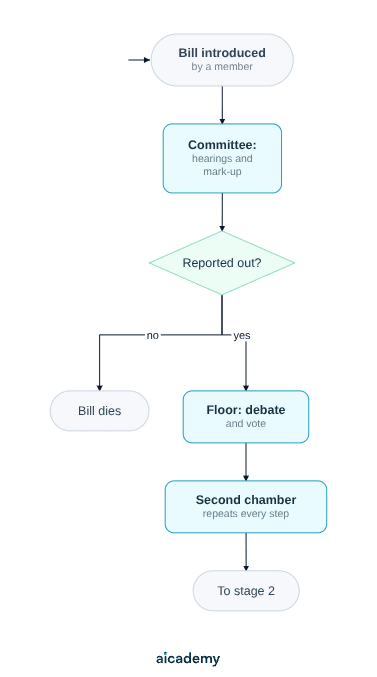
Only when both chambers have passed identical text does the bill reach the President.
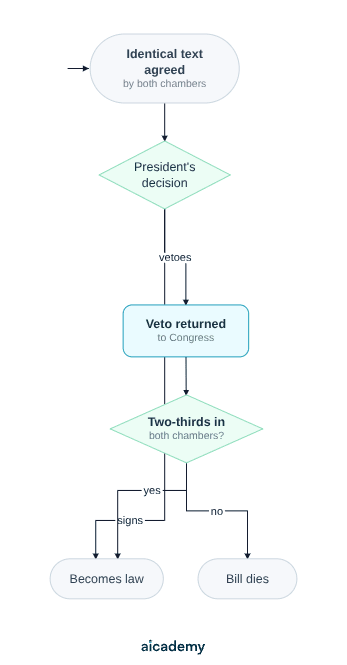
Each diamond across those two flowcharts is a place a bill can stop. Counting them is the fastest way to see why so little passes.
Studying this for an exam?
Generate a personalised learning path for this subject. Free to get started.
Key terms
- Pigeonholing
- A committee chair's decision to leave a bill unscheduled, killing it without any member having to vote against it.
- Mark-up
- The committee stage at which members go through a bill line by line and agree amendments before reporting it to the floor.
- Discharge petition
- A House procedure allowing 218 members to force a bill out of a committee that refuses to report it, rarely used with success.
- Closed rule
- A rule issued by the House Rules Committee that forbids floor amendments to a bill, so members may only vote it up or down.
- Rider
- A provision attached to a bill that has little to do with its subject, used in the Senate to attach measures that could not pass on their own.
- Pork barrel
- Federal spending directed to a particular member's district or state, often added to win that member's vote on a wider bill.
- Conference committee
- A temporary joint committee of members from both chambers convened to reconcile differing versions of the same bill.
- Pocket veto
- The lapsing of a bill when the President declines to sign it and Congress adjourns within the ten-day window, leaving Congress no opportunity to override.
- Omnibus bill
- A single very large measure bundling many separate items, often used for spending so that members must accept the package as a whole.
- Gridlock
- A state in which the institutions that must agree to pass legislation block one another, so little of significance reaches the statute book.
Frequently asked questions
A member introduces it; a committee holds hearings and marks it up; the chamber schedules and votes on it; the other chamber does the same; differences are resolved so both pass identical text; then the President signs it, vetoes it, or lets it become law without signature after ten days.
The process is built from veto points. A committee chair can shelve a bill, the Rules Committee can decline to schedule it, 41 senators can filibuster it, the other chamber can amend it to death, and the President can veto it. More than ten thousand measures are introduced each Congress and only a few hundred pass.
The House is majoritarian: the Rules Committee sets strict debate limits and amendments must be relevant to the bill. The Senate protects individuals: debate is unlimited unless 60 senators vote for cloture, and unrelated amendments known as riders can be attached.
Generate revision on any topic you study
Type any topic you're studying and Aicademy generates a complete lesson, quiz, and flashcard set, personalised to your level.
Lessons on anything
Structured, level-matched lessons on any topic you study
Practice quizzes
Find out what you actually know before the exam does
Flashcard sets
Lock in key concepts with instant revision cards
Ask Aica
Stuck on something? Get a clear explanation, any time
Congress and Representation
Congressional Oversight
Related lessons
16 min
14 min
12 min