Track progress, take quizzes and save notes on this lesson.

Free forever · no card needed

Start free
Intermediate

The Legislative Process

Paper 2, 2.3 The legislative process

Aligned to the Pearson Edexcel 9PL0 specification

Level
Intermediate
Reading time
14 min
Published
9 September 2026
On this page
  1. 1.Where Legislation Comes From
  2. 2.The Stages a Bill Must Go Through
  3. 3.Committee Stage: Public Bill Committees
  4. 4.Ping-Pong: How the Two Houses Settle a Disagreement
  5. 5.The Salisbury Convention
  6. 6.Private Members' Bills
  7. 7.How Much Does Parliament Really Change a Bill?
  8. 8.Exam Focus: The Legislative Process

Key takeaways

  • A bill passes five stages in each House — first reading, second reading, committee, report and third reading — then returns for consideration of amendments before Royal Assent.
  • Committee stage in the Commons is normally taken by a public bill committee that mirrors party strength, so the government usually has a majority; first-class constitutional bills go to a Committee of the Whole House.
  • Where the two Houses disagree, the bill passes back and forth in ping-pong until one gives way; the Commons wins these exchanges when the government has a working majority.
  • The Salisbury Convention, agreed in 1945, means the Lords does not vote down at second reading a bill implementing a commitment from the winning party's manifesto.
  • Private members' bills rarely become law because they lack government time, but the route has produced major statutes including the Abortion Act 1967.

Where Legislation Comes From

Most law starts inside government, not inside Parliament. The government sets out its programme in the King's Speech at the start of each session, often after consulting through a green paper (a discussion document) and a white paper (a firm proposal). Parliamentary counsel then draft the bill.

Four categories of bill exist, and the differences matter.

Type of billIntroduced byChance of becoming lawExample
Public (government) billA ministerHigh — the government controls the timetableSafety of Rwanda (Asylum and Immigration) Act 2024
Private member's billA backbench MP or peerLow — depends on scarce Friday timeAbortion Act 1967
Private billAn outside body such as a company or councilModerateLocal infrastructure and harbour powers
Hybrid billA minister, but affecting specific private interestsModerate, and slowMajor rail and construction schemes

Two consequences run through the whole topic.

  • The executive dominates the legislative timetable. Government bills get the time; everything else competes for what is left.
  • A bill can start in either House. Less contentious and technical measures often begin in the Lords to spread the workload, but money bills begin in the Commons.

"Legislative bills" in the specification's terminology simply means proposed laws going through Parliament. A bill becomes an Act at Royal Assent; before that it has no legal force.

The Stages a Bill Must Go Through

Every bill passes the same five stages in each House, and the sequence is examinable in exactly this order.
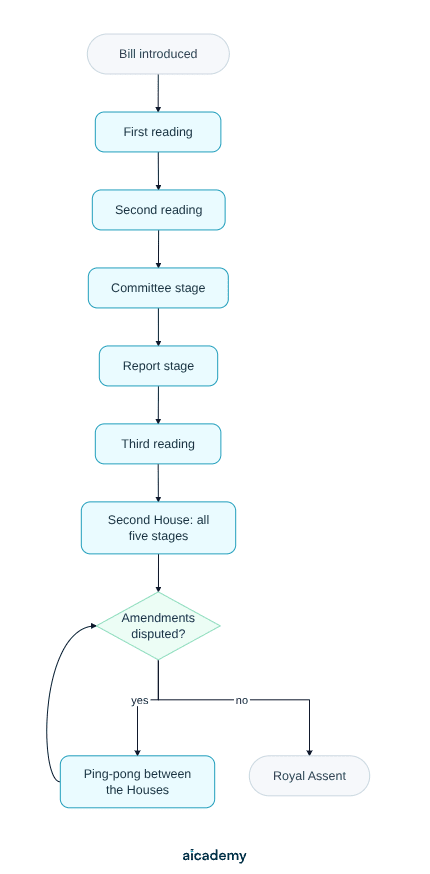
A bill is introduced, passes first reading, second reading, committee stage, report stage and third reading, then repeats all five stages in the second House. While amendments stay disputed it loops through ping-pong; once both Houses agree it receives Royal Assent.

First reading is purely formal: the title is read, the bill is printed, and there is no debate or vote.

Second reading is the substantive debate on the principle of the bill, followed by a vote. Defeat here kills the bill outright, so a government with a working majority is rarely beaten at this stage — the Shops Bill of 1986 is the standard example precisely because it is so unusual.

Committee stage examines the bill clause by clause. In the Commons this is normally a public bill committee; bills of first-class constitutional importance are taken by a Committee of the Whole House instead.

Report stage brings the amended bill back to the whole House, which can accept, reject or add amendments.

Third reading is the final Commons vote on the bill as amended. No amendments are permitted at this stage in the Commons, though the Lords does allow them.

The bill then goes to the second House and repeats all five stages, after which the two Houses settle any differences. Royal Assent turns it into an Act. That step is formal: assent was last refused in 1708.

Committee Stage: Public Bill Committees

Issue 4 of the specification names public bill committees explicitly, so treat them as assessable content rather than background.

A public bill committee is created for a single bill and dissolves once it reports. Its features:

  • Membership mirrors the Commons. Party strengths on the committee reflect party strengths in the House, so a government with a Commons majority has a committee majority too.
  • The whips choose the members. Places are allocated through the usual channels, so a minister rarely faces a committee stacked against them.
  • Expertise is not required. Members are not selected for knowledge of the subject.
  • Evidence sessions are possible. Since 2006, committees on most government bills can take oral and written evidence from outside witnesses before starting line-by-line scrutiny — a genuine improvement on the older standing committees.
  • Amendments succeed mainly when the government wants them to. Ministers table their own amendments in committee; opposition amendments are usually voted down and re-tabled later at report stage.

Why this is contested. Defenders of the House of Lords argue that the Lords compensates for exactly this weakness: because Commons committees are whipped, staffed by non-specialists and working to a programme motion that caps debating time, parts of a long bill can reach the statute book without ever being examined. That was the argument advanced publicly in December 2025 by the crossbench peer Professor Alison Wolf — that modern bills are long and badly drafted, and that the Commons has largely stopped scrutinising them in detail.

Commons committee stageLords committee stage
Who sits on itA public bill committee of MPs chosen by the whipsAny peer may attend; a Committee of the Whole House or Grand Committee
Government majorityYesNo
Time limitsSet by a programme motionEffectively none
Outside evidencePossible on most government bills since 2006Taken through separate Lords committees
Typical outcomeGovernment amendments pass, others fallAmendments pass against the government's wishes

Ping-Pong: How the Two Houses Settle a Disagreement

When the second House amends a bill, the first House considers those amendments. If it disagrees, the bill goes back. This exchange is ping-pong, and it continues until one side gives way or the session ends and the bill falls.

Worked case study — the Rwanda bill, 2024. The Safety of Rwanda (Asylum and Immigration) Bill was central to Rishi Sunak's asylum policy. The Lords amended it repeatedly, on questions including whether the courts could examine the safety of Rwanda and the treatment of people who had assisted UK forces. Each time, the Commons used the government's majority to strike the amendments out and send the bill back. After several rounds the Lords gave way and the bill received Royal Assent in April 2024.

What it shows: ping-pong ending the way it usually ends. The Lords extracted debate and publicity but no change of substance, because a government with a Commons majority can simply repeat the vote.

Worked case study — the Brexit bill, January 2020. Peers passed five amendments to Boris Johnson's European Union (Withdrawal Agreement) Bill, including protections for unaccompanied child refugees. In January 2020 the Commons overturned all five, and the Lords did not insist. Johnson's majority of 80, won weeks earlier at the December 2019 general election, made the outcome predictable.

What it shows: the size of the government's Commons majority, not the merits of the amendments, is the best single predictor of who wins ping-pong.

Peers usually give way for a reason: pushing to a genuine constitutional showdown invites the Parliament Acts, and the Lords prefers not to draw attention to the fact that it is unelected.

Something not quite clicking?

Ask Aica to explain any part of this differently. Free, takes 30 seconds.

Ask Aica

The Salisbury Convention

The Salisbury Convention is named in the specification, so learn its origin, its scope and its limits.

Origin. Labour won a landslide in 1945, but the House of Lords was overwhelmingly Conservative and could have wrecked the government's programme. Viscount Cranborne — later the 5th Marquess of Salisbury — leading the Conservatives in the Lords, agreed with the Labour leader in the Lords, Viscount Addison, that peers would not vote down at second reading a bill implementing a manifesto commitment. It is sometimes called the Salisbury–Addison Convention.

The principle. An unelected chamber has no mandate to overturn a policy the electorate has just endorsed. The convention converts the democratic argument into an operating rule.

What it covers and what it does not:

Covered by the conventionNot covered
A bill implementing a specific manifesto commitmentPolicies not in the manifesto
Rejection at second reading, wrecking amendments and unreasonable delayOrdinary amendment at committee, report or ping-pong
The winning party's manifestoMeasures added later in the parliament

Peers can therefore amend a manifesto bill heavily while still observing the convention, so long as the amendments do not wreck it — and the line between heavy amendment and wrecking is where most disputes about it begin.

A live example. In December 2025 the Lords dropped its attempt to amend Labour's employment rights bill, a manifesto measure, in line with the Salisbury Convention. The effect was that several contested features of the bill were left to be settled by consultation after it became law rather than by amendment in Parliament.

Where the convention is contested. Because it rests on the idea of a mandate, it weakens whenever the mandate is doubtful. Peers from smaller parties have argued that a government elected on around a third of the vote cannot claim that every manifesto line was endorsed — an argument with obvious force after 2024, when Labour took about 63% of Commons seats on 33.7% of the vote. It also sits awkwardly with coalition and minority governments, where no single manifesto was put to voters.

Private Members' Bills

Backbench legislation is a small route with a disproportionate history.

Three ways in:

  • The ballot. At the start of each session, backbenchers enter a draw; the highest-placed names get the best slots on the thirteen sitting Fridays set aside for such bills. Ballot bills are the ones with a realistic chance.
  • The Ten Minute Rule. An MP makes a ten-minute speech for a bill. Most are gestures designed to put an issue on the record.
  • Presentation. The bill is formally introduced without a speech, and usually goes no further.

Why so few pass. Friday sittings are short and thinly attended; a bill can be talked out by opponents who keep speaking until time expires, and stopping them requires a closure motion supported by 100 MPs. Above all, a private member's bill that the government declines to support will struggle to find time in the Lords as well.

Worked case study — the assisted dying bill. The Terminally Ill Adults (End of Life) Bill was introduced by the backbench Labour MP Kim Leadbeater and passed the House of Commons in June 2025, an achievement in itself for a private member's bill on a matter of conscience. In the Lords it attracted very large numbers of amendments and moved slowly. By December 2025 Leadbeater was warning publicly that the bill could run out of time, and three Labour figures — Justin Madders, Dame Nia Griffith and select committee chair Debbie Abrahams — argued that an unelected chamber was over-reaching by holding up a measure the elected House had passed.

What it shows: the structural weakness of the private members' route. A government bill in the same position would have been given extra time; a backbench bill has no such protection, so delay in the Lords functions as a veto the Lords does not formally possess.

Historic successes. Major social reforms have come through this route when governments preferred not to legislate themselves: the Murder (Abolition of Death Penalty) Act 1965, introduced by Sydney Silverman, and the Abortion Act 1967, introduced by David Steel, are the standard examples.

How Much Does Parliament Really Change a Bill?

The specification asks about the process; the essay marks come from judging how well it works.

The case that the process is executive-dominated:

  • The government drafts the bill, controls the timetable and, through the programme motion, decides how long each stage may be debated.
  • Public bill committees carry a government majority and are staffed by the whips.
  • Defeat at second reading is so rare that the Shops Bill of 1986 is still the example reached for.
  • Where the Lords does force a change, the Commons can reverse it — as it did across the Rwanda bill in 2024 and the Brexit bill in January 2020.

The case that scrutiny is real:

  • The Lords has no government majority and around 22% of its members were crossbenchers in March 2026, so amendments genuinely pass against the government's wishes.
  • Ministers routinely make concessions in advance to avoid a defeat; those concessions leave no trace in the division records, so a raw count of government defeats understates parliamentary influence.
  • Evidence sessions in public bill committees since 2006 bring outside expertise into the process.
  • Delay is a real cost. A bill that runs out of session falls, which gives peers leverage that grows as the session ends.

A defensible judgement. The legislative process is dominated by the executive at the point of initiation and timetabling, but is genuinely contested at the point of revision, and the revision happens mostly in the Lords. That is why arguments about the legislative process turn so quickly into arguments about whether an unelected chamber should be doing it.

Exam Focus: The Legislative Process

1. Listing the stages without saying what happens at each

"First reading, second reading, committee, report, third reading" is a list, not knowledge. Attach one sentence to each: which is formal, which votes on the principle, which examines clauses, which allows the whole House to amend.

2. Forgetting that both Houses repeat the whole sequence

A bill does not go to the Lords "for approval". It goes through five stages there as well. Missing this makes ping-pong impossible to explain.

3. Writing about "committees" without naming public bill committees

Issue 4 names them. Public bill committees examine bills; select committees scrutinise departments. Using the wrong term in a question about legislation loses AO1 credit for no reason.

4. Overstating the Salisbury Convention

It protects manifesto bills from rejection at second reading. It does not stop peers amending them, short of amendments that wreck the bill, and its authority is disputed where the government's mandate is thin. An answer that treats it as an absolute bar has overstated it.

5. Treating Royal Assent as a real check

The last refusal was in 1708. Mention it as a formality that completes the process, and spend the words on the stages where power is actually exercised.

6. Choosing examples that cannot carry an argument

Pick bills where something happened: the Rwanda bill for ping-pong, the employment rights bill for the Salisbury Convention, the assisted dying bill for the private members' route. Date each one. A dated example that illustrates a mechanism is worth more than three bill names.

Key terms

Bill
A proposed law under consideration by Parliament, which becomes an Act once it has passed both Houses and received Royal Assent.
Public bill committee
A Commons committee formed to examine one bill clause by clause, with party strengths mirroring the whole House and its members chosen by the whips.
Second reading
The debate and vote on the general principle of a bill, taken before any detailed examination of its clauses.
Report stage
The point at which the whole House reviews the version of a bill that emerged from committee and may make further amendments.
Salisbury Convention
The understanding, dating from 1945, that peers will not vote down at second reading a measure the governing party promised in the manifesto voters elected it on.
Private member's bill
A bill introduced by a backbench MP or peer rather than by the government, which depends on scarce parliamentary time to survive.
Programme motion
A Commons motion that sets a timetable for a bill's remaining stages, capping how long each part may be debated.
Royal Assent
The monarch's formal approval that turns a bill into an Act of Parliament; it has not been withheld since 1708.

Frequently asked questions

First reading (formal introduction), second reading (debate on the principle), committee stage (line-by-line examination), report stage (amendments considered by the whole House) and third reading (final vote). The bill then repeats all five stages in the other House before Royal Assent.

An agreement dating from 1945 under which the House of Lords does not block at second reading legislation that implements a promise in the governing party's election manifesto. It exists because an unelected chamber has no mandate to overturn one the voters endorsed.

The stage where a bill moves back and forth between the Commons and the Lords, each considering the other's amendments, until they agree a text. It ends when one House gives way — usually the Lords, since the Commons can invoke the Parliament Acts.

Generate revision on any topic you study

Type any topic you're studying and Aicademy generates a complete lesson, quiz, and flashcard set, personalised to your level.

Lessons on anything

Structured, level-matched lessons on any topic you study

Practice quizzes

Find out what you actually know before the exam does

Flashcard sets

Lock in key concepts with instant revision cards

Ask Aica

Stuck on something? Get a clear explanation, any time

Prev

Comparative Powers of the Commons and Lords

Next

How Parliament Scrutinises the Executive

Related lessons

13 min

Lesson

Parliament: Structure and Functions

A-Level Politics · Pearson Edexcel 9PL0

2 hours ago

12 min

Lesson

Comparative Powers of the Commons and Lords

A-Level Politics · Pearson Edexcel 9PL0

2 hours ago

18 min

Lesson

How Parliament Scrutinises the Executive

A-Level Politics · Pearson Edexcel 9PL0

2 hours ago

Top students don’t revise more. They revise what counts.

Start revising free

Free to start. No card needed.