The Electoral College and the Case for Reform

Aligned to the Pearson Edexcel 9PL0 specification
- Level
- Advanced
- Reading time
- 11 min
- Published
- 9 September 2026
On this page
Key takeaways
- There are 538 electors and 270 are needed to win. Each state gets electors equal to its House seats plus its two senators, and the 23rd Amendment gives Washington DC three.
- Five presidents have won the Electoral College while losing the national popular vote: 1824, 1876, 1888, 2000 and 2016.
- Because every state gets two electors regardless of size, a Wyoming elector represented about 192,000 people at the 2020 census against about 732,000 in California — roughly a four-to-one gap.
- Winner-take-all in 48 states and DC concentrates campaigning on a handful of swing states and makes votes for the losing party in a safe state count for nothing in the result.
- Reform is blocked by Article V: two-thirds of both chambers and 38 of 50 states. The National Popular Vote Interstate Compact is a workaround, holding 222 electoral votes in August 2026 of the 270 needed.
Malapportionment: The Weight of a Vote
Because every state receives two electors regardless of population, an elector does not represent the same number of people everywhere.
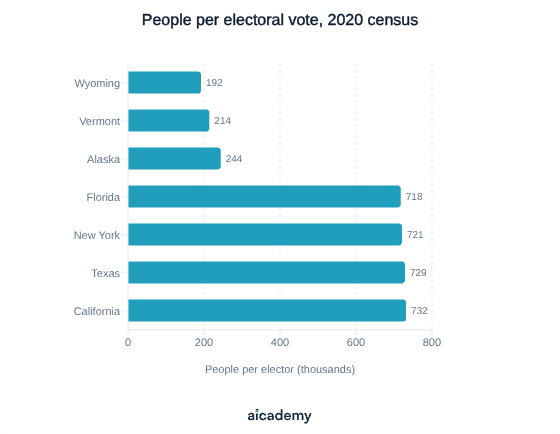
Wyoming's 576,851 residents elect three electors — about 192,000 people per elector. California's 39,538,223 residents elect 54 — about 732,000 per elector. A Wyoming voter's share of the College is therefore close to four times a Californian's.
Defenders answer that this is the point, not a flaw: the Senate is malapportioned for the same reason, and the College inherits it. The United States is a federation, and small states accepted the constitutional settlement in 1787 partly because it protected them from being governed entirely by the large.
Want more lessons like this one?
Generate lessons on anything you study. Free account, no card needed.
Key terms
- Electoral College
- The body of 538 electors that formally elects the US president, with each state's share equal to its total representation in Congress.
- Winner-take-all
- The rule, used in 48 states and Washington DC, awarding all of a state's electors to whichever candidate wins the most votes in that state.
- Congressional district method
- The system used only in Maine and Nebraska, awarding one elector to the winner of each congressional district and two to the statewide winner.
- Faithless elector
- An elector who casts a presidential vote for someone other than the candidate they were pledged to support.
- Swing state
- A state where the two parties are close enough that either could win it, so campaign resources are concentrated there.
- National Popular Vote Interstate Compact
- An agreement among participating states to award their electors to the national popular vote winner, binding only once signatory states hold at least 270 electoral votes.
Frequently asked questions
Yes, and it has happened five times: 1824, 1876, 1888, 2000 and 2016. The presidency is decided by 270 of 538 electoral votes, not by the national vote total, so a candidate can win narrowly in enough states while losing heavily elsewhere.
Abolition needs a constitutional amendment under Article V: two-thirds of both chambers of Congress and ratification by 38 of the 50 states. Small states and whichever party currently benefits have little incentive to agree, so no amendment has come close.
An agreement among states to award their electors to whoever wins the national popular vote. It takes effect only once members hold 270 electoral votes between them. As of August 2026 it had 222, from 18 states and DC.
Generate revision on any topic you study
Type any topic you're studying and Aicademy generates a complete lesson, quiz, and flashcard set, personalised to your level.
Lessons on anything
Structured, level-matched lessons on any topic you study
Practice quizzes
Find out what you actually know before the exam does
Flashcard sets
Lock in key concepts with instant revision cards
Ask Aica
Stuck on something? Get a clear explanation, any time
US Presidential and Congressional Elections
Campaign Finance in the USA
Related lessons
13 min
US Presidential and Congressional Elections
A-Level Politics · Pearson Edexcel 9PL0
2 months ago
11 min
14 min
15 min