Track progress, take quizzes and save notes on this lesson.

Free forever · no card needed

Start free
Intermediate

Transverse and Longitudinal Waves

4.6.1.1 Transverse and longitudinal waves

Aligned to the AQA 8463 specification

Topic
Waves
Level
Intermediate
Reading time
6 min
Published
2 July 2026
On this page
  1. 1.What a Wave Actually Does
  2. 2.Transverse Waves
  3. 3.Longitudinal Waves
  4. 4.Comparing the Two Types
  5. 5.Evidence That the Medium Does Not Travel
  6. 6.Common Exam Mistakes

Key takeaways

  • A wave transfers energy from one place to another without transferring matter; the particles of the medium only oscillate about fixed positions.
  • In a transverse wave the oscillations are at 90° to the direction of energy transfer; water ripples and all electromagnetic waves are transverse.
  • In a longitudinal wave the oscillations are parallel to the direction of energy transfer, producing compressions and rarefactions; sound in air is longitudinal.
  • A floating object on a passing wave bobs up and down but does not move along with the wave, showing that the medium itself does not travel.

What a Wave Actually Does

A wave is a disturbance that transfers energy from one place to another without transferring matter. This single idea sits behind everything else in this topic, so it is worth pinning down before anything else.

When a wave passes through a material (the medium), the particles of that material vibrate about fixed positions. They pass energy on to their neighbours, but they do not travel along with the wave. Once the wave has gone, each particle is back roughly where it started.

Think of a stadium Mexican wave. The "wave" sweeps around the ground, yet every spectator stays in their own seat, only standing up and sitting down. The pattern moves; the people do not. A water wave behaves the same way: a duck floating on a pond bobs up and down as ripples pass under it, but it does not get carried across to the far bank.

A wave transfers energy and information, not the substance it travels through. This is the defining property of every wave.

Transverse Waves

In a transverse wave, the oscillations (vibrations) are perpendicular to the direction of energy transfer — that is, at 90° to the way the wave is moving.

The visual below shows the shape a transverse wave traces out. The high points are called crests (or peaks) and the low points are called troughs. The wave moves horizontally to the right, while each particle moves up and down.
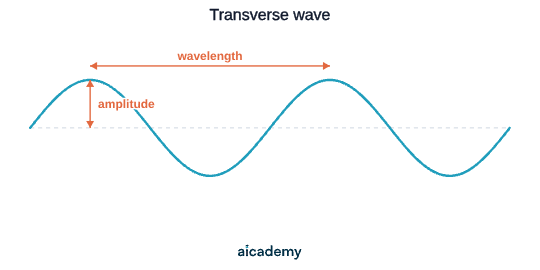
Examples of transverse waves you must know:

  • Water ripples on the surface of a pond.
  • All electromagnetic waves (light, radio, microwaves, X-rays and the rest of the spectrum).
  • Waves on a rope or spring when you shake one end up and down.

For a rope wave, your hand moves the rope up and down while the wave energy travels along the rope's length. The two directions are at right angles, which is exactly what makes it transverse.

Longitudinal Waves

In a longitudinal wave, the oscillations are parallel to the direction of energy transfer — the particles vibrate back and forth along the same line the wave travels.

This produces alternating regions along the wave:

  • Compressions — where particles are squashed close together, giving a region of higher pressure.
  • Rarefactions — where particles are spread apart, giving a region of lower pressure.

The classic demonstration is a slinky (long spring) pushed and pulled along its length. You can see the coils bunch up (a compression) and stretch out (a rarefaction), and these regions travel along the spring while each coil only shuffles back and forth.

Sound in air is the key example of a longitudinal wave. A loudspeaker cone pushes forward and squashes the air in front of it (a compression), then pulls back and lets the air spread out (a rarefaction). These pressure changes travel outwards to your ear, but the air molecules themselves stay in the same average position.

Sound is a longitudinal wave: air particles vibrate along the direction the sound travels, creating compressions and rarefactions. Sound cannot travel through a vacuum because it needs particles to vibrate.

Comparing the Two Types

Both wave types transfer energy without transferring matter. The single distinguishing feature is the direction of oscillation relative to the direction of travel.

FeatureTransverse waveLongitudinal wave
Direction of oscillationPerpendicular (90°) to energy transferParallel to energy transfer
Features along the waveCrests and troughsCompressions and rarefactions
Key examplesWater ripples, all EM waves, rope wavesSound waves, seismic P-waves, slinky pushed lengthways
Can it travel through a vacuum?EM waves can; mechanical transverse waves cannotNo — needs a medium of particles

A useful memory hook: in a transverse wave the vibration goes across the direction of travel; in a longitudinal wave the vibration goes along the direction of travel.

Something not quite clicking?

Ask Aica to explain any part of this differently. Free, takes 30 seconds.

Ask Aica

Evidence That the Medium Does Not Travel

The specification asks you to describe evidence that it is the wave, and not the medium, that travels. There are two everyday observations that show this clearly.

Observation 1 — a floating object. Drop a small cork or a leaf onto still water and send ripples towards it. As each ripple passes, the cork bobs up and down on the spot. It is not pushed across the water in the direction the wave is moving. If the water itself were travelling, the cork would be swept along with it. Because the cork stays put, the water must be staying put too — only the wave (and its energy) moves forward.

Observation 2 — a slinky. Lay a long spring on a table and send a pulse along it. Tie a small piece of coloured tape to one coil and watch it. The tape (and the coil it marks) vibrates back and forth over a small distance and then stops in its original position. The pulse, however, travels the full length of the spring. The marked coil never reaches the far end, proving the spring material does not travel with the wave.

Both observations lead to the same conclusion: the particles oscillate about fixed points and pass energy on, while the disturbance itself moves through the medium.

Common Exam Mistakes

1. Saying that waves carry matter forward

A wave transfers energy, not matter. Writing that "the water moves across the pond" or "the air travels to your ear" loses marks. State that the particles oscillate about fixed positions and only the energy is transferred.

2. Mixing up the direction of oscillation

For transverse, oscillations are perpendicular to the direction of travel; for longitudinal, they are parallel to it. Do not write "up and down" for a longitudinal wave, or "back and forth" for a transverse wave, unless you have first defined which direction the wave itself is going.

3. Using crests and troughs for longitudinal waves

Crests and troughs belong to transverse waves. Longitudinal waves have compressions and rarefactions. Using the wrong pair of terms is a common and avoidable error.

4. Claiming sound is transverse

Sound is longitudinal. A frequent slip is to draw a transverse wiggle to represent sound; that is only a way of plotting the pressure changes, not the actual particle motion, which is back and forth along the direction of travel.

5. Forgetting that sound needs a medium

Sound cannot travel through a vacuum because it needs particles to pass on the vibrations. Electromagnetic waves (which are transverse) can travel through a vacuum, which is why light from the Sun reaches us but its sound never could.

Key terms

Transverse wave
A wave in which the oscillations are perpendicular to the direction of energy transfer.
Longitudinal wave
A wave in which the oscillations are parallel to the direction of energy transfer.
Compression
A region of a longitudinal wave where the particles are pushed close together, giving higher pressure.
Rarefaction
A region of a longitudinal wave where the particles are spread apart, giving lower pressure.

Frequently asked questions

In a transverse wave the oscillations are perpendicular (at 90°) to the direction the wave travels, as in water ripples. In a longitudinal wave the oscillations are parallel to the direction of travel, producing compressions and rarefactions, as in sound.

Waves transfer energy, not matter. The particles of the medium vibrate about fixed positions and stay roughly where they are; only the energy and the wave pattern move forward.

Sound is a longitudinal wave. The air particles vibrate back and forth in the same direction the sound travels, creating regions of high pressure (compressions) and low pressure (rarefactions).

Generate revision on any topic you study

Type any topic you're studying and Aicademy generates a complete lesson, quiz, and flashcard set, personalised to your level.

Lessons on anything

Structured, level-matched lessons on any topic you study

Practice quizzes

Find out what you actually know before the exam does

Flashcard sets

Lock in key concepts with instant revision cards

Ask Aica

Stuck on something? Get a clear explanation, any time

Next

Wave Properties and the Wave Equation

Related lessons

6 min

Lesson

Sound Waves and Ultrasound

AQA GCSE Physics · AQA 8463

19 days ago

7 min

Top students don’t revise more. They revise what counts.

Start revising free

Free to start. No card needed.