Track progress, take quizzes and save notes on this lesson.

Free forever · no card needed

Start free
Advanced

Wave Properties and the Wave Equation

4.6.1.2 Properties of waves (including Required practical 8)

Aligned to the AQA 8463 specification

Topic
Waves
Level
Advanced
Reading time
7 min
Published
2 July 2026
On this page
  1. 1.The Four Quantities That Describe a Wave
  2. 2.Reading Amplitude and Wavelength from a Diagram
  3. 3.Period and Frequency: T = 1/f
  4. 4.The Wave Equation: v = fλ
  5. 5.Required Practical 8: Measuring Waves in a Ripple Tank and a Solid
  6. 6.Measuring the Speed of Sound and of Ripples
  7. 7.Common Exam Mistakes

Key takeaways

  • Amplitude is the maximum displacement from rest; wavelength is the distance between the same point on two adjacent waves; frequency is the number of waves passing a point per second, in hertz (Hz).
  • Period is the time for one complete wave to pass a point, given by T = 1/f. This equation is given on the Physics equation sheet.
  • Wave speed is the speed at which energy is transferred through a medium and is found from v = fλ. You must recall and apply this equation.
  • Required practical 8 measures the frequency, wavelength and speed of waves in a ripple tank and in a solid, then combines them using v = fλ.
  • Wave speed depends on the medium, so when a wave passes into a new material its speed and wavelength change but its frequency stays the same.

The Four Quantities That Describe a Wave

Every wave, transverse or longitudinal, can be described by the same four measurements. Get these definitions exactly right, because the wording is marked closely.

  • Amplitude — the maximum displacement of a point on the wave from its rest (undisturbed) position. It is a distance, measured in metres. Louder sounds and brighter light have larger amplitudes.
  • Wavelength (λ) — the distance between a point on one wave and the same point on the next wave, for example crest to crest or compression to compression. Measured in metres, symbol λ (the Greek letter lambda).
  • Frequency (f) — the number of complete waves that pass a point each second. Measured in hertz (Hz), where 1 Hz = 1 wave per second.
  • Period (T) — the time taken for one complete wave to pass a point. Measured in seconds.

Amplitude is measured from the rest position to a crest, not from a trough to a crest. Measuring the full top-to-bottom height gives double the amplitude and is a common error.

Reading Amplitude and Wavelength from a Diagram

You must be able to identify amplitude and wavelength directly from a wave diagram. The transverse wave below shows both.
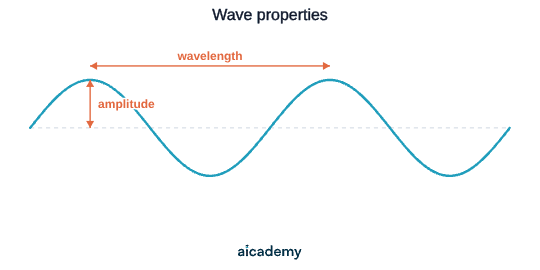
Reading it correctly:

  • Amplitude is measured vertically, from the central rest line up to a crest (or down to a trough). It is not the distance from a trough all the way to a crest.
  • Wavelength is measured horizontally, from one crest to the next crest, or from any point to the matching point one full cycle later.

For a longitudinal wave the same ideas apply, but wavelength is measured from one compression to the next compression, and amplitude relates to how far the particles move from their rest positions.

Period and Frequency: T = 1/f

Period and frequency describe the same thing from opposite directions. Frequency counts waves per second; period times how long one wave takes. They are reciprocals of each other.

where is the period in seconds (s) and is the frequency in hertz (Hz).

This equation is given on the Physics equation sheet, so you do not have to memorise it, but you must be able to use and rearrange it confidently.

Worked example — period from frequency. A sound wave has a frequency of 200 Hz. Find its period.

So one complete wave takes 0.005 seconds (5 milliseconds) to pass.

Worked example — frequency from period. A pendulum-like wave has a period of 0.02 s. Rearranging gives :

The Wave Equation: v = fλ

The wave speed is the speed at which the wave (and its energy) moves through the medium. It links frequency and wavelength through the wave equation.

where is wave speed in metres per second (m/s), is frequency in hertz (Hz) and is wavelength in metres (m).

You must recall and apply this equation. It is not given on the equation sheet.

Worked example — finding speed. Water ripples have a frequency of 5 Hz and a wavelength of 0.04 m. Find their speed.

Worked example — rearranging for wavelength. A sound wave travels at 340 m/s with a frequency of 170 Hz. Find its wavelength. Rearranging gives :

A key consequence: when a wave passes into a different medium, its frequency stays the same but its speed changes, so its wavelength must change to keep balanced. (Physics only) this is why velocity, frequency and wavelength are all inter-related when a wave passes between media.

Worth saving these ideas?

Turn what you've read into instant revision cards. Free to get started.

Make flashcards

Required Practical 8: Measuring Waves in a Ripple Tank and a Solid

Required practical 8 asks you to select suitable apparatus to measure the frequency, wavelength and speed of waves, using a ripple tank for water waves and a stretched string or spring for waves in a solid.

Ripple tank (water waves):

  • Apparatus: a shallow tank of water, a motorised bar (ripple generator) with an adjustable frequency, a lamp above and a white screen below so the ripples cast shadows.
  • Method: switch on the generator to make straight ripples. Read the frequency from the generator's setting. Measure the wavelength by using a strobe light (or a dimmed image) to freeze the ripples, then measure across several wavelengths with a ruler and divide by the number of gaps — measuring 10 wavelengths and dividing by 10 reduces the percentage error. Calculate speed with .
  • Why measure several wavelengths? A single wavelength is small and hard to read precisely; measuring ten and dividing shrinks the effect of the ruler's uncertainty.

Waves in a solid (stretched string):

  • Apparatus: a string fixed at one end and attached to a vibration generator driven by a signal generator, with a hanging mass keeping it taut.
  • Method: adjust the signal generator's frequency until a clear standing-wave pattern forms. Read the frequency directly from the signal generator. Measure the wavelength with a ruler (for a standing wave, the distance between adjacent still points is half a wavelength, so measure across several loops). Calculate speed with .

Variables: the independent variable is the frequency you set; the dependent variable is the wavelength you observe; controls include the water depth (ripple tank) and the tension/mass and string type (solid), which must be kept constant for a fair test.

Measuring the Speed of Sound and of Ripples

Beyond the required practical, you should be able to describe two everyday methods.

Speed of sound in air (echo or two-observer method). Two students stand a measured distance apart, say 100 m. One bangs two blocks together; the other starts a stopwatch on seeing the blocks meet and stops it on hearing the bang. Because light reaches the eye almost instantly, the timed gap is the sound's travel time. Repeating and averaging reduces reaction-time error.

Worked example. The sound covers 100 m in an average of 0.30 s. Using :

This is close to the accepted value of about 330–340 m/s for sound in air, confirming the method.

Speed of ripples on water. Time how long a single ripple takes to travel a measured length of the tank, then use speed = distance ÷ time. Alternatively, measure the frequency and wavelength as in the required practical and apply . Both routes should give the same answer.

Common Exam Mistakes

1. Measuring amplitude from trough to crest

Amplitude is measured from the rest position to a crest, so the full trough-to-crest height is twice the amplitude. Halve it before quoting an amplitude.

2. Forgetting to convert units before using v = fλ

The wave equation needs wavelength in metres. If a wavelength is given in centimetres or millimetres, convert first: 4 cm becomes 0.04 m. Mixing units gives an answer wrong by a factor of 100 or 1000.

3. Confusing frequency and period

Frequency is waves per second (Hz); period is seconds per wave. They are reciprocals, so a 200 Hz wave has a period of 0.005 s, not 200 s. Check which one the question wants.

4. Thinking frequency changes when a wave enters a new medium

When a wave crosses into a new material its speed and wavelength change, but its frequency stays the same. Assuming the frequency changes leads to wrong wavelength calculations.

5. Measuring only one wavelength in the ripple tank

Single-wavelength measurements carry a large percentage error. Measure across ten wavelengths and divide by ten to reduce the uncertainty; examiners reward this technique.

Key terms

Amplitude
The maximum displacement of a point on a wave from its undisturbed (rest) position.
Wavelength
The distance from one point on a wave to the same point on the next wave, measured in metres.
Frequency
The number of complete waves passing a point each second, measured in hertz (Hz).
Period
The time taken for one complete wave to pass a point, measured in seconds.
Wave speed
The speed at which energy is transferred through a medium by a wave, measured in metres per second.

Frequently asked questions

Wave speed = frequency × wavelength, written v = fλ, where v is in metres per second (m/s), f is in hertz (Hz) and λ is in metres (m). You must recall and apply this equation; it is not on the sheet.

Frequency is the number of waves passing a point each second (in hertz). Period is the time for one full wave to pass, in seconds. They are reciprocals: T = 1/f, which is given on the equation sheet.

Measure the frequency from the ripple generator's setting, measure the wavelength using a metre ruler and a strobe or a dimmed shadow image, then calculate speed using v = fλ.

Generate revision on any topic you study

Type any topic you're studying and Aicademy generates a complete lesson, quiz, and flashcard set, personalised to your level.

Lessons on anything

Structured, level-matched lessons on any topic you study

Practice quizzes

Find out what you actually know before the exam does

Flashcard sets

Lock in key concepts with instant revision cards

Ask Aica

Stuck on something? Get a clear explanation, any time

Prev

Transverse and Longitudinal Waves

Next

The Electromagnetic Spectrum

Related lessons

6 min

7 min

6 min

Lesson

Sound Waves and Ultrasound

AQA GCSE Physics · AQA 8463

19 days ago

6 min

Top students don’t revise more. They revise what counts.

Start revising free

Free to start. No card needed.