Track progress, take quizzes and save notes on this lesson.

Free forever · no card needed

Start free
Advanced

Black Body Radiation

4.6.3.1 Emission and absorption of infrared radiation·4.6.3.2 Perfect black bodies and radiation

Aligned to the AQA 8463 specification

Topic
Waves
Level
Advanced
Reading time
6 min
Published
2 July 2026
On this page
  1. 1.Every Object Emits and Absorbs Infrared
  2. 2.The Perfect Black Body
  3. 3.How Radiation Changes With Temperature
  4. 4.The Balance Between Absorbing and Emitting (Higher Tier)
  5. 5.The Temperature of the Earth (Higher Tier)
  6. 6.Common Exam Mistakes

Key takeaways

  • (Separate Physics only) All bodies emit and absorb infrared radiation, and the hotter a body is, the more radiation it emits in a given time.
  • (Separate Physics only) A perfect black body absorbs all the radiation that hits it, reflecting and transmitting none, and it is also the best possible emitter of radiation.
  • (Separate Physics only) As a body gets hotter, the total intensity of radiation it emits increases and the peak of the emitted radiation shifts to shorter wavelengths.
  • (Higher Tier) A body at constant temperature absorbs radiation as fast as it emits it; its temperature rises when it absorbs faster than it emits and falls when it emits faster than it absorbs.
  • (Higher Tier) The temperature of the Earth depends on the balance between the radiation it absorbs from the Sun and the radiation it emits and reflects back into space.

Every Object Emits and Absorbs Infrared

(Separate Physics only) This topic is assessed only in the separate GCSE Physics course, not in Combined Science.

All bodies emit and absorb infrared radiation, no matter what temperature they are. A cup of tea, an ice cube, your own body and a distant star all radiate infrared continuously, and all absorb infrared from their surroundings.

The hotter a body is, the more radiation it emits in a given time.

This is why a radiator feels warm from a distance without touching it: it emits more infrared than the cooler room around it, and that radiation transfers energy to you. The rate of emission rises steeply with temperature, so a small rise in temperature gives a large rise in the radiation emitted.

An object also both emits and absorbs at the same time. Whether it warms up, cools down or stays the same depends on which rate is larger, a point developed later in this lesson.

This is thermal radiation by infrared, which needs no medium and travels through a vacuum, which is how energy reaches the Earth from the Sun.

The Perfect Black Body

(Separate Physics only)

To describe emission and absorption exactly, physicists use an idealised object called a perfect black body.

A perfect black body absorbs all of the radiation that hits it. It reflects none and transmits none of the incident radiation.

Because it absorbs everything and reflects nothing, no reflected light reaches your eye from it, which is why the idea is called a "black" body. A matt black surface is a good real-world approximation.

The second, equally important property follows from the first:

A perfect black body is also the best possible emitter of radiation. A good absorber is always a good emitter.

This link between absorbing and emitting explains the results of Required Practical 10 (infrared and surfaces): the matt black face of a Leslie cube both absorbs the most infrared and emits the most, while the shiny silver face absorbs and emits the least. Good absorbers and good emitters are the same surfaces.

How Radiation Changes With Temperature

(Separate Physics only)

Every body emits a spread of wavelengths, not a single one. The intensity and the wavelength distribution of the radiation emitted both depend on the temperature of the body.

As a body gets hotter, two things happen to the radiation it emits:

  1. The total intensity increases — more energy is radiated each second across all wavelengths.
  2. The peak of the emission shifts to shorter wavelengths — the wavelength at which the most radiation is emitted becomes shorter.

You can see both effects in a heated piece of metal. A cool object emits mostly long-wavelength infrared, which you cannot see. As it is heated, it begins to glow dull red, then orange, then yellow-white as more of its radiation moves into the shorter-wavelength visible range, and the whole glow gets brighter.

TemperatureTotal intensity emittedPeak wavelength
CoolerLowerLonger (infrared)
HotterHigherShorter (towards visible light)

The colour of a hot object is a clue to its temperature. A blue-white star is hotter than a red one, because its emission peaks at a shorter wavelength.

The Balance Between Absorbing and Emitting (Higher Tier)

(Higher Tier only)

Because a body emits and absorbs radiation at the same time, its temperature depends on the balance between these two rates.

  • If a body absorbs radiation faster than it emits, its temperature rises.
  • If a body emits radiation faster than it absorbs, its temperature falls.
  • If a body absorbs and emits at exactly the same rate, its temperature stays constant.

(Higher Tier) A body at a constant temperature is absorbing radiation at the same rate as it is emitting it.

This is a dynamic balance, not a state of no activity: the body is still absorbing and emitting all the time, but the two rates are equal, so there is no overall change in its energy and its temperature holds steady. A change to either rate, for example more incoming radiation, upsets the balance and the temperature changes until a new balance is reached.

Studying this for an exam?

Generate a personalised learning path for this subject. Free to get started.

Create a learning path

The Temperature of the Earth (Higher Tier)

(Higher Tier only)

The same radiation balance sets the average temperature of the Earth.

(Higher Tier) The temperature of the Earth depends on the rates at which it absorbs radiation from the Sun, emits radiation back into space, and reflects radiation into space.

During the day the Earth absorbs short-wavelength radiation (including visible light) from the Sun. It also emits longer-wavelength infrared radiation out to space, day and night, and reflects some incoming radiation straight back (for example off clouds and ice). The average temperature stays roughly steady when the rate of emission and reflection into space matches the rate of absorption from the Sun.
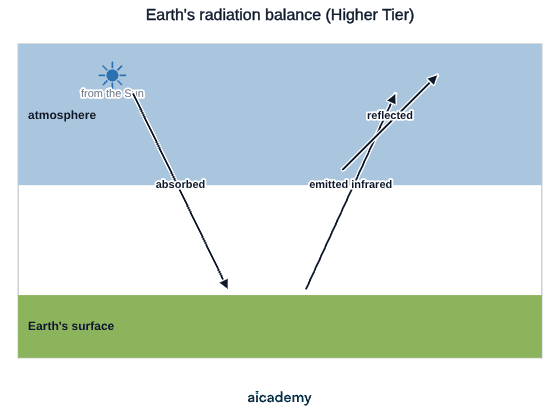
If the rate of absorption rises above the rate of emission and reflection, for example if the atmosphere traps more of the outgoing infrared, the balance tips, energy builds up, and the average temperature rises until a new balance is reached.

Common Exam Mistakes

1. Saying only hot objects emit radiation

Every body emits infrared radiation at any temperature, and every body absorbs it too. Hotter bodies simply emit more per second. Even cold objects like ice emit infrared.

2. Forgetting that a good absorber is a good emitter

A perfect black body absorbs all incident radiation and is the best emitter. Matt black surfaces are best at both; shiny silver surfaces are worst at both. Do not treat absorbing and emitting as opposites.

3. Only mentioning intensity when temperature changes

When a body gets hotter, the intensity rises and the peak wavelength gets shorter. A full answer states both changes, not just that it "emits more".

4. Confusing which way the temperature moves

Temperature rises when a body absorbs faster than it emits, and falls when it emits faster than it absorbs. At constant temperature the two rates are equal. State the comparison of rates, not just "it gains energy".

5. Leaving reflection out of the Earth's balance

The Earth's temperature depends on radiation absorbed from the Sun, radiation emitted to space, and radiation reflected back into space. Omitting reflection gives an incomplete Higher Tier answer.

Key terms

Black body
An object that absorbs all radiation falling on it and is the best possible emitter of radiation.
Intensity (of radiation)
The energy of radiation arriving at or leaving a surface per second per unit area.
Radiation balance
The comparison between the rate a body absorbs radiation and the rate it emits radiation, which determines whether its temperature rises, falls or stays constant.

Frequently asked questions

A perfect black body is an object that absorbs all of the radiation that hits it, reflecting and transmitting none. It is also the best possible emitter of radiation, so a good absorber is also a good emitter.

As an object gets hotter it emits more radiation in total, so the intensity increases, and the peak of the radiation shifts to shorter wavelengths. This is why a heated metal glows dull red, then orange, then white as it gets hotter.

The Earth's temperature stays roughly constant when it emits radiation into space as fast as it absorbs radiation from the Sun. If it absorbs faster than it emits, its temperature rises; if it emits faster than it absorbs, it falls.

Generate revision on any topic you study

Type any topic you're studying and Aicademy generates a complete lesson, quiz, and flashcard set, personalised to your level.

Lessons on anything

Structured, level-matched lessons on any topic you study

Practice quizzes

Find out what you actually know before the exam does

Flashcard sets

Lock in key concepts with instant revision cards

Ask Aica

Stuck on something? Get a clear explanation, any time

Prev

Visible Light and Colour

Next

Magnets and Magnetic Fields

Related lessons

6 min

6 min

Top students don’t revise more. They revise what counts.

Start revising free

Free to start. No card needed.