Hot Deserts: Characteristics, Development and Desertification

Aligned to the AQA 8035 specification
- Topic
- The living world
- Level
- Intermediate
- Reading time
- 14 min
- Published
- 10 June 2026
- Updated
- 16 August 2026
On this page
- 1.Location and Climate of Hot Deserts
- 2.Desert Soils, Ecosystem and Interdependence
- 3.Plant and Animal Adaptations
- 4.Development Opportunities in Hot Deserts: Case Study — Western Desert, USA
- 5.Challenges of Hot Desert Development
- 6.Desertification: Causes and Strategies — The Sahel Region
- 7.Common Exam Mistakes
Key takeaways
- Hot deserts receive less than 250 mm of rainfall per year and cover about 20% of Earth's land surface, forming mainly between 15 and 30 degrees latitude where descending dry Hadley Cell air suppresses rainfall.
- Desert plants adapt by storing water (the saguaro stores up to 750 litres), using deep tap roots or wide shallow roots, reducing leaves to spines, and using CAM photosynthesis to open stomata only at night.
- Desert animals adapt through nocturnal activity, water conservation (the kangaroo rat extracts metabolic water from seeds), reflective colouration, burrowing, and fat storage in extremities such as the camel's hump.
- Development in the Western Desert USA includes mineral extraction, solar and wind energy, irrigated farming, and tourism like Las Vegas, but faces extreme heat, water shortages and inaccessibility.
- Desertification degrades semi-arid fringes like the Sahel through climate change, population growth, fuel-wood removal, overgrazing and over-cultivation; strategies include zai pits, bunds, tree planting and cookstoves.
Location and Climate of Hot Deserts
Hot deserts are arid ecosystems receiving less than 250 mm of rainfall per year, characterised by extreme heat, wide temperature ranges, and sparse vegetation. They cover approximately 20% of the Earth's land surface, making them the second-largest biome after boreal forest.
Why hot deserts form where they do: Hot deserts develop primarily in two settings:
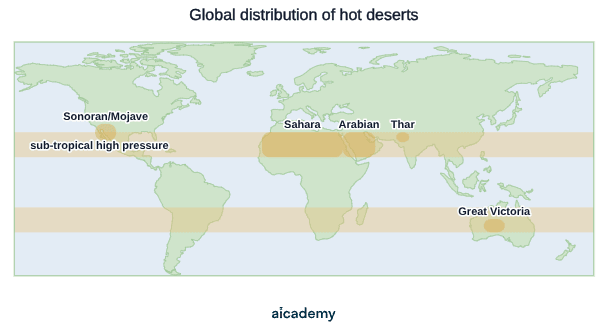
- Sub-tropical high pressure zones — between 15° and 30° north and south of the equator, where the Hadley Cell causes descending dry air. Descending air warms and dries as it falls, suppressing cloud formation and precipitation.
- Rain shadow areas and continental interiors — far from ocean moisture sources, or on the leeward side of mountain ranges.
Major hot deserts:
| Desert | Location | Approximate area |
|---|---|---|
| Sahara | North Africa | 9.2 million km² (world's largest) |
| Arabian Desert | Middle East | 2.3 million km² |
| Thar Desert | India/Pakistan | 0.2 million km² |
| Sonoran / Mojave / Chihuahuan | SW USA, Mexico | ~0.5 million km² combined |
| Great Victoria Desert | Australia | 0.4 million km² |
The map below shows why deserts cluster in two belts roughly 15–30° north and south of the equator, where descending dry air from the Hadley Cell suppresses rainfall.
Climate characteristics:
| Variable | Typical value |
|---|---|
| Annual rainfall | Under 250 mm (some deserts under 25 mm) |
| Daytime temperature | 38–50°C in summer |
| Diurnal temperature range | Up to 30–40°C (cold nights due to no cloud insulation) |
| Humidity | Very low (under 25%) |
Want more lessons like this one?
Generate lessons on anything you study. Free account, no card needed.
Key terms
- Hot desert
- An arid ecosystem receiving less than 250 mm of rainfall per year, with extreme heat, wide temperature ranges and sparse vegetation.
- Diurnal temperature range
- The difference between daytime and night-time temperatures, which can reach 30 to 40 degrees in deserts because there is no cloud cover to retain heat at night.
- Interdependence
- The way soils, plants, animals and people in a desert depend on one another, so that disrupting one component affects the others.
- CAM photosynthesis
- A water-saving adaptation in which a plant opens its stomata only at night, not during the hot, dry day, dramatically reducing water loss.
- Ephemeral life cycle
- A plant strategy where seeds lie dormant for years then germinate, flower and set seed within weeks of rare rainfall.
- Desertification
- The process by which fertile land at the semi-arid margins of deserts becomes increasingly arid and unproductive, losing vegetation, soil structure and the ability to support farming.
- Overgrazing
- Keeping more livestock than grassland can support, destroying plant roots and exposing bare soil to wind erosion.
- Over-cultivation
- Continuous cropping without fallow periods that depletes soil nutrients and breaks down soil structure.
- Zai pits
- Shallow planting pits about 30 cm in diameter that capture rainfall and concentrate water around plant roots, raising yields in the Sahel by 30 to 50%.
- Bunds
- Low stone walls built along contours to slow runoff and allow water to infiltrate the soil.
Frequently asked questions
Hot deserts form in sub-tropical high pressure zones between 15 and 30 degrees north and south of the equator, where the Hadley Cell causes air to descend. As this air falls it warms and dries, suppressing cloud and rainfall. Deserts also form in rain shadows and dry continental interiors far from ocean moisture.
Plants store water in stems, grow deep tap roots or wide shallow roots, reduce leaves to spines, and use CAM photosynthesis to open stomata only at night. Animals are mostly nocturnal, conserve water (the kangaroo rat extracts metabolic water from seeds), have pale colouring, burrow, and store fat in a hump.
A hot desert is an arid biome receiving under 250 mm of rain a year. Desertification is a process by which fertile land at the semi-arid fringes of deserts becomes increasingly arid and unproductive, losing vegetation and soil structure. It affects the margins, not the desert itself, which is already desert.
Generate revision on any topic you study
Type any topic you're studying and Aicademy generates a complete lesson, quiz, and flashcard set, personalised to your level.
Lessons on anything
Structured, level-matched lessons on any topic you study
Practice quizzes
Find out what you actually know before the exam does
Flashcard sets
Lock in key concepts with instant revision cards
Ask Aica
Stuck on something? Get a clear explanation, any time
Global Development: Measuring and Comparing
Resource Management: Food, Water and Energy
Related lessons
11 min