Climate Change: Evidence and Causes

Aligned to the AQA 8035 specification
- Level
- Intermediate
- Reading time
- 10 min
- Published
- 10 June 2026
- Updated
- 25 August 2026
On this page
Key takeaways
- Current climate change is distinctive for its speed, not the fact of change: recent warming of about 1.2C over roughly 150 years is far faster than natural glacial-interglacial transitions in the Quaternary record.
- Evidence for climate change comes from independent sources: instrumental records, ice cores linking CO2 and temperature over 800,000 years, sea level rise of about 20cm since 1900, and retreating glaciers.
- Natural causes such as Milankovitch orbital cycles, solar output and volcanic activity explain the Quaternary ice ages but cannot explain recent warming; solar output has been stable or declining since the 1980s.
- The enhanced greenhouse effect occurs when human activity raises greenhouse gas levels: CO2 has risen from about 280ppm pre-industrial to about 422ppm, and burning fossil fuels causes roughly 75% of global emissions.
- Volcanic eruptions produce short-term cooling from SO2 aerosols, not long-term warming, and modern volcanic CO2 is 50 to 100 times less than human emissions, so volcanoes cannot drive current warming.
Worth saving these ideas?
Turn what you've read into instant revision cards. Free to get started.
Human Causes: Fossil Fuels and the Enhanced Greenhouse Effect
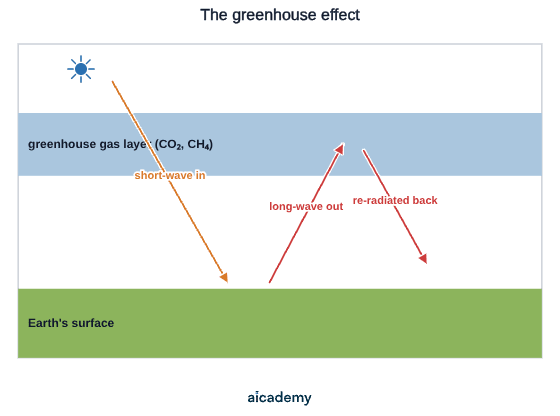
The greenhouse effect is a natural process that makes Earth habitable:
- Short-wave solar radiation passes through the atmosphere and warms Earth's surface
- Earth radiates heat upward as long-wave (infrared) radiation
- Greenhouse gases (CO₂, CH₄, N₂O, water vapour) absorb this outgoing radiation and re-emit it in all directions — including back toward Earth
- This traps heat, maintaining Earth's average temperature at ~15°C (without the greenhouse effect it would be approximately –18°C)
The diagram below shows the process: short-wave radiation reaches the surface, the warmed Earth re-emits long-wave radiation, and greenhouse gases trap some of it and send it back down.
The enhanced greenhouse effect occurs when human activity increases greenhouse gas concentrations, trapping more heat than before:
| Greenhouse gas | Pre-industrial level | Approx. level in 2024 |
|---|---|---|
| Carbon dioxide (CO₂) | ~280 ppm | ~422 ppm |
| Methane (CH₄) | ~722 ppb | ~1,900 ppb |
Recent CO₂ levels are the highest in at least 800,000 years of ice core records.
Burning fossil fuels (coal, oil, natural gas) for electricity generation, transport, heating, and industry accounts for approximately 75% of global greenhouse gas emissions. Combustion converts stored carbon — locked in geological deposits over millions of years — into CO₂ released into the atmosphere in seconds.
Key terms
- Climate
- The long-term average of weather conditions, typically measured over at least 30 years.
- Quaternary period
- The last 2.6 million years of geological time, during which Earth has cycled between cold glacial periods and warmer interglacials.
- Greenhouse effect
- A natural process where greenhouse gases absorb outgoing long-wave radiation and re-emit it toward Earth, trapping heat and keeping average temperature at about 15C.
- Enhanced greenhouse effect
- The extra warming that occurs when human activity increases greenhouse gas concentrations, trapping more heat than before.
- Milankovitch cycles
- Natural variations in Earth's orbit (eccentricity, axial tilt and precession) that change how much solar energy reaches different latitudes and drive ice ages and interglacials.
- Ice cores
- Ice drilled from Antarctica and Greenland containing ancient air bubbles, revealing past atmospheric CO2 and temperature over 800,000 years.
- Interglacial
- A warmer period between glacial periods; Earth is currently in an interglacial.
Frequently asked questions
They are different processes. The greenhouse effect traps heat using atmospheric gases like CO2 and methane, while the ozone layer in the stratosphere protects Earth from UV radiation. Ozone depletion does not cause global warming, and confusing the two undermines an extended answer.
Natural factors operate too slowly or in the wrong direction. Milankovitch orbital cycles act over tens of thousands of years, solar output has been stable or declining since the 1980s, and volcanoes cause short-term cooling. None can explain 1.2C of warming in about 150 years.
Burning fossil fuels is the largest cause, releasing CO2 and accounting for roughly 75% of global greenhouse gas emissions. Agriculture adds methane from livestock and rice paddies and nitrous oxide from fertilisers, while deforestation releases stored carbon and removes future absorption capacity.
Generate revision on any topic you study
Type any topic you're studying and Aicademy generates a complete lesson, quiz, and flashcard set, personalised to your level.
Lessons on anything
Structured, level-matched lessons on any topic you study
Practice quizzes
Find out what you actually know before the exam does
Flashcard sets
Lock in key concepts with instant revision cards
Ask Aica
Stuck on something? Get a clear explanation, any time
UK Weather Hazards and Extreme Weather
Managing Climate Change: Mitigation and Adaptation
Related lessons
15 min
9 min
10 min