Computational Thinking and Representing Algorithms

Aligned to the AQA 8525 specification
- Level
- Intermediate
- Reading time
- 10 min
- Published
- 9 June 2026
- Updated
- 16 August 2026
On this page
Key takeaways
- An algorithm is a sequence of steps to complete a task and is independent of any programming language; a program is one implementation of an algorithm, so the two are not the same thing.
- Decomposition breaks a complex problem into smaller sub-problems that each accomplish a single, identifiable task and can be designed and tested on their own.
- Abstraction removes detail that is genuinely irrelevant to the problem, keeping only what is needed; it is not the same as oversimplification.
- Every algorithm can be described by its inputs, processing and outputs, and identifying these within a given algorithm is a direct AQA exam requirement.
- AQA only requires informal time-based comparisons of efficiency: an algorithm that solves the same problem in fewer steps is more efficient, which matters most with large amounts of data.
Decomposition
Decomposition means breaking a problem into a number of sub-problems so that each sub-problem accomplishes an identifiable task. Each sub-problem may itself be further subdivided.
Worked example — decomposing a library system:
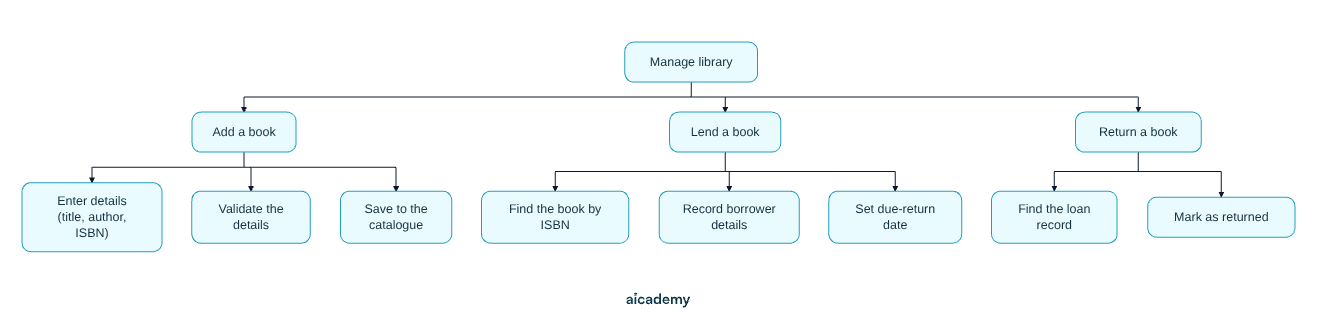
Each branch is an identifiable, manageable task that can be designed and tested on its own.
Why decomposition is essential:
- A problem that feels too large to tackle becomes a set of smaller, solvable tasks
- Each sub-problem can be assigned to a different developer and worked on in parallel
- Individual sub-problems can be tested independently before the complete system is assembled
- A sub-problem that appears in more than one place need only be solved once
In an exam, when asked to decompose a problem, identify the distinct responsibilities or stages of the system. Each sub-problem should have a single, clear purpose — not just "half of everything."
Worth saving these ideas?
Turn what you've read into instant revision cards. Free to get started.
Representing Algorithms: Flowcharts
A flowchart represents an algorithm visually using standard symbols connected by directed arrows.
Standard symbols:
| Symbol | Shape | Purpose |
|---|---|---|
| Terminator | Rounded rectangle (oval) | Marks the Start or End of the algorithm |
| Process | Rectangle | An instruction, calculation, or assignment |
| Input / Output | Parallelogram | Reading input from a user or displaying output |
| Decision | Diamond | A yes/no question — flow branches depending on the answer |
Example — flowchart for checking if a score is a pass:
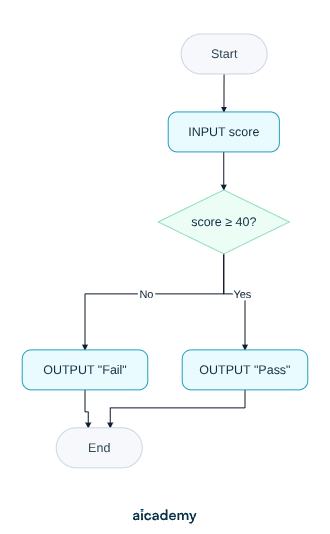
Rules when drawing flowcharts:
- Arrows must show direction of flow
- Every decision diamond has exactly two exits, each labelled Yes and No
- There is exactly one Start; every path through the algorithm must lead to an End
Exam questions may ask you to complete, correct, or interpret a flowchart. Read the decision labels carefully — the branch taken depends on whether the condition is true or false, not on intuition.
Key terms
- Algorithm
- A precise, ordered sequence of steps that can be followed to complete a task, independent of any programming language.
- Decomposition
- Breaking a complex problem into smaller sub-problems, each accomplishing a single identifiable task.
- Abstraction
- Removing detail that is genuinely irrelevant to a problem, keeping only the information needed to solve it.
- Pseudocode
- A way of expressing an algorithm using structured, language-independent statements, in AQA's standard format.
- Flowchart
- A visual representation of an algorithm using standard symbols connected by directed arrows.
- Decision (flowchart)
- A diamond symbol posing a yes/no question, with exactly two labelled exits where flow branches on the answer.
- Trace table
- A table tracking the value of every relevant variable after each step of an algorithm, used to verify it or find errors.
- Efficiency
- A measure of how many steps an algorithm takes; an algorithm solving the same problem in fewer steps is more efficient.
Frequently asked questions
An algorithm is a sequence of steps to solve a problem and has no programming language or syntax, while a program is one way of implementing that algorithm in a specific language for a specific machine. Confusing them in a definition answer loses marks.
Decomposition breaks a complex problem into smaller sub-problems that each accomplish an identifiable task, while abstraction removes detail that is irrelevant to solving the problem. Decomposition is about dividing the problem; abstraction is about ignoring unnecessary detail.
A trace table tracks the value of every relevant variable after each step of an algorithm. It is used to verify that an algorithm works correctly or to identify where an error occurs, recording a new row every time a variable changes.
Generate revision on any topic you study
Type any topic you're studying and Aicademy generates a complete lesson, quiz, and flashcard set, personalised to your level.
Lessons on anything
Structured, level-matched lessons on any topic you study
Practice quizzes
Find out what you actually know before the exam does
Flashcard sets
Lock in key concepts with instant revision cards
Ask Aica
Stuck on something? Get a clear explanation, any time
Linear Search and Binary Search
Related lessons
6 min
8 min
6 min
8 min