Track progress, take quizzes and save notes on this lesson.

Free forever · no card needed

Start free
Intermediate

Collision Theory, Activation Energy and Catalysts

4.6.1.3 Collision theory and activation energy·4.6.1.4 Catalysts

Aligned to the AQA 8462 specification

Level
Intermediate
Reading time
6 min
Published
2 July 2026
On this page
  1. 1.Collision Theory: Why Reactions Need Collisions
  2. 2.Activation Energy
  3. 3.Explaining Each Factor with Collision Theory
  4. 4.Simple Proportionality
  5. 5.How a Catalyst Works
  6. 6.Key Facts About Catalysts
  7. 7.Common Exam Mistakes

Key takeaways

  • Collision theory states that a reaction only happens when particles collide with enough energy; the minimum energy needed for a successful collision is the activation energy.
  • Increasing concentration, pressure and surface area increases the frequency of collisions, so the rate increases. Increasing temperature increases both the frequency of collisions and the energy of the collisions.
  • A catalyst speeds up a reaction by providing a different reaction pathway with a lower activation energy, so more collisions are successful.
  • A catalyst is not used up in the reaction and does not appear in the chemical equation; different reactions need different catalysts, and enzymes are biological catalysts.

Collision Theory: Why Reactions Need Collisions

For a reaction to happen, reacting particles must first bump into each other. But not every collision causes a reaction. Collision theory explains which ones do.

Two conditions must both be met for a successful collision:

  • The particles must collide with each other.
  • They must collide with enough energy to react.

A collision with too little energy simply bounces the particles apart unchanged. So the rate of a reaction depends on how often particles collide and on what fraction of those collisions have enough energy.

Reactions occur only when particles collide with sufficient energy. A collision with too little energy does not cause a reaction.

The more frequent the successful collisions, the faster the reaction. Everything that increases rate does so by increasing the frequency of collisions, the energy of collisions, or both.

Activation Energy

The "enough energy" in collision theory has a name: the activation energy.

Activation energy is the minimum energy that colliding particles must have for a reaction to occur.

Think of it as an energy barrier the particles have to get over. If a collision brings less than the activation energy, the reaction cannot start and the particles separate again. If it brings at least the activation energy, the collision is successful and products form.

This idea links directly to reaction rate. At any moment, only a fraction of particles are moving fast enough for a collision between them to exceed the activation energy. Anything that raises the proportion of collisions that clear this barrier will speed the reaction up. The reaction profile below shows the activation energy as the "hump" reactants must climb before turning into products.

Explaining Each Factor with Collision Theory

Each factor from the previous lesson can now be explained. The key is to say whether it changes the frequency of collisions, the energy of collisions, or both.

Factor increasedEffect on collisionsWhy the rate rises
Concentration (solution)More frequent collisionsMore particles in the same volume, so they collide more often
Pressure (gas)More frequent collisionsGas particles squeezed closer together, so they collide more often
Surface area of a solidMore frequent collisionsMore of the solid is exposed, so more particles are available to be hit
TemperatureMore frequent and more energetic collisionsParticles move faster, so they collide more often and more collisions exceed the activation energy

Concentration, pressure and surface area increase only the frequency of collisions. Temperature increases both the frequency and the energy of collisions, which is why it has such a strong effect.

For surface area, it is the surface area to volume ratio of the solid that matters: smaller pieces have a higher ratio, exposing proportionally more particles.

Simple Proportionality

Collision theory lets you make rough predictions using proportionality. If doubling the concentration doubles the number of particles in a given volume, it roughly doubles how often they collide, so the rate roughly doubles.

For example, if a reaction produces gas at 2 cm³/s at a certain acid concentration, then doubling that concentration would be expected to give a rate of about 4 cm³/s, because collisions happen about twice as often.

If the concentration of a reactant doubles, the frequency of collisions roughly doubles, so the rate roughly doubles.

This is a simple proportional relationship, not an exact rule for every reaction, but it is the reasoning the exam expects when a graph or table shows how rate changes with concentration.

How much of this have you taken in?

Quiz yourself on this section, free, no card needed.

Test myself

How a Catalyst Works

A catalyst increases the rate of a reaction without being used up. It does this by providing a different reaction pathway with a lower activation energy.

Lowering the activation energy means the barrier is easier to clear, so a greater proportion of collisions now have enough energy to be successful. More successful collisions per second means a faster reaction.

The energy profile below shows both pathways. The uncatalysed route (higher hump) needs more energy to start; the catalysed route (lower hump) needs less. The reactants and products sit at the same energy levels in both cases, so the catalyst does not change the overall energy released or absorbed, only the height of the barrier between them.
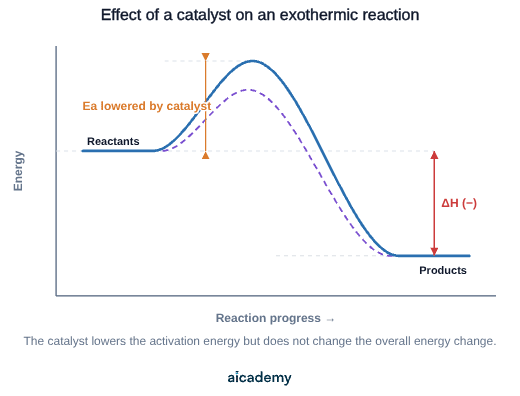
A catalyst provides a pathway with a lower activation energy. It does not lower the energy of the reactants or products, only the barrier between them.

Key Facts About Catalysts

Catalysts have a set of properties the exam tests directly.

  • A catalyst is not used up in the reaction, so it can be reused. A small amount catalyses a large amount of reaction.
  • A catalyst does not appear in the chemical equation, because it is not a reactant or a product.
  • Different reactions need different catalysts. A catalyst that speeds up one reaction may do nothing for another.
  • Enzymes are biological catalysts. They speed up reactions in living organisms, such as digestion.

You can identify a catalyst in an experiment because it increases the rate but its mass is unchanged at the end and it is absent from the balanced equation.

You do not need to recall the names of catalysts beyond those specified in the course. What you must explain is that a catalyst works by lowering the activation energy and is not used up.

Common Exam Mistakes

1. Saying a catalyst lowers the energy of the reactants

A catalyst lowers the activation energy, which is the height of the barrier. It does not change the energy of the reactants or products, so the overall energy change stays the same.

2. Saying a catalyst is used up

A catalyst is chemically unchanged at the end of the reaction. It is not a reactant, does not appear in the equation, and can be used again.

3. Explaining temperature the same way as concentration

Concentration and pressure only increase how often particles collide. Temperature also gives each collision more energy, so more collisions exceed the activation energy. State both effects for temperature.

4. Forgetting that collisions need enough energy

More collisions alone do not guarantee more reaction. The collisions must have at least the activation energy. A full answer mentions both the frequency and the energy of collisions.

5. Confusing catalyst and fuel

A catalyst is not consumed and provides no energy. It simply lowers the activation energy so existing collisions succeed more often.

Key terms

Collision theory
The idea that a reaction only occurs when reacting particles collide with each other with at least the activation energy.
Activation energy
The minimum energy that colliding particles must have for a reaction to take place.
Catalyst
A substance that increases the rate of a reaction without being used up, by providing a lower-activation-energy pathway.
Enzyme
A biological catalyst; a protein that speeds up reactions in living organisms.

Frequently asked questions

Activation energy is the minimum amount of energy that colliding particles must have for a reaction to happen. If a collision has less than this energy, the particles bounce apart without reacting.

A catalyst provides a different reaction pathway with a lower activation energy. This means a greater proportion of collisions have enough energy to be successful, so the rate increases. The catalyst is not used up and is not in the equation.

Increasing temperature does two things: particles collide more frequently and each collision carries more energy, so more collisions exceed the activation energy. Concentration only increases how often particles collide.

Generate revision on any topic you study

Type any topic you're studying and Aicademy generates a complete lesson, quiz, and flashcard set, personalised to your level.

Lessons on anything

Structured, level-matched lessons on any topic you study

Practice quizzes

Find out what you actually know before the exam does

Flashcard sets

Lock in key concepts with instant revision cards

Ask Aica

Stuck on something? Get a clear explanation, any time

Prev

Factors Affecting the Rate of Reaction

Next

Reversible Reactions and Equilibrium

Related lessons

Top students don’t revise more. They revise what counts.

Start revising free

Free to start. No card needed.