Collision Theory, Activation Energy and Catalysts

Aligned to the AQA 8462 specification
- Level
- Intermediate
- Reading time
- 7 min
- Published
- 2 July 2026
- Updated
- 16 August 2026
On this page
Key takeaways
- Collision theory states that a reaction only happens when particles collide with enough energy; the minimum energy needed for a successful collision is the activation energy.
- Increasing concentration, pressure and surface area increases the frequency of collisions, so the rate increases. Increasing temperature increases both the frequency of collisions and the energy of the collisions.
- A catalyst speeds up a reaction by providing a different reaction pathway with a lower activation energy, so more collisions are successful.
- A catalyst is not used up in the reaction and does not appear in the chemical equation; different reactions need different catalysts, and enzymes are biological catalysts.
How much of this have you taken in?
Quiz yourself on this section, free, no card needed.
How a Catalyst Works
A catalyst increases the rate of a reaction without being used up. It does this by providing a different reaction pathway with a lower activation energy.
Lowering the activation energy means the barrier is easier to clear, so a greater proportion of collisions now have enough energy to be successful. More successful collisions per second means a faster reaction.
The energy profile below shows both pathways. The uncatalysed route (higher hump) needs more energy to start; the catalysed route (lower hump) needs less. The reactants and products sit at the same energy levels in both cases, so the catalyst does not change the overall energy released or absorbed, only the height of the barrier between them.
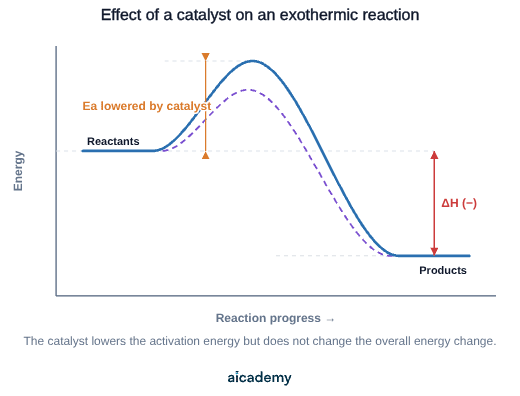
A catalyst provides a pathway with a lower activation energy. It does not lower the energy of the reactants or products, only the barrier between them.
Key terms
- Collision theory
- The idea that a reaction only occurs when reacting particles collide with each other with at least the activation energy.
- Activation energy
- The minimum energy that colliding particles must have for a reaction to take place.
- Catalyst
- A substance that increases the rate of a reaction without being used up, by providing a lower-activation-energy pathway.
- Enzyme
- A biological catalyst; a protein that speeds up reactions in living organisms.
Frequently asked questions
Activation energy is the minimum amount of energy that colliding particles must have for a reaction to happen. If a collision has less than this energy, the particles bounce apart without reacting.
A catalyst provides a different reaction pathway with a lower activation energy. This means a greater proportion of collisions have enough energy to be successful, so the rate increases. The catalyst is not used up and is not in the equation.
Increasing temperature does two things: particles collide more frequently and each collision carries more energy, so more collisions exceed the activation energy. Concentration only increases how often particles collide.
Generate revision on any topic you study
Type any topic you're studying and Aicademy generates a complete lesson, quiz, and flashcard set, personalised to your level.
Lessons on anything
Structured, level-matched lessons on any topic you study
Practice quizzes
Find out what you actually know before the exam does
Flashcard sets
Lock in key concepts with instant revision cards
Ask Aica
Stuck on something? Get a clear explanation, any time
Factors Affecting the Rate of Reaction
Reversible Reactions and Equilibrium
Related lessons
7 min
6 min
6 min