Track progress, take quizzes and save notes on this lesson.

Free forever · no card needed

Start free
Intermediate

Control of Body Temperature

4.5.2.4 Control of body temperature (Biology only)

Aligned to the AQA 8461 specification

Level
Intermediate
Reading time
8 min
Published
16 June 2026
Updated
1 July 2026
On this page
  1. 1.Why Body Temperature Must Stay Steady
  2. 2.The Thermoregulatory Centre
  3. 3.Negative Feedback: How Control Works
  4. 4.If the Body Is Too Hot: Vasodilation and Sweating
  5. 5.If the Body Is Too Low: Vasoconstriction and Shivering
  6. 6.Too Hot vs Too Cold: Side-by-Side
  7. 7.Common Exam Mistakes

Key takeaways

  • Body temperature is held close to 37°C, the temperature at which enzymes work best; too hot and enzymes denature, too cold and reactions slow too much.
  • Temperature is monitored by the thermoregulatory centre in the brain, which has receptors sensitive to blood temperature, and by temperature receptors in the skin that detect the surroundings.
  • When too hot, blood vessels supplying the skin dilate (vasodilation) and sweat glands release sweat that cools the body as it evaporates.
  • When too cold, blood vessels constrict (vasoconstriction), sweating stops, and skeletal muscles shiver, with the respiration this needs releasing heat.
  • Temperature control works by negative feedback: the body responds in whichever direction returns temperature to about 37°C.

Why Body Temperature Must Stay Steady

Human body temperature is held close to 37°C. This is the temperature at which your enzymes work best.

Enzymes are protein catalysts that control nearly every reaction in your cells, including respiration and digestion. If the body gets too hot, enzymes start to denature — their shape changes and they stop working. If it gets too cold, reactions slow down too much to keep cells alive. Either way, the body fails.

Keeping internal conditions stable is called homeostasis.

Homeostasis is the regulation of the internal conditions of a cell or organism to maintain optimum conditions for function, in response to internal and external changes.

Controlling temperature is one example of homeostasis. The body must constantly balance two things:

  • Heat gained — mainly from respiration in cells, and from a hot environment.
  • Heat lost — mainly through the skin to the surroundings.

When these are balanced, core temperature stays near 37°C. When they drift, the body acts to bring temperature back to normal. The rest of this lesson explains how it detects the change and what it does about it.

The Thermoregulatory Centre

Temperature is monitored and controlled by the thermoregulatory centre, a region in the brain.

The thermoregulatory centre works using two sources of information:

DetectorLocationWhat it senses
Receptors in the thermoregulatory centreIn the brainThe temperature of the blood flowing through the brain
Temperature receptors in the skinIn the skinThe temperature of the surroundings

The skin receptors send nervous impulses along neurones to the thermoregulatory centre. This gives the brain an early warning about the outside environment, while its own receptors check the temperature of the blood inside the body.

Once the thermoregulatory centre detects that the body is too hot or too cold, it coordinates a response. It sends nervous impulses to effectors in the skin and muscles, which act to return temperature to normal.

Exam tip: name two sets of receptors — receptors in the thermoregulatory centre that detect blood temperature, and temperature receptors in the skin that detect the external temperature. Many students only mention one.

Negative Feedback: How Control Works

Temperature control is an example of negative feedback. When a condition moves away from its normal level, the body responds to reverse the change and bring it back.

The same loop runs whether you are too hot or too cold:
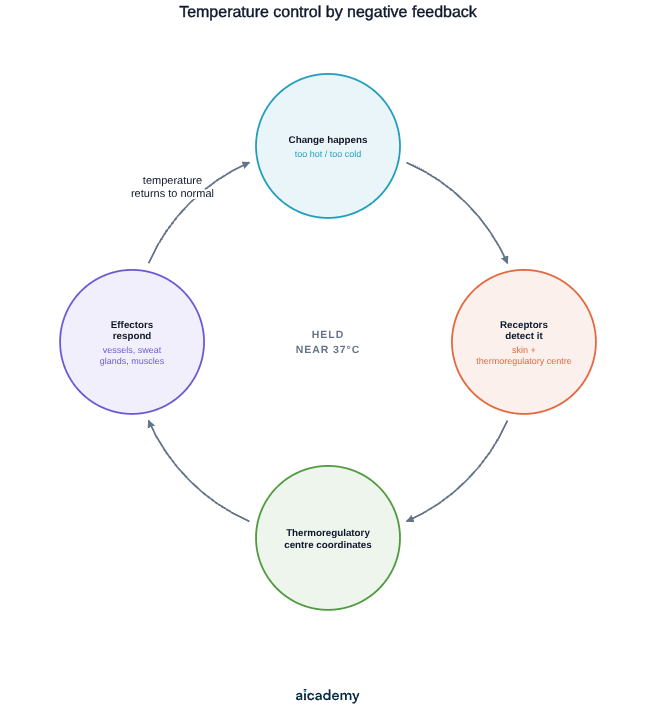
The key idea: the response always opposes the change. Overheating triggers cooling; over-cooling triggers warming. This is why your temperature does not run away in one direction.

Negative feedback means the body acts to cancel out a change and restore the normal level. The bigger the change, the stronger the response.

If the Body Is Too Hot: Vasodilation and Sweating

When the thermoregulatory centre detects that body temperature is too high, it triggers two responses that increase heat loss from the skin.

1. Vasodilation. The blood vessels supplying the skin capillaries dilate — they get wider. This lets more blood flow close to the surface of the skin, so more energy is transferred from the blood to the cooler surroundings. The body loses heat faster.

Important: vasodilation means the blood vessels widen. The vessels do not move closer to the surface — they stay where they are; they simply carry more blood, so more heat reaches the skin's surface to be lost.

2. Sweating. Sweat glands release sweat onto the skin's surface. As the sweat evaporates, it takes energy (heat) from the skin with it, cooling the body down.

Sweat does not cool you by being wet. It cools you when it evaporates — turning from liquid to vapour uses energy taken from your skin.

Walk-through — running on a hot day:

  1. Muscles respire faster, releasing more heat → core temperature rises.
  2. Receptors in the skin and thermoregulatory centre detect the rise.
  3. The thermoregulatory centre sends impulses to the skin's blood vessels and sweat glands.
  4. Vasodilation increases blood flow to the surface; sweat is produced and evaporates.
  5. Heat is lost from the skin → temperature falls back toward 37°C.

This is negative feedback: the rise in temperature triggers a cooling response that reverses it.

How much of this have you taken in?

Quiz yourself on this section, free, no card needed.

Test myself

If the Body Is Too Low: Vasoconstriction and Shivering

When the thermoregulatory centre detects that body temperature is too low, it triggers three responses that reduce heat loss and generate heat.

1. Vasoconstriction. The blood vessels supplying the skin capillaries constrict — they get narrower. Less blood flows near the surface, so less energy is transferred to the surroundings. Heat is kept deeper in the body.

2. Sweating stops. No sweat is produced, so no heat is lost through evaporation.

3. Shivering. Skeletal muscles contract rapidly and repeatedly. This contraction needs respiration, and respiration releases some energy as heat, warming the body.

Walk-through — why shivering warms you up:

  1. Cold surroundings cause the body to lose heat → core temperature falls.
  2. Receptors detect the fall; the thermoregulatory centre coordinates a response.
  3. Skeletal muscles contract and relax quickly — this is shivering.
  4. Muscle contraction requires energy, supplied by respiration.
  5. Respiration is exothermic — it releases energy, some of which is heat.
  6. That heat raises body temperature back toward 37°C.

Shivering is not random. It is muscle activity deliberately triggered to release heat from respiration.

(Higher Tier only — in the exam you may be asked to explain how these mechanisms raise or lower body temperature in a given context, e.g. why someone shivers after swimming in cold water, or why their skin looks flushed during exercise. Describe the receptor → thermoregulatory centre → effector pathway and the heat effect, not just the name of the response.)

Too Hot vs Too Cold: Side-by-Side

The two responses are mirror images. The thermoregulatory centre picks whichever one moves temperature back toward 37°C.

ResponseIf too HOTIf too COLD
Skin blood vesselsDilate (vasodilation) — widerConstrict (vasoconstriction) — narrower
Blood flow near skin surfaceIncreasesDecreases
Sweat glandsProduce sweatStop producing sweat
Skeletal musclesNo shiveringShiver (rapid contraction)
Net effectMore heat lostMore heat kept / generated

A useful way to remember it: when hot, the body wants to lose heat (open up the surface, sweat). When cold, the body wants to keep and make heat (close down the surface, shiver).

Extra context — not required by AQA 8461. When cold, tiny muscles attached to skin hairs contract to make hairs stand up ("goosebumps"), trapping a layer of air. In furry animals this insulates well; in humans the effect is very small. The four mechanisms in the table above are the ones the spec assesses.

Common Exam Mistakes

1. Saying the blood vessels "move to the surface"

Vasodilation and vasoconstriction change the width of the blood vessels, not their position. The vessels widen so more warm blood flows near the surface and loses heat — they do not physically move up or down.

2. Forgetting that sweat cools by evaporation

Producing sweat alone does not cool you. The cooling happens when sweat evaporates, taking energy (heat) from the skin. State the evaporation step for the mark.

3. Not explaining how shivering generates heat

Shivering is rapid skeletal muscle contraction, which requires respiration. Respiration releases energy, some as heat, which warms the body. Saying only "you shiver" misses the explanation marks on a Higher-Tier question.

4. Naming only one set of receptors

There are two: receptors in the thermoregulatory centre sensing blood temperature, and temperature receptors in the skin sensing the surroundings. The skin receptors send impulses to the brain.

5. Mixing up vasodilation and vasoconstriction

Both start "vaso-" (blood vessel). Dilation = widen = lose heat = too hot. Constriction = narrow = keep heat = too cold. Link each term to the situation rather than memorising it in isolation.

6. Treating temperature control as a one-way process

It is negative feedback: the body corrects in whichever direction is needed. A rise triggers cooling; a fall triggers warming. Both responses aim to return the body to about 37°C.

Key terms

Homeostasis
The regulation of the internal conditions of a cell or organism to maintain optimum conditions for function, in response to internal and external changes.
Thermoregulatory centre
A region in the brain that monitors and controls body temperature using receptors sensitive to blood temperature.
Vasodilation
The widening of the blood vessels supplying the skin, letting more blood flow near the surface so more heat is lost.
Vasoconstriction
The narrowing of the blood vessels supplying the skin, so less blood flows near the surface and heat is kept deeper in the body.
Sweating
Release of sweat onto the skin's surface that cools the body as it evaporates, taking heat from the skin.
Shivering
Rapid, repeated contraction of skeletal muscles, which needs respiration and so releases heat that warms the body.
Negative feedback
Control in which the body acts to cancel out a change and restore the normal level, with a bigger change producing a stronger response.

Frequently asked questions

The thermoregulatory centre triggers two responses. Blood vessels supplying the skin dilate (vasodilation) so more blood flows near the surface and loses heat, and sweat glands release sweat that takes heat from the skin as it evaporates.

Shivering is rapid contraction of skeletal muscles. This contraction needs respiration, which releases some energy as heat, warming the body back toward 37°C. Saying only that you shiver misses the explanation that respiration generates the heat.

No. Vasodilation means the blood vessels supplying the skin get wider, not that they move. The vessels stay where they are but carry more blood near the surface, so more heat is transferred to the cooler surroundings.

Generate revision on any topic you study

Type any topic you're studying and Aicademy generates a complete lesson, quiz, and flashcard set, personalised to your level.

Lessons on anything

Structured, level-matched lessons on any topic you study

Practice quizzes

Find out what you actually know before the exam does

Flashcard sets

Lock in key concepts with instant revision cards

Ask Aica

Stuck on something? Get a clear explanation, any time

Next

The Endocrine System and Negative Feedback

Related lessons

Top students don’t revise more. They revise what counts.

Start revising free

Free to start. No card needed.