Track progress, take quizzes and save notes on this lesson.

Free forever · no card needed

Start free
Intermediate

Ecosystems and Interdependence

4.7.1.1 Communities·4.7.1.2 Abiotic factors·4.7.1.3 Biotic factors

Aligned to the AQA 8461 specification

Topic
Ecology
Level
Intermediate
Reading time
10 min
Published
16 June 2026
Updated
1 July 2026
On this page
  1. 1.Levels of Organisation in an Ecosystem
  2. 2.What Organisms Need to Survive
  3. 3.Worked Example: Identifying What Organisms Compete For
  4. 4.Interdependence and Stable Communities
  5. 5.Abiotic Factors
  6. 6.Biotic Factors
  7. 7.Common Exam Mistakes

Key takeaways

  • A population is all the organisms of one species in a habitat, a community is all the populations of different species, and an ecosystem is the community plus the abiotic environment they interact with.
  • Plants compete for light, space, water and mineral ions, while animals compete for food, mates and territory.
  • Interdependence means each species depends on others for things like food and pollination, so removing one species can affect many others in the community.
  • A stable community is one where all the species and environmental factors are in balance, so population sizes remain fairly constant over time.
  • Abiotic factors are non-living conditions such as light, temperature and water, while biotic factors are living, such as food availability, new predators, new pathogens and one species outcompeting another.

Levels of Organisation in an Ecosystem

An ecosystem is the interaction of a community of living organisms with the non-living parts of their environment. The living parts are called biotic; the non-living parts are called abiotic.

To make sense of any ecosystem, biologists describe it at increasing scales. Each level contains the ones before it.

LevelDefinitionExample
IndividualA single organismOne oak tree
PopulationAll the organisms of one species in a habitatAll the oak trees in a wood
CommunityAll the populations of different species in a habitatThe oaks, foxes, beetles and fungi
EcosystemThe community plus the abiotic environment they interact withThe whole woodland: organisms + soil, light, water

A habitat is the place where an organism lives. A community is all the populations of all the different species living together in that habitat.

Notice the key step: a population is one species, while a community is many species interacting together.

What Organisms Need to Survive

To survive and reproduce, every organism needs a supply of materials from its surroundings and from the other living organisms around it.

When a resource is in short supply, organisms must compete for it. The better-adapted competitors get more of the resource, survive, and reproduce; the rest may not.

Plants and animals compete for different things, because they obtain energy and materials in different ways:

GroupCompetes forWhy it is needed
PlantsLightPowers photosynthesis to make glucose
PlantsSpaceRoom for roots and leaves to grow and reach resources
PlantsWaterNeeded for photosynthesis and to keep cells turgid
PlantsMineral ions (from soil)E.g. nitrate ions to build proteins for growth
AnimalsFoodSource of energy and materials
AnimalsMatesNeeded to reproduce and pass on genes
AnimalsTerritorySpace containing food, shelter and breeding sites

Plants compete for light, space, water and mineral ions. Animals compete for food, mates and territory. Learning these two lists in full is worth easy marks.

Worked Example: Identifying What Organisms Compete For

A common exam task gives you a habitat and asks you to suggest the factors organisms are competing for. Read the scenario, identify the organism type, then choose from the correct list.

Scenario — A dense patch of bluebells grows on a woodland floor. In early spring the bluebells flower and grow quickly, then die back. By late spring the oak trees above them are in full leaf, and the woodland floor becomes deeply shaded.

Step 1 — Identify the organisms. Bluebells are plants. So they compete for light, space, water and mineral ions.

Step 2 — Match the scenario to the resource. The trees coming into leaf block the sunlight reaching the floor. The limiting resource here is light.

Step 3 — Explain the outcome. By flowering and growing early, the bluebells get the light they need for photosynthesis before the oak canopy closes over. This is an adaptation that lets them avoid losing the competition for light.

Answer: The bluebells compete with the oak trees for light. They are adapted to grow and flower early in the year, so they photosynthesise before the canopy shades the floor.

When asked to suggest a competed-for factor, only name factors from the correct plant/animal list — and link your choice directly to a detail in the scenario.

Interdependence and Stable Communities

Within a community, each species depends on other species — for food, shelter, pollination, seed dispersal and more. This web of dependencies is called interdependence.

Because the species are linked, if one species is removed it can affect the whole community. A change to one population ripples outward to others.

Interdependence: within a community each species depends on other species. Removing or changing one species can affect many others.

A stable community is one where all the species and environmental factors are in balance, so that population sizes remain fairly constant over time.

Worked example — removing one species from a community:

Consider a simple meadow community:
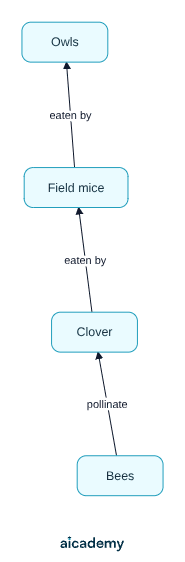
Now suppose a disease wipes out the bees. Trace the effect step by step:

  1. With no bees, the clover is not pollinated, so it produces far fewer seeds and the clover population falls.
  2. Less clover means less food for the field mice, so the mouse population falls.
  3. Fewer mice means less prey for the owls, so the owl population falls too.

One removed species has reduced three others. The community is no longer in balance — it is no longer stable. This is interdependence in action.

Worth saving these ideas?

Turn what you've read into instant revision cards. Free to get started.

Make flashcards

Abiotic Factors

Abiotic factors are the non-living conditions of an environment that can affect a community. A change in any of them can change the size of a population.

Abiotic factorExample effect of a change
Light intensityLess light → slower photosynthesis → plants grow less → fewer plants and the animals that eat them
TemperatureAffects enzyme activity and growth rate; many species breed only within a temperature range
Moisture levelsToo little water limits plant growth; some species cannot survive in dry or waterlogged ground
Soil pH and mineral contentWrong pH or low minerals (e.g. nitrate) → plants grow poorly → fewer plants
Wind intensity and directionStrong wind increases water loss (transpiration) from plants and can damage them
Carbon dioxide levels (plants)More CO₂ can raise the rate of photosynthesis, increasing plant growth
Oxygen levels (aquatic animals)Low dissolved oxygen in water → aquatic animals such as fish cannot respire enough → numbers fall

Note two factors with a specific organism group: carbon dioxide matters for plants (photosynthesis), and oxygen levels matter for aquatic animals (respiration in water).

In an exam you may be given a graph or table and asked to explain how a change in an abiotic factor affects a community — to gain full marks, link the factor to a process (photosynthesis, respiration, enzyme activity) and then to population size.

Biotic Factors

Biotic factors are the living factors that can affect a community. The AQA specification lists four:

Biotic factorExample effect of a change
Availability of foodLess food → animals starve or fail to breed → population falls
New predators arrivingA new predator eats a prey species that has no defence → prey numbers fall sharply
New pathogensA new disease spreads through a population with no resistance → many die
One species outcompeting anotherA better competitor takes the resources, so the other species' numbers drop too low to breed

The fourth factor is precise: one species outcompetes another so its numbers are no longer sufficient to breed. Outcompeting reduces a population to the point where breeding fails.

Worked example — classify the factor, then predict the effect:

Scenario — Grey squirrels are introduced to a woodland already home to red squirrels. The greys are larger, eat a wider range of food, and carry a virus that is harmless to them but deadly to red squirrels. Over several years the red squirrel population collapses.

Step 1 — Classify each factor. Both the grey squirrels and the virus are living, so these are biotic factors.

Step 2 — Name the specific biotic factors. (a) One species outcompeting another — greys take more of the shared food. (b) A new pathogen — the virus the greys carry.

Step 3 — Predict the effect. The red squirrels get less food and are killed by a disease they have no resistance to. Their numbers fall until too few remain to breed, so the population collapses. The community shifts towards grey squirrels.

To decide abiotic vs biotic, ask one question: is the factor alive (or made by a living thing)? Predators, food, pathogens and competitors are biotic. Light, temperature, water, pH, wind, CO₂ and oxygen are abiotic.

Common Exam Mistakes

1. Confusing population, community and ecosystem

A population is one species; a community is all the populations of different species; an ecosystem is the community plus the abiotic environment. Marks are lost for using "community" when you mean "population".

2. Mixing up what plants and animals compete for

Plants compete for light, space, water and mineral ions. Animals compete for food, mates and territory. Writing "plants compete for food" or "animals compete for mineral ions" loses the mark.

3. Swapping the carbon dioxide and oxygen factors

Carbon dioxide is the abiotic factor that matters for plants (photosynthesis). Oxygen levels matter for aquatic animals (respiration in water). Do not state them the other way round.

4. Calling a factor abiotic when it is living

A new predator, a new pathogen, food availability and a competing species are all biotic — they are living or come from living things. Only non-living conditions are abiotic.

5. Vague definition of a stable community

A stable community is not just "one that does not change". State it precisely: all the species and environmental factors are in balance, so population sizes remain fairly constant.

6. Forgetting to follow the knock-on effect through the community

When asked how removing one species affects others, do not stop at the first link. Trace the chain of interdependence (food, pollination, predation) through each affected population to show the full effect.

Key terms

Ecosystem
The interaction of a community of living organisms with the non-living (abiotic) parts of their environment.
Community
All the populations of all the different species living together in a habitat.
Population
All the organisms of one species in a habitat.
Habitat
The place where an organism lives.
Biotic factor
A living factor that can affect a community, such as food availability, new predators, new pathogens or a competing species.
Abiotic factor
A non-living condition of an environment that can affect a community, such as light, temperature, moisture, pH, wind or gas levels.
Interdependence
The way each species within a community depends on other species for things such as food, shelter, pollination and seed dispersal.
Stable community
A community where all the species and environmental factors are in balance, so population sizes remain fairly constant.
Competition
The struggle between organisms for a resource that is in short supply, which the better-adapted competitors are more likely to win.

Frequently asked questions

A population is all the organisms of one species in a habitat, a community is all the populations of different species living together, and an ecosystem is that community plus the abiotic (non-living) environment they interact with. A population is one species; a community is many.

Plants compete for light, space, water and mineral ions, while animals compete for food, mates and territory. Naming the right list for the organism type earns easy marks, so do not say plants compete for food or animals for mineral ions.

Abiotic factors are non-living conditions such as light intensity, temperature, moisture, soil pH, wind, carbon dioxide and oxygen levels. Biotic factors are living, including food availability, new predators, new pathogens and one species outcompeting another.

Generate revision on any topic you study

Type any topic you're studying and Aicademy generates a complete lesson, quiz, and flashcard set, personalised to your level.

Lessons on anything

Structured, level-matched lessons on any topic you study

Practice quizzes

Find out what you actually know before the exam does

Flashcard sets

Lock in key concepts with instant revision cards

Ask Aica

Stuck on something? Get a clear explanation, any time

Prev

Classification of Living Organisms

Next

Adaptations

Related lessons

9 min

Lesson

Adaptations

AQA GCSE Biology · AQA 8461

1 month ago

9 min

Top students don’t revise more. They revise what counts.

Start revising free

Free to start. No card needed.