Track progress, take quizzes and save notes on this lesson.

Free forever · no card needed

Start free
Advanced

Psychological Explanations and Therapies for Schizophrenia

4.3.5 Schizophrenia

Aligned to the AQA 7182 specification

Level
Advanced
Reading time
11 min
Published
1 July 2026
On this page
  1. 1.Family Dysfunction as an Explanation
  2. 2.Double-Bind Theory and Expressed Emotion
  3. 3.Cognitive Explanations: Dysfunctional Thought Processing
  4. 4.Cognitive Behaviour Therapy for Psychosis (CBTp)
  5. 5.Family Therapy
  6. 6.The Interactionist Approach: The Diathesis-Stress Model
  7. 7.Evaluation (AO3)
  8. 8.Common Exam Mistakes

Key takeaways

  • Family dysfunction explanations blame abnormal family processes: the schizophrenogenic mother, double-bind theory, and high expressed emotion (criticism, hostility, over-involvement), which predicts relapse.
  • Cognitive explanations focus on dysfunctional thought processing: Frith's dysfunction in metarepresentation could explain hallucinations, while dysfunction in central control could explain disorganised speech.
  • CBTp helps patients challenge irrational beliefs and reduce the distress symptoms cause; it manages symptoms rather than curing them and is usually used alongside medication.
  • Family therapy reduces expressed emotion and improves communication, which lowers relapse and hospital readmission rates (Pharoah et al.).
  • The interactionist diathesis-stress model says schizophrenia results from a vulnerability (diathesis) interacting with a stressor; neither alone is usually sufficient, so treatment combines drugs with therapy.

Family Dysfunction as an Explanation

Family dysfunction explanations argue that abnormal processes within a family are a source of schizophrenia. Rather than looking at genes or brain chemistry, they locate the cause in how family members communicate with and treat one another. Three ideas dominate this approach, and the exam expects you to distinguish them clearly.

ExplanationKey theoristCore claim
Schizophrenogenic motherFromm-ReichmannA cold, rejecting, controlling mother creates a tense, secretive climate
Double-bind theoryBatesonContradictory messages produce a disorganised view of reality
Expressed emotion (EE)Brown and colleaguesA stressful family communication style that predicts relapse

The schizophrenogenic mother ("schizophrenia-causing") was proposed by Fromm-Reichmann. She described a mother who is cold, rejecting and controlling. This creates a family atmosphere of tension and secrecy, which leads to distrust and can later develop into paranoid delusions.

Family dysfunction explanations treat schizophrenia as a response to a disturbed family environment, not an inherited condition. This makes them psychological rather than biological explanations.

Double-Bind Theory and Expressed Emotion

Bateson's double-bind theory focuses on the way a developing child communicates with their family. The child repeatedly receives contradictory messages — for example, an expression of love in words paired with hostility in tone. The child fears doing the wrong thing but cannot comment on the unfairness of the situation, because there is no way to escape or resolve it. This confused, mutually contradictory communication is thought to lead to a disorganised view of reality, which shows up in disorganised thinking and symptoms such as delusions.

Expressed emotion (EE) describes a family communication style directed at a patient who is living at home. It has three components:

  • Criticism — verbal criticism of the patient, sometimes with resentment.
  • Hostility — anger and rejection towards the patient.
  • Emotional over-involvement — excessive concern, self-sacrifice and intrusive behaviour.

High EE is a serious source of stress for the patient. Its most important role in the exam is as a predictor of relapse: a patient returning to a high-EE family is far more likely to relapse than one returning to a low-EE household.

Double-bind is about communication during a child's development that may cause schizophrenia. Expressed emotion is about the current family climate around an existing patient that triggers relapse. Keeping these apart is a frequent source of marks.

Cognitive Explanations: Dysfunctional Thought Processing

Cognitive explanations argue that schizophrenia is linked to faulty cognition — abnormal information processing that underlies the symptoms. Frith identified two kinds of dysfunctional thought processing, and each is tied to a specific set of symptoms.

Cognitive systemWhat it normally doesSymptoms if it is dysfunctional
MetarepresentationLets us reflect on our own thoughts and behaviour, and label them as our ownHallucinations; thought insertion (thoughts feel externally planted)
Central controlLets us suppress automatic responses and act on deliberate intentionsDisorganised speech and thought; derailment of thinking

Metarepresentation is the cognitive ability to reflect on our own thoughts and behaviour. It lets us recognise our actions and thoughts as being carried out by ourselves. Dysfunction here could explain hallucinations and thought insertion, because a patient may fail to recognise their own thoughts as their own and instead experience them as coming from outside.

Central control is the cognitive ability to suppress automatic responses while we perform deliberate actions. Dysfunction here could explain disorganised speech and thought: patients may experience each word triggering associations that they cannot suppress, so their speech derails.

Cognitive explanations describe faulty processing as the immediate mechanism behind symptoms. They sit alongside the biological approach rather than replacing it, since faulty cognition may itself have a biological origin.

Cognitive Behaviour Therapy for Psychosis (CBTp)

Cognitive behaviour therapy for psychosis (CBTp) applies the principles of CBT to the symptoms of schizophrenia. It does not aim to cure the disorder. Instead, it helps patients make sense of their symptoms and reduce the distress those symptoms cause.

The therapist works with the patient to:

  1. Identify irrational beliefs and delusions and gently challenge them, testing them against evidence.
  2. Understand the origins of the symptoms — for example, explaining that a hallucinated voice is a product of their own mind can make it feel less threatening.
  3. Develop coping strategies that reduce distress and improve day-to-day functioning.

For example, a patient who believes voices are all-powerful beings can be helped to reframe them as a symptom they can learn to manage. This does not remove the voice, but it reduces the fear and disruption it causes.

CBTp manages symptoms and reduces distress; it does not eliminate schizophrenia. It is typically used alongside antipsychotic medication, which stabilises symptoms enough for the patient to engage with therapy.

Want more lessons like this one?

Generate lessons on anything you study. Free account, no card needed.

Start generating

Family Therapy

Family therapy treats schizophrenia by working with the whole family rather than the patient alone. Its central aim is to reduce expressed emotion and improve the family's communication, lowering the overall level of stress the patient experiences at home. Because high EE predicts relapse, reducing it is expected to reduce relapse.

Family therapy typically tries to:

  • Reduce criticism, hostility and emotional over-involvement within the family.
  • Improve communication so family members can express concerns constructively.
  • Educate the family about schizophrenia so they respond more helpfully to symptoms.
  • Reduce the burden of care and the guilt or anger that fuels high EE.

Pharoah et al. carried out a review of family therapy studies and found evidence that it reduces relapse rates and hospital readmission, and improves the patient's compliance with medication. This gives the therapy a solid evidence base for a strategy that is fundamentally about lowering environmental stress.

Family therapy attacks the same stressor that the family-dysfunction explanation identifies. By lowering expressed emotion it lowers the chance of relapse, which is why it is usually combined with drug therapy rather than used alone.

The Interactionist Approach: The Diathesis-Stress Model

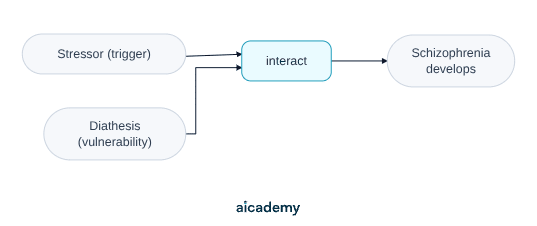
The interactionist approach argues that schizophrenia cannot be fully explained by biology or by psychology alone. Instead it results from an interaction between the two. The diathesis-stress model captures this with two ingredients:

  • A diathesis — a vulnerability. In the original model this was genetic, but the modern version broadens it to include early trauma and other psychological and biological factors.
  • A stressor — an environmental trigger, such as cannabis use, a dysfunctional family or significant life stress.

The key claim is that neither factor alone is usually sufficient. A person can carry a vulnerability and never develop schizophrenia if they are never exposed to enough stress; likewise, stress alone rarely produces schizophrenia in someone with no vulnerability. The disorder appears when a diathesis meets a sufficient stressor.
Because the model treats schizophrenia as both biological and psychological, it justifies combined treatment: antipsychotic medication (targeting the biological vulnerability) plus psychological therapy such as CBTp or family therapy (targeting stress and coping). Research suggests this combination tends to work better than either approach used alone.

The diathesis-stress model needs both a vulnerability and a stressor. Writing that a genetic predisposition alone causes schizophrenia misses the whole point of the interactionist approach.

Evaluation (AO3)

Family explanations have supporting evidence, but they are socially sensitive. Read et al. reported that adults with schizophrenia are more likely to have experienced childhood trauma and insecure attachment, and high-EE research reliably predicts relapse. This supports a link between family environment and the disorder. However, these explanations have historically blamed parents, especially mothers, causing distress to families already coping with a serious illness. The evidence is also largely retrospective and correlational, so it cannot show that family dysfunction causes schizophrenia rather than being a response to it.

Cognitive explanations have research support but describe a proximal cause. Stirling et al. found that patients performed worse than controls on cognitive tasks such as the Stroop test, consistent with dysfunctional thought processing. This gives the approach empirical backing. The limitation is that it identifies a proximal cause — the faulty processing linked to symptoms — without explaining the distal origin of that dysfunction, such as why the cognition became faulty in the first place. The explanation therefore feels incomplete on its own.

The therapies work best in combination. Both CBTp and family therapy have evidence of effectiveness, and NICE recommends both for the treatment of schizophrenia. However, their effects tend to be modest, and they generally require medication to stabilise symptoms before a patient can engage with therapy. This means they are better seen as valuable additions to drug treatment than as standalone cures.

The interactionist model is well supported and clinically useful. Tienari et al.'s adoption study found the highest rates of schizophrenia among adoptees who had both a genetic risk (a biological mother with schizophrenia) and a dysfunctional adoptive family, with much lower rates when only one factor was present. This is strong support for the diathesis-stress model. It also has real practical value: it explains why combined biological and psychological treatment outperforms either alone.

Common Exam Mistakes

1. Confusing double-bind with expressed emotion

Double-bind (Bateson) is about contradictory messages during development that may help cause schizophrenia. Expressed emotion is a current family communication style (criticism, hostility, over-involvement) that acts as a stressor and predicts relapse in an existing patient. Mixing them up loses easy marks.

2. Treating psychological explanations as fully separate from biology

The interactionist point is that psychological and biological factors interact. Presenting family dysfunction or cognitive explanations as if biology were irrelevant ignores the diathesis-stress model and weakens an evaluation.

3. Saying CBT cures schizophrenia

CBTp manages symptoms and reduces distress; it does not cure schizophrenia and is used alongside medication. Claiming it is a cure, or that it replaces drugs, is factually wrong.

4. Forgetting the diathesis-stress model needs both ingredients

The model requires a vulnerability (diathesis) and a stressor. Describing only genetic vulnerability, or only environmental stress, misses the interaction that is the entire point of the model.

5. Name-dropping studies without using them

Naming Read, Stirling, Pharoah or Tienari earns little on its own. State what the study found and what it shows about the explanation or therapy — the finding and its conclusion are where the AO3 marks sit.

Key terms

Family dysfunction
The idea that abnormal processes within a family, such as poor communication and high stress, act as a source of schizophrenia.
Double-bind
A situation, described by Bateson, in which a child repeatedly receives contradictory messages and cannot comment on the unfairness, leading to a disorganised view of reality.
Expressed emotion
A family communication style involving high levels of criticism, hostility and emotional over-involvement directed at the patient, which acts as a stressor and predicts relapse.
Dysfunctional thought processing
Faulty cognition thought to underlie schizophrenia, including dysfunction in metarepresentation and in central control (Frith).
CBTp
Cognitive behaviour therapy for psychosis, which helps patients identify and challenge irrational beliefs and delusions and reduce the distress their symptoms cause.
Family therapy
A psychological therapy that works with the whole family to reduce expressed emotion and improve communication, thereby lowering relapse rates.
Diathesis-stress model
The interactionist explanation that schizophrenia results from an interaction between a vulnerability (diathesis) and an environmental stressor.

Frequently asked questions

Double-bind (Bateson) is about contradictory messages a child receives while developing, leading to a disorganised view of reality. Expressed emotion is a communication style in the family of an existing patient (criticism, hostility, over-involvement) that acts as a stressor and predicts relapse.

No. CBTp does not cure schizophrenia. It helps patients identify and challenge irrational beliefs and delusions and reduces the distress the symptoms cause, improving coping and functioning. It is usually used alongside antipsychotic medication, not instead of it.

It is the interactionist idea that schizophrenia develops when a diathesis (a vulnerability, such as a genetic predisposition or early trauma) combines with a stressor (an environmental trigger such as cannabis use or a dysfunctional family). Both are usually needed for the disorder to appear.

Generate revision on any topic you study

Type any topic you're studying and Aicademy generates a complete lesson, quiz, and flashcard set, personalised to your level.

Lessons on anything

Structured, level-matched lessons on any topic you study

Practice quizzes

Find out what you actually know before the exam does

Flashcard sets

Lock in key concepts with instant revision cards

Ask Aica

Stuck on something? Get a clear explanation, any time

Prev

Biological Explanations and Drug Therapy for Schizophrenia

Next

Food Preferences and the Control of Eating

Related lessons

Top students don’t revise more. They revise what counts.

Start revising free

Free to start. No card needed.