Track progress, take quizzes and save notes on this lesson.

Free forever · no card needed

Start free
Intermediate

Offender Profiling

4.3.9 Forensic Psychology

Aligned to the AQA 7182 specification

Level
Intermediate
Reading time
10 min
Published
1 July 2026
On this page
  1. 1.What Offender Profiling Is
  2. 2.The Typology (Top-Down) Approach
  3. 3.The Four Stages of Top-Down Profiling
  4. 4.The Data-Driven (Bottom-Up) Approach
  5. 5.Geographical Profiling
  6. 6.Evaluation (AO3)
  7. 7.Comparing the Two Approaches
  8. 8.Common Exam Mistakes

Key takeaways

  • Offender profiling is an investigative tool that narrows the field of suspects by inferring an offender's likely characteristics from crime-scene evidence; it assists an investigation rather than solving it.
  • The typology (top-down) approach was developed by the FBI from interviews with 36 convicted US serial killers and rapists, and fits offenders into pre-set organised or disorganised categories.
  • Organised offenders plan the crime and control the scene; disorganised offenders show little planning and leave a chaotic scene with clues.
  • The data-driven (bottom-up) approach, developed by Canter, builds a profile from statistical analysis of evidence with no pre-set types, and includes investigative psychology and geographical profiling.
  • Geographical profiling uses the locations of linked crimes to infer where an offender is based, assuming spatial consistency; Canter's circle theory distinguishes the marauder from the commuter.

What Offender Profiling Is

Offender profiling is an investigative tool that helps police narrow the field of suspects. Rather than identifying a culprit outright, a profiler infers an offender's likely characteristics — such as age, background, personality and lifestyle — from the evidence left at the crime scene.

The logic is that the way a crime is committed reveals something about the person who committed it. A profile might predict where the offender lives, what job they do, whether they have a criminal record, and how they are likely to behave. Police then use this to prioritise suspects and focus resources.

There are two contrasting approaches you must be able to describe and compare:

ApproachOriginHow the profile is built
Top-down (typology)USA (FBI)Fits the offender into a pre-set category from experience
Bottom-up (data-driven)UK (Canter)Builds the profile from statistical analysis of the evidence

Offender profiling assists an investigation by narrowing suspects; it does not identify a specific individual or guarantee a solution. Treating it as able to "solve" a crime is a common exam error.

The Typology (Top-Down) Approach

The typology approach, also called the top-down approach, was developed by the FBI's Behavioral Science Unit in the 1970s. It was based on in-depth interviews with 36 convicted serial killers and rapists in the USA, including Ted Bundy.

From these interviews the FBI concluded that the details of a serious crime scene fit into one of two pre-set templates. The profiler starts from these templates ("top-down") and uses experience and intuition to decide which category a new offender matches. It is best suited to serious, extreme crimes — such as murder and rape — because these reveal the most psychological detail about the offender.

The two categories are the organised and disorganised types:

FeatureOrganised offenderDisorganised offender
PlanningCrime is planned in advanceLittle or no planning; impulsive
VictimTargeted strangerLittle control over the victim
Crime sceneControlled; few clues leftChaotic; clues left behind
IntelligenceAbove averageBelow average
Social/sexual skillsSocially and sexually competentSocially and sexually immature
EmploymentOften in a skilled jobOften unskilled or unemployed

Organised = planned and controlled. Disorganised = chaotic and impulsive. Muddling the two is one of the most common mistakes on this topic.

The Four Stages of Top-Down Profiling

Once the FBI decides which type an offender fits, the profile is assembled through a set sequence of four stages. You should be able to list these in order.
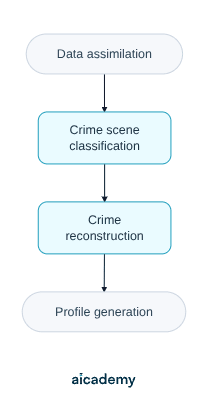
  1. Data assimilation — the profiler reviews all the available evidence: crime-scene photographs, police reports, pathology and witness statements.
  2. Crime scene classification — the profiler decides whether the scene points to an organised or a disorganised offender.
  3. Crime reconstruction — hypotheses are formed about the sequence of events, the victim's behaviour and how the crime unfolded.
  4. Profile generation — a profile of the likely offender is built, including their demographic and physical characteristics, behaviour and background, to guide the investigation.

Because the categories are fixed in advance, the top-down approach depends heavily on the profiler correctly classifying the scene at stage 2. A wrong classification sends the whole profile off course.

The Data-Driven (Bottom-Up) Approach

The data-driven approach, also called the bottom-up approach, was developed in the UK by David Canter. It works in the opposite direction to the top-down method: instead of starting from pre-set types, it builds a picture of the offender from the ground up through the systematic statistical analysis of crime-scene evidence.

There are no pre-set categories. The profile emerges from patterns in the data itself, which makes the approach more objective and allows it to be applied to a wider range of crimes, not just extreme ones. The bottom-up approach has two components you must know: investigative psychology and geographical profiling.

Investigative psychology applies statistical analysis to establish patterns that are likely to recur across crime scenes. Its key ideas are:

  • Interpersonal coherence — the way an offender behaves at the scene (for example, towards a victim) reflects their behaviour in everyday situations, so their actions during the crime are a clue to their normal character.
  • The significance of time and place — the timing and location of offences can indicate where an offender lives and their mobility.
  • Forensic awareness — offenders who take steps to cover their tracks may have had past dealings with the police, which the pattern of evidence can reveal.

The bottom-up approach is data-driven: the profile is built from the evidence rather than fitted to a template. Remembering that "bottom-up = build from data" is the cleanest way to keep the two approaches apart.

How much of this have you taken in?

Quiz yourself on this section, free, no card needed.

Test myself

Geographical Profiling

Geographical profiling is the second part of the bottom-up approach. It uses the locations of an offender's linked crimes to infer where that offender is likely to live or be based. It rests on the assumption of spatial consistency: offenders tend to commit crimes within an area they know, so the geographical pattern of their offences points back towards a base — often a "centre of gravity" around which the crimes cluster.

Canter's circle theory identifies two types of offender based on this pattern:

TypeWhere they operateWhat the map shows
MarauderClose to home, from a fixed baseCrimes cluster around the home
CommuterAway from home; they travel to offendCrimes cluster away from the home area

For a marauder, drawing a circle that encloses the linked offences tends to contain the offender's home near its centre. For a commuter, the crimes form a cluster in a separate area the offender has travelled to, so the home lies outside the offence circle.

Geographical profiling is part of the bottom-up approach, not a separate third method. It is easy to lose marks by forgetting this in a comparison question.

Evaluation (AO3)

A strong exam answer weighs the two approaches against each other and against the evidence. Use these developed points.

The top-down approach rests on a small, unrepresentative sample. It was built from just 36 US serial killers and rapists who agreed to be interviewed, so the findings may not generalise to other offenders or to less extreme crimes. The organised/disorganised dichotomy is also oversimplified: Canter's own analysis of serial-killer data found the two "types" are not clearly distinct, and many offenders show a mix of organised and disorganised features. This weakens the reliability of the classification the whole method depends on.

The top-down approach only applies to certain crimes. It works for serious, extreme offences (such as murder and rape) that reveal psychological detail, but has little to offer for everyday crimes such as burglary or theft, which limits its usefulness.

The bottom-up approach is more scientific and objective. Because it is grounded in data and statistics rather than a profiler's intuition, it is less subjective and applies to a wider range of crimes. There is supporting evidence: Canter and Heritage's analysis of assault cases identified consistent behavioural patterns, and Lundrigan and Canter's study of serial killers found the locations of offences created a "centre of gravity" consistent with spatial consistency, supporting geographical profiling.

Profiling assists rather than solves. Its real-world track record is mixed: profiles can be misleading when wrong and have occasionally sent investigations in the wrong direction. Profiling is one investigative tool among many, not a guaranteed method, so its value should be judged as support for an investigation rather than a route to certainty.

A top-band evaluation does not just list studies — it uses them. State the point, back it with evidence (the 36-offender sample, Canter and Heritage, Lundrigan and Canter), and draw out what it means for the approach's validity.

Comparing the Two Approaches

A frequent exam task is to compare the approaches directly. Keep the contrast sharp: the top-down method reasons from types to the offender, while the bottom-up method reasons from evidence to the profile.

DimensionTop-down (typology)Bottom-up (data-driven)
Direction of reasoningFits offender to pre-set categoriesBuilds profile up from the evidence
OriginUSA — FBIUK — Canter
BasisProfiler's experience and intuitionStatistical analysis of crime data
Pre-set types?Yes (organised / disorganised)No
Range of crimesSerious, extreme crimes onlyWider range of crimes
ObjectivityMore subjectiveMore scientific and objective

Both approaches share the same goal — narrowing the field of suspects to help an investigation — and both draw inferences about an offender from crime-scene evidence. The difference is entirely in how they reach the profile.

If a question asks you to compare, do not just describe each approach in turn. Explicitly say what is the same (goal, use of scene evidence) and what differs (pre-set types versus data-driven, subjective versus objective).

Common Exam Mistakes

1. Confusing the top-down and bottom-up approaches

Top-down fits an offender to pre-set organised/disorganised types using the profiler's experience. Bottom-up builds a profile from the ground up through statistical analysis, with no pre-set types. Reversing these loses easy marks.

2. Muddling organised and disorganised offenders

Organised offenders plan the crime and control the scene (few clues), and tend to be of above-average intelligence and socially competent. Disorganised offenders show little planning and leave a chaotic scene with clues. Keep "planned and controlled" versus "chaotic and impulsive" clear.

3. Treating profiling as able to "solve" crimes

Profiling assists an investigation by narrowing suspects; it does not identify a culprit or guarantee an outcome. Overstating what it achieves misrepresents the whole tool.

4. Forgetting geographical profiling is part of the bottom-up approach

Geographical profiling and investigative psychology are both components of the bottom-up approach. Presenting geographical profiling as a separate third method, or attaching it to the top-down approach, is a common error.

5. Listing evaluation studies without using them

Naming Canter and Heritage or Lundrigan and Canter is not enough. State what each shows and link it back to the validity of the approach — evidence must be applied, not just dropped in.

Key terms

Offender profiling
An investigative tool used by police to narrow the field of suspects by inferring an offender's likely characteristics from evidence gathered at the crime scene.
Top-down (typology) approach
A profiling method, developed by the FBI, that fits an offender into a pre-set category (organised or disorganised) using the profiler's experience and intuition.
Organised offender
An offender who plans the crime, targets a stranger and controls the scene, leaving few clues; typically above-average intelligence and socially and sexually competent.
Disorganised offender
An offender who shows little planning and leaves a chaotic crime scene with clues; typically below-average intelligence and socially and sexually immature.
Bottom-up (data-driven) approach
A profiling method, developed by Canter, that builds a profile from the systematic statistical analysis of crime-scene evidence, with no pre-set categories.
Investigative psychology
A part of the bottom-up approach that applies statistical analysis to crime-scene evidence to establish behavioural patterns, using ideas such as interpersonal coherence and forensic awareness.
Geographical profiling
A part of the bottom-up approach that uses the locations of an offender's linked crimes to infer where they are likely to be based, on the assumption of spatial consistency.

Frequently asked questions

Top-down (typology) profiling fits an offender into pre-set organised or disorganised categories using the profiler's experience. Bottom-up (data-driven) profiling builds a profile from the ground up through statistical analysis of crime-scene evidence, with no pre-set types.

An organised offender plans the crime, targets a stranger and controls the scene, leaving few clues; they tend to be of above-average intelligence and socially competent. A disorganised offender shows little planning and leaves a chaotic scene with clues.

Geographical profiling is part of the bottom-up approach. It analyses the locations of an offender's linked crimes to infer where they are likely to live or be based, assuming spatial consistency. Canter's circle theory distinguishes marauders (close to home) from commuters (who travel away).

Generate revision on any topic you study

Type any topic you're studying and Aicademy generates a complete lesson, quiz, and flashcard set, personalised to your level.

Lessons on anything

Structured, level-matched lessons on any topic you study

Practice quizzes

Find out what you actually know before the exam does

Flashcard sets

Lock in key concepts with instant revision cards

Ask Aica

Stuck on something? Get a clear explanation, any time

Prev

Institutional and Media Influences on Aggression

Next

Biological and Psychological Explanations of Offending

Related lessons

Top students don’t revise more. They revise what counts.

Start revising free

Free to start. No card needed.