Dealing with Offending Behaviour

Aligned to the AQA 7182 specification
- Topic
- Forensic Psychology
- Level
- Intermediate
- Reading time
- 10 min
- Published
- 1 July 2026
- Updated
- 16 August 2026
On this page
Key takeaways
- The four aims of custodial sentencing are deterrence, incapacitation, retribution and rehabilitation; deterrence can be general (society) or individual (the offender).
- Custody has psychological effects including stress, anxiety and depression (with high self-harm and suicide rates), institutionalisation, prisonisation and loss of identity, alongside high recidivism.
- Behaviour modification uses operant conditioning: a token economy rewards desirable behaviour with tokens (secondary reinforcers) exchanged for privileges, shaping behaviour through selective reinforcement.
- Anger management is a cognitive-behavioural programme (Novaco) with three stages: cognitive preparation, skill acquisition and application practice.
- Restorative justice focuses on the needs of the victim and repairing harm: the offender voluntarily takes responsibility, hears the impact, and agrees reparation.
Behaviour Modification in Custody
Behaviour modification in custody is based on the behaviourist principle of operant conditioning: behaviour that is reinforced is repeated, and behaviour that is not reinforced dies away. The aim is to reduce undesirable behaviour and increase desirable behaviour inside the institution.
The main method is the token economy:
- Desirable behaviours are identified in advance (for example, following rules, keeping a cell tidy, avoiding conflict).
- When a prisoner performs a desirable behaviour, they are given a token.
- Tokens are secondary reinforcers — they have no value in themselves, but can later be exchanged for privileges or rewards (phone time, visits, snacks).
- Undesirable behaviour is not reinforced, and in some systems tokens are removed for it.
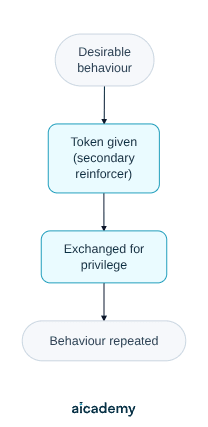
Because reinforcement is selective — only desirable behaviour is rewarded — the token economy gradually shapes the prisoner's behaviour towards what the institution wants.
A token is a secondary reinforcer: it becomes rewarding only because it can be swapped for something the prisoner actually values. This is why the exchange step is essential to the system.
Want more lessons like this one?
Generate lessons on anything you study. Free account, no card needed.
Key terms
- Custodial sentencing
- A judicial sentence in which an offender is punished by serving time in a prison or other closed institution.
- Recidivism
- Reoffending; the tendency of a convicted offender to commit further crimes after release, often used to judge how well a sentence works.
- Behaviour modification
- A programme, based on operant conditioning, that changes an offender's behaviour by selectively reinforcing desirable actions.
- Token economy
- A behaviour modification system in which desirable behaviour is rewarded with tokens (secondary reinforcers) that can later be exchanged for privileges or rewards.
- Anger management
- A cognitive-behavioural programme that treats anger as a cause of offending and teaches offenders to recognise and control it in three stages.
- Restorative justice
- A process focused on the needs of the victim and repairing harm, in which the offender takes responsibility and agrees some form of reparation.
Frequently asked questions
The four aims are deterrence (putting people off offending), incapacitation (removing the offender to protect the public), retribution (society taking revenge) and rehabilitation (reforming the offender). Deterrence can be general or individual.
The three stages are cognitive preparation (identifying anger triggers and thoughts), skill acquisition (learning coping skills such as relaxation and self-talk), and application practice (rehearsing skills in controlled role-plays).
Behaviour modification (the token economy) is based on operant conditioning and reinforces surface behaviour. Anger management is a cognitive-behavioural programme that targets the thoughts and triggers behind offending, addressing a cause rather than just behaviour.
Generate revision on any topic you study
Type any topic you're studying and Aicademy generates a complete lesson, quiz, and flashcard set, personalised to your level.
Lessons on anything
Structured, level-matched lessons on any topic you study
Practice quizzes
Find out what you actually know before the exam does
Flashcard sets
Lock in key concepts with instant revision cards
Ask Aica
Stuck on something? Get a clear explanation, any time
Biological and Psychological Explanations of Offending
Describing Addiction and Risk Factors
Related lessons
11 min
10 min
Biological and Psychological Explanations of Offending
A-Level Psychology · AQA 7182
4 months ago