The Cognitive Approach to Depression

Aligned to the AQA 7182 specification
- Level
- Intermediate
- Reading time
- 12 min
- Published
- 1 July 2026
- Updated
- 16 August 2026
On this page
Key takeaways
- The cognitive approach explains depression as the product of faulty, negative thinking: it is how a person interprets events, not the events themselves, that produces low mood.
- Beck's theory has three parts: faulty information processing, negative self-schemas, and the negative triad of automatic negative views of the self, the world and the future.
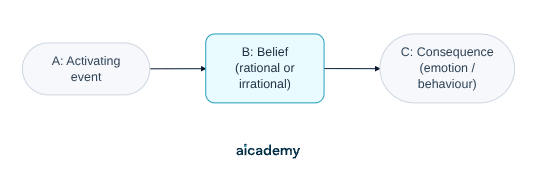
- Ellis's ABC model states that an Activating event triggers a Belief (rational or irrational) which produces the emotional and behavioural Consequence; irrational beliefs cause depression.
- CBT identifies negative or irrational thoughts, challenges them and replaces them with realistic ones; Beck uses the 'patient as scientist', Ellis's REBT adds Dispute and Effect (ABCDE).
- CBT is as effective as antidepressant drugs and avoids their side effects, but may not suit severely depressed patients and can overlook real situational causes such as poverty or abuse.
The Negative Triad
At the heart of Beck's theory is the negative triad: three types of automatic negative thought that a depressed person cannot easily switch off. "Automatic" means the thoughts appear without effort or choice, and they reinforce one another to maintain the depression.
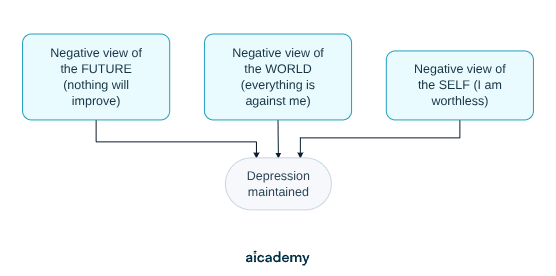
| Part of the triad | Automatic negative thought |
|---|---|
| The self | "I am worthless and a failure." |
| The world | "Everything and everyone is against me." |
| The future | "Nothing will ever get better." |
These thoughts feed each other: seeing the self as worthless makes the world look hostile, which makes the future look hopeless, which reinforces the low view of the self. The cycle keeps the depression going.
Learn the triad as self, world, future — in that order. Muddling the three parts, or listing only two of them, is one of the most common ways students lose marks on this topic.
Ellis's ABC Model
Ellis (1962) offered a different cognitive explanation. He argued that good mental health is the result of rational thinking, and that depression follows from irrational beliefs — beliefs that are illogical or unrealistic and interfere with being happy. His ABC model breaks this down into three steps.
- A — Activating event. Something happens: you are rejected, you fail a test, a friend cancels a plan.
- B — Belief. You form a belief about the event. This belief may be rational ("that's disappointing, but these things happen") or irrational ("this proves nobody likes me").
- C — Consequence. The belief produces an emotional and behavioural consequence. A rational belief leads to a healthy emotion; an irrational belief leads to an unhealthy one, such as depression.
The key insight is that it is the belief (B), not the activating event (A), that produces the consequence (C). The same event can lead to very different outcomes depending on the belief applied to it.
Ellis named two common irrational beliefs. "Musturbation" is the demand that things must go a certain way ("I must succeed at everything I do"). "Utopianism" is the belief that life must always be fair. Because reality rarely meets these rigid demands, they set the person up for disappointment and depression.
Do not confuse Ellis's ABC with Beck's triad. Ellis explains depression through irrational beliefs about an event; Beck explains it through negative self-schemas and the negative triad.
Studying this for an exam?
Generate a personalised learning path for this subject. Free to get started.
Key terms
- Negative triad
- Beck's set of three automatic negative views held by a depressed person: negative views of the self, the world and the future.
- Faulty information processing
- The tendency of depressed people to attend selectively to the negative aspects of a situation and to think in absolutist, black-and-white terms.
- Negative self-schema
- A package of negative beliefs and expectations about oneself, often acquired in childhood, that biases how a person interprets new experiences.
- ABC model
- Ellis's model in which an Activating event triggers a Belief that produces an emotional and behavioural Consequence; it is the belief, not the event, that causes the consequence.
- Irrational beliefs
- Beliefs that are illogical or unrealistic and interfere with happiness, such as the demand that things must always go a certain way (musturbation) or that life must always be fair (utopianism).
- CBT
- Cognitive behaviour therapy: a treatment that identifies and challenges negative or irrational thoughts, replaces them with realistic ones, and adds behavioural activation.
- REBT
- Rational emotive behaviour therapy: Ellis's extension of the ABC model to ABCDE, adding Dispute of the irrational belief and the Effect of a new, healthier belief.
Frequently asked questions
The negative triad is a set of automatic negative views about the self, the world and the future. A depressed person sees themselves as worthless, their surroundings as hostile and their future as hopeless, and these three views maintain the depression.
Both are cognitive explanations, but Beck focuses on the negative triad and negative self-schemas built from faulty information processing, while Ellis's ABC model focuses on irrational beliefs about an activating event that produce an emotional consequence.
CBT identifies a patient's negative or irrational thoughts, challenges them by testing them against evidence, and replaces them with more realistic ones. It also uses behavioural activation to increase engagement in enjoyable activities.
Generate revision on any topic you study
Type any topic you're studying and Aicademy generates a complete lesson, quiz, and flashcard set, personalised to your level.
Lessons on anything
Structured, level-matched lessons on any topic you study
Practice quizzes
Find out what you actually know before the exam does
Flashcard sets
Lock in key concepts with instant revision cards
Ask Aica
Stuck on something? Get a clear explanation, any time
The Behavioural Approach to Phobias
The Biological Approach to OCD
Related lessons
8 min