Track progress, take quizzes and save notes on this lesson.

Free forever · no card needed

Start free
Intermediate

The Biological Approach to OCD

4.1.4 Clinical Psychology and Mental Health

Aligned to the AQA 7182 specification

Level
Intermediate
Reading time
9 min
Published
1 July 2026
On this page
  1. 1.The Genetic Explanation of OCD
  2. 2.Evidence for the Genetic Explanation
  3. 3.The Neural Explanation: Neurotransmitters
  4. 4.The Neural Explanation: The Worry Circuit
  5. 5.Drug Therapy: SSRIs
  6. 6.Drug Therapy: Alternatives to SSRIs
  7. 7.Evaluation (AO3)
  8. 8.Common Exam Mistakes

Key takeaways

  • OCD is polygenic: many candidate genes each contribute a small effect. The COMT gene (dopamine regulation) and the SERT gene (serotonin transport) are commonly cited examples.
  • Twin studies support a genetic component: Nestadt et al. (2010) reviewed twin studies and found around 68% concordance in identical (MZ) twins compared with about 31% in non-identical (DZ) twins.
  • The neural explanation links OCD to low serotonin activity and to an overactive worry circuit involving the orbitofrontal cortex, an impaired caudate nucleus, and the thalamus.
  • SSRIs such as fluoxetine are the main drug treatment: they block the reuptake of serotonin at the synapse, increasing its availability, and typically take 3 to 4 months of daily use to reduce symptoms.
  • Concordance rates are never 100%, so genes create vulnerability rather than certainty; the diathesis-stress model explains OCD as genetic predisposition triggered by environmental stress.

The Genetic Explanation of OCD

The biological approach argues that obsessive-compulsive disorder (OCD) is inherited: it runs in families and is passed on through genes. The key idea for the exam is that OCD is polygenic. This means it is not caused by one single gene but by many genes, each contributing a small effect to a person's overall vulnerability.

Research has identified specific candidate genes that appear to increase the risk of developing OCD. Two you should be able to name are:

Candidate geneWhat it affects
COMT geneRegulates the production of the neurotransmitter dopamine
SERT gene (also called 5-HTT)Affects the transport of serotonin across the synapse

Because so many genes are involved, no single gene "for OCD" exists, and different combinations of genes may lead to OCD in different people.

OCD is polygenic: many candidate genes each contribute a small effect. Saying a single gene causes OCD is a common and costly exam error.

Evidence for the Genetic Explanation

Two types of study provide the main evidence that OCD has a genetic basis: twin studies and family studies.

Twin studies compare identical (monozygotic, MZ) twins, who share 100% of their genes, with non-identical (dizygotic, DZ) twins, who share about 50%. If OCD is genetic, MZ twins should show higher concordance (both twins having the disorder).

Nestadt et al. (2010) reviewed twin studies and found around 68% of identical (MZ) twins shared OCD, compared with about 31% of non-identical (DZ) twins.

The much higher rate in MZ twins strongly suggests a genetic influence. Family studies point the same way: a person who has a first-degree relative (parent or sibling) with OCD has a substantially higher risk of developing it than someone from the general population.

But notice the concordance is 68%, not 100%. If OCD were purely genetic, identical twins would always both have it. This is why the genetic explanation is best understood through diathesis-stress: genes create a vulnerability (the diathesis) that an environmental stressor can then trigger. Genes load the gun; the environment pulls the trigger.

The Neural Explanation: Neurotransmitters

The neural explanation looks at how the brain functions in people with OCD, focusing first on neurotransmitters (the chemical messengers that carry signals between neurones).

The central claim is that OCD is linked to abnormally low serotonin activity. Serotonin helps regulate mood, and low levels are associated with the anxiety and low mood seen in OCD. The strongest support for this is indirect but persuasive: drugs that increase serotonin activity reduce OCD symptoms, which implies serotonin was part of the problem.

Some cases also implicate dopamine. Higher dopamine levels have been associated with the repetitive, compulsive behaviours characteristic of OCD, which fits with the role of the COMT candidate gene in regulating dopamine.

NeurotransmitterProposed role in OCD
SerotoninAbnormally low activity is linked to obsessions and low mood
DopamineHigher levels associated with compulsive, repetitive behaviours

The claim is low serotonin activity, not high. Writing that high serotonin causes OCD reverses the explanation and loses marks.

The Neural Explanation: The Worry Circuit

The neural explanation also points to specific brain structures that form a loop sometimes called the worry circuit. When this circuit malfunctions, obsessive thoughts are not "switched off" and instead loop repeatedly.

Three structures matter:

  • The orbitofrontal cortex (OFC) sends "worry" signals when it detects something potentially threatening.
  • The caudate nucleus (part of the basal ganglia) normally suppresses these signals, filtering out minor worries.
  • If the caudate nucleus is impaired, it fails to suppress the signals, so the OFC and the thalamus become overactive, creating a self-reinforcing loop of obsessive worry and the compulsions performed to relieve it.
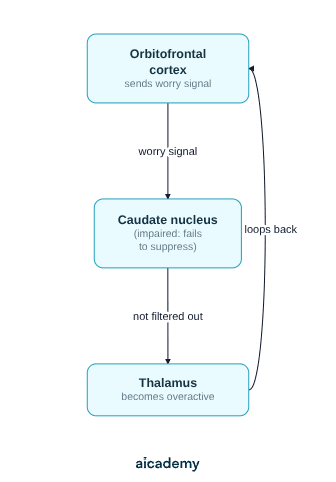
Keep the roles straight: the OFC generates the worry, the caudate nucleus normally suppresses it. When the caudate is impaired, the loop runs unchecked. Confusing these two structures is a frequent exam mistake.

Something not quite clicking?

Ask Aica to explain any part of this differently. Free, takes 30 seconds.

Ask Aica

Drug Therapy: SSRIs

The main biological treatment for OCD is drug therapy, and the first-line drugs are SSRIsselective serotonin reuptake inhibitors (for example, fluoxetine).

To understand how they work, recall what normally happens at a synapse. When serotonin has carried its signal across the gap, it is reabsorbed back into the sending neurone in a process called reuptake. An SSRI blocks this reuptake, so serotonin stays in the synapse longer and continues to stimulate the next neurone. This increases the availability of serotonin, correcting the low serotonin activity thought to underlie OCD.

Feature of SSRI treatmentDetail
MechanismBlocks reuptake of serotonin, raising its availability at the synapse
Example drugFluoxetine
Time to take effectTypically 3 to 4 months of daily use before symptoms reduce
Often combined withCBT (cognitive behaviour therapy) for better outcomes

SSRIs do not work instantly. They usually take 3 to 4 months of daily use before symptoms improve. Writing that they work immediately is a common error.

Drug Therapy: Alternatives to SSRIs

SSRIs do not work for everyone. When a patient does not respond to them, doctors turn to alternative drugs that also raise serotonin activity, sometimes at higher doses or through slightly different mechanisms.

The two alternatives you should know are:

  • Tricyclics (for example, clomipramine) — an older class of antidepressant that also acts on the serotonin system. They are usually kept in reserve because they tend to have stronger side effects than SSRIs.
  • SNRIs (serotonin-noradrenaline reuptake inhibitors) — a newer class that increases the availability of both serotonin and noradrenaline, used as a second-line option when SSRIs are ineffective.
Drug typeExampleWhen used
SSRIFluoxetineFirst-line treatment
TricyclicClomipramineWhen SSRIs are ineffective; more side effects
SNRISecond-line alternative to SSRIs

Drug therapy is often combined with psychological therapy such as CBT. The drugs reduce the anxiety enough for the patient to engage with the therapy, and the therapy tackles the thoughts and behaviours the drugs do not address. A combined approach frequently produces better outcomes than either treatment alone.

Evaluation (AO3)

A strong exam answer weighs the evidence for and against the biological approach rather than just describing it.

Genetic support, but not the whole story. Twin and family studies clearly support a genetic component: Nestadt et al.'s 68% MZ versus 31% DZ concordance is hard to explain without genes. However, concordance is never 100%, so environment must also play a role, which is why diathesis-stress is a better model than pure genetics. Because OCD is polygenic with so many candidate genes, genetic testing has low predictive value and cannot reliably tell someone they will develop OCD.

Neural evidence is mixed. Antidepressants that raise serotonin reduce OCD symptoms, which supports the serotonin link, and brain scans reveal OFC and caudate nucleus differences in patients. But it is unclear whether these differences are a cause or an effect of OCD. Serotonin abnormalities also appear in depression, which is often co-morbid with OCD, so they may not be specific to OCD at all.

Drug therapy is effective and easy to use. SSRIs are cheaper and far less disruptive than psychological therapy — a patient takes a tablet rather than attending weekly sessions — and evidence supports them: Soomro et al. found SSRIs more effective than placebo at reducing OCD symptoms. However, SSRIs have side effects (nausea, insomnia, loss of libido), do not cure OCD (symptoms often return when the drug is stopped), and some trials are funded by drug companies, raising concerns about publication bias.

Comparing the approaches: drug therapy treats the symptoms biologically while ignoring any psychological or environmental triggers. This is why a combined approach (drugs plus CBT) is often considered best.

Common Exam Mistakes

1. Saying OCD is caused by a single gene

OCD is polygenic — many genes each contribute a small effect. Naming COMT or SERT as "the OCD gene" is wrong; they are candidate genes that raise vulnerability, not sole causes.

2. Confusing the OFC and the caudate nucleus

The orbitofrontal cortex generates worry signals; the caudate nucleus normally suppresses them. In OCD the caudate is impaired, so the OFC and thalamus become overactive. Swapping these roles loses marks.

3. Claiming SSRIs work immediately

SSRIs take roughly 3 to 4 months of daily use before symptoms reduce. Any suggestion that they act instantly is incorrect.

4. Saying high serotonin causes OCD

OCD is linked to low serotonin activity. SSRIs help precisely because they increase serotonin availability. Stating that high serotonin is the problem reverses the mechanism.

5. Treating concordance rates as proof OCD is purely genetic

A concordance of 68% in MZ twins is not 100%, so genes cannot be the whole story. Use this figure to argue for diathesis-stress, not for pure genetic determinism.

Key terms

OCD
Obsessive-compulsive disorder, an anxiety disorder marked by persistent intrusive thoughts (obsessions) and repetitive behaviours (compulsions) performed to reduce the resulting anxiety.
Candidate genes
Specific genes that research has identified as creating vulnerability to a disorder, such as the COMT and SERT genes in OCD.
Diathesis-stress
The model that a disorder develops when a genetic or biological vulnerability (the diathesis) is triggered by an environmental stressor.
Serotonin
A neurotransmitter that helps regulate mood; abnormally low serotonin activity is associated with OCD.
SSRI
Selective serotonin reuptake inhibitor, a drug that blocks the reabsorption of serotonin at the synapse to increase its availability.
Orbitofrontal cortex
A region at the front of the brain that generates 'worry' signals; it is thought to be overactive in OCD.

Frequently asked questions

The biological approach explains OCD through genes and brain function. It is polygenic, with candidate genes like COMT and SERT creating a vulnerability, combined with low serotonin activity and an overactive worry circuit (orbitofrontal cortex, caudate nucleus, thalamus).

SSRIs such as fluoxetine block the reuptake of serotonin at the synapse, so more serotonin stays available to stimulate the next neurone. They usually take 3 to 4 months of daily use to reduce symptoms and are often combined with CBT.

No. OCD is polygenic, meaning many genes each contribute a small effect rather than one gene causing it. Because so many candidate genes are involved and concordance is never 100%, genetic testing has low predictive value for OCD.

Generate revision on any topic you study

Type any topic you're studying and Aicademy generates a complete lesson, quiz, and flashcard set, personalised to your level.

Lessons on anything

Structured, level-matched lessons on any topic you study

Practice quizzes

Find out what you actually know before the exam does

Flashcard sets

Lock in key concepts with instant revision cards

Ask Aica

Stuck on something? Get a clear explanation, any time

Prev

The Cognitive Approach to Depression

Next

The Behaviourist Approach

Related lessons

Top students don’t revise more. They revise what counts.

Start revising free

Free to start. No card needed.