Animal Studies of Attachment: Lorenz and Harlow

Aligned to the AQA 7182 specification
- Topic
- Attachment
- Level
- Intermediate
- Reading time
- 9 min
- Published
- 1 July 2026
- Updated
- 16 August 2026
On this page
Key takeaways
- Lorenz found that geese imprint on the first large moving object they see soon after hatching, and this can only happen during a critical period of a few hours up to about two days.
- Sexual imprinting means birds later direct their courtship behaviour towards the type of object they imprinted on, not necessarily their own species.
- Harlow's rhesus monkeys spent most time on a cloth-covered surrogate that gave no milk rather than a wire one that did, showing contact comfort matters more than food for attachment.
- Harlow found monkeys reared with surrogates alone grew up socially and sexually abnormal, and identified a critical period of about 90 days for an attachment to form.
- Lorenz studied birds whose attachment differs from mammals, so his findings generalise poorly to humans; Harlow's monkeys are closer to humans but his work raises serious ethical concerns.
Sexual Imprinting and Its Long-Term Effect
Lorenz's most striking finding came later: imprinting did not just shape which object a bird followed as a chick, it also shaped its mating behaviour in adulthood. This is called sexual imprinting.
Birds that had imprinted on a particular type of object went on to direct their courtship behaviour towards that type of object rather than towards their own species. Lorenz described a peacock that had been raised in a reptile house, where the first moving things it saw after hatching were giant tortoises. As an adult, that peacock directed its courtship displays only at tortoises.
The general pattern of Lorenz's argument runs as follows:
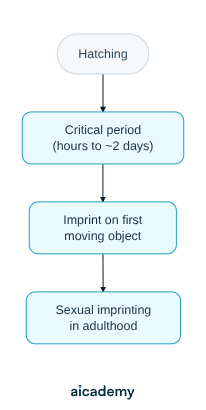
Sexual imprinting shows imprinting has consequences that last into adulthood: the object imprinted on as a chick shapes who or what the adult bird tries to mate with.
How much of this have you taken in?
Quiz yourself on this section, free, no card needed.
Key terms
- Imprinting
- The tendency of a young animal, such as a bird, to attach to and follow the first large moving object it sees soon after hatching.
- Critical period
- A specific and limited time window during which an attachment must form; if it does not form in this window, it may not form at all.
- Contact comfort
- The comfort and security an infant gains from physical, tactile contact with a soft caregiver, shown by Harlow to matter more than food for attachment.
- Sexual imprinting
- The process by which an animal later directs its courtship and mating behaviour towards the type of object it imprinted on early in life.
- Attachment
- A close, two-way emotional bond between two individuals in which each treats the other as essential for emotional security.
Frequently asked questions
Lorenz showed that geese imprint on and follow the first large moving object they see after hatching. The incubator group imprinted on Lorenz, the control group followed their mother, and imprinting could only occur during a critical period of hours up to about two days.
The monkeys preferred the cloth mother even though only the wire mother gave milk. They fed briefly from the wire mother but clung to the soft cloth mother and ran to it when frightened, showing that contact comfort, not food, drives attachment.
Lorenz studied imprinting in birds, where an infant follows the first moving object during a critical period. Harlow studied contact comfort in monkeys, showing infants attach to a soft surrogate for comfort rather than to whatever provides food.
Generate revision on any topic you study
Type any topic you're studying and Aicademy generates a complete lesson, quiz, and flashcard set, personalised to your level.
Lessons on anything
Structured, level-matched lessons on any topic you study
Practice quizzes
Find out what you actually know before the exam does
Flashcard sets
Lock in key concepts with instant revision cards
Ask Aica
Stuck on something? Get a clear explanation, any time
Improving Eyewitness Testimony: The Cognitive Interview
Explanations of Attachment: Learning Theory and Bowlby
Related lessons
9 min
Explanations of Attachment: Learning Theory and Bowlby
A-Level Psychology · AQA 7182
4 months ago
8 min
10 min
9 min