Limits of Computation and Tractability

Aligned to the AQA 7517 specification
- Level
- Advanced
- Reading time
- 6 min
- Published
- 13 June 2026
- Updated
- 16 August 2026
On this page
Key takeaways
- A tractable problem has a polynomial-time algorithm (O(nᵏ)) and is considered efficiently solvable; an intractable problem has no known polynomial-time algorithm, with best known solutions exponential or worse.
- An intractable problem still has an algorithm that just takes too long for large inputs, whereas a non-computable problem has no algorithm at all; these are different categories.
- Heuristic methods find good-enough, near-optimal solutions in acceptable time but do not guarantee the optimal solution, so claiming a heuristic finds the shortest route is incorrect.
- Alan Turing proved in 1936 that the halting problem is non-computable: no general algorithm can decide for all programs and inputs whether a program halts.
- The halting problem is provably unsolvable, not merely very hard; no faster computer or better algorithm can solve it for all inputs.
Studying this for an exam?
Generate a personalised learning path for this subject. Free to get started.
Summary: Computable vs Tractable
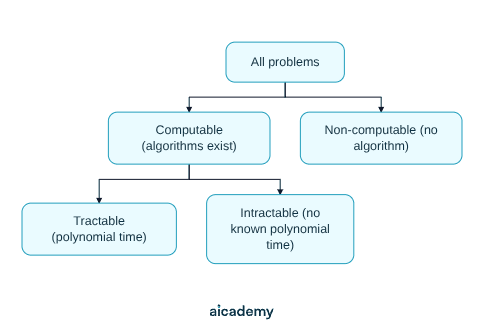
Most day-to-day software sits in the "tractable" category. The boundaries matter for:
- Security (brute-force attacks rely on intractability of factoring large numbers)
- AI (many optimisation problems are intractable; heuristics are essential)
- Formal verification (halting problem limits what we can prove about software)
Key terms
- Tractable problem
- A problem for which a polynomial-time algorithm exists (complexity O(nᵏ) for some constant k), considered efficiently solvable in practice.
- Intractable problem
- A problem for which no polynomial-time algorithm is currently known; the best known algorithms are exponential or worse.
- Heuristic
- An approach that does not guarantee the optimal solution but runs in acceptable time and typically produces a near-optimal solution.
- Computable problem
- A problem for which an algorithm exists that terminates with the correct answer for all valid inputs.
- Non-computable problem
- A problem that no algorithm can solve for all possible inputs; it is provably unsolvable, not just hard.
- Halting problem
- The question of whether an arbitrary program P will eventually halt on an input I; Alan Turing proved in 1936 that no general algorithm can solve it for all programs and inputs.
- Travelling Salesman Problem (TSP)
- An intractable problem to find the shortest route visiting all n cities exactly once, with brute force O(n!) and no known polynomial solution.
- Boolean satisfiability (SAT)
- An intractable problem to determine whether a Boolean formula can be satisfied, with O(2ⁿ) brute force.
Frequently asked questions
An intractable problem has an algorithm that just takes too long for large inputs, such as exponential-time solutions. A non-computable problem has no algorithm at all and is provably unsolvable, regardless of time or hardware. They are different categories.
No. Heuristics find good-enough, near-optimal solutions quickly in acceptable time but do not guarantee optimality. For example, the TSP nearest-neighbour heuristic runs in O(n²) but may produce a route 20 to 25 percent longer than optimal.
The halting problem proves that some problems are non-computable: Alan Turing showed in 1936 that no general algorithm can decide whether an arbitrary program halts on a given input. It is provably unsolvable, not just very hard, and limits what tools like compilers and static analysers can guarantee.
Generate revision on any topic you study
Type any topic you're studying and Aicademy generates a complete lesson, quiz, and flashcard set, personalised to your level.
Lessons on anything
Structured, level-matched lessons on any topic you study
Practice quizzes
Find out what you actually know before the exam does
Flashcard sets
Lock in key concepts with instant revision cards
Ask Aica
Stuck on something? Get a clear explanation, any time
Complexity and Big-O Notation
Turing Machines
Related lessons
6 min
6 min