Working with Suppliers

Aligned to the Pearson Edexcel 1BS0 specification
- Level
- Intermediate
- Reading time
- 10 min
- Published
- 14 June 2026
- Updated
- 16 August 2026
On this page
Key takeaways
- The reorder level on a bar gate stock graph is where a new order is placed, not where the delivery arrives — stock continues to fall during the lead time before replenishment.
- Just in time stock control eliminates storage costs and frees up cash, but any supply chain disruption immediately halts production because no buffer stock is held.
- Different businesses prioritise supplier factors differently: a hospital values quality and reliability above cost; a budget supermarket prioritises cost because tight margins make every saving significant.
- Holding too much stock ties up cash and increases storage costs; holding too little risks production stoppages, lost sales, and expensive emergency orders from alternative suppliers.
- Supply chain failures damage a business's reputation even when the fault lies with the supplier — customers hold the brand responsible for late or defective deliveries.
Managing Stock — The Bar Gate Graph
Stock management is about holding enough stock to meet demand without tying up too much cash in unsold goods. A bar gate stock graph (also called a saw-tooth graph) shows how stock levels change over time as stock is used up and then replenished by deliveries.
The graph below shows the saw-tooth pattern. Stock falls as it is used, hits the reorder level (where a new order is placed), keeps falling through the lead time, then jumps back to maximum when the delivery arrives.
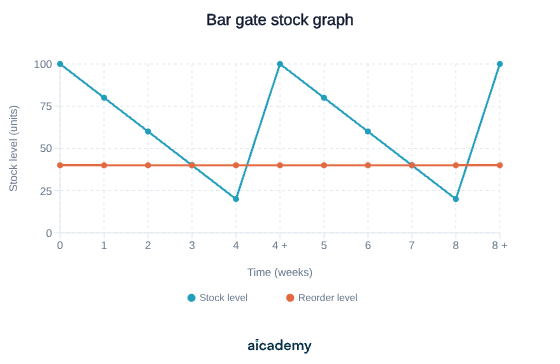
In this example stock is reordered at 40 units (the reorder level) and replenished back to 100 units (the maximum stock level). The drop from week 3 to week 4, and again from week 7 to week 8, is the lead time — stock keeps falling until the delivery arrives.
Key features of the graph:
- Maximum stock level — the highest amount of stock held; set to avoid overstocking and high storage costs
- Reorder level — the stock level at which a new order is triggered; set high enough to cover usage during the lead time
- Reorder quantity — the amount ordered each time; stock jumps back toward the maximum when a delivery arrives
- Lead time — the gap between placing an order and receiving delivery; if lead time increases unexpectedly, stock may run out before the delivery arrives
When stock falls to the reorder level, a new order is placed. Stock continues to fall during the lead time. Once the delivery arrives, stock rises sharply back toward the maximum. The graph creates a repeated "teeth" pattern.
Exam tip: Questions often ask you to mark the reorder level, reorder quantity, or lead time on a graph. Reorder level is the stock level when a new order is placed — not when the delivery arrives.
Something not quite clicking?
Ask Aica to explain any part of this differently. Free, takes 30 seconds.
Key terms
- Bar gate stock graph
- A saw-tooth graph showing stock levels falling as stock is used, triggering a reorder at the reorder level, then jumping back up when a delivery arrives.
- Reorder level
- The stock level at which a new order is placed with the supplier; set high enough to cover usage during the lead time.
- Lead time
- The gap between placing an order with a supplier and the delivery arriving; stock continues to fall during this period.
- Maximum stock level
- The highest amount of stock a business holds, set to avoid overstocking and excess storage costs.
- Just in time (JIT)
- A stock management approach where stock is ordered and delivered exactly when needed for production, so no buffer stock is held.
- Procurement
- The process of sourcing and purchasing the goods and services a business needs to operate, including choosing suppliers.
- Logistics
- The physical movement of goods through the supply chain, from supplier to business and from business to customer.
Frequently asked questions
The reorder level is the stock quantity at which a new order is triggered. Lead time is the gap between placing that order and the delivery arriving. During the lead time, stock keeps falling — so the reorder level must be set high enough to cover usage throughout the lead time.
JIT eliminates storage and warehousing costs and avoids cash being tied up in unsold inventory. The main risk is that any delay from a supplier immediately halts production, since no buffer stock exists to cover disruption. It requires completely reliable suppliers and predictable demand.
The choice depends on the business's priorities. A supplier that is cheaper but less reliable may cost more overall if late deliveries halt production or cause quality failures. The business should calculate both the direct cost saving and the indirect costs of unreliability before deciding.
Generate revision on any topic you study
Type any topic you're studying and Aicademy generates a complete lesson, quiz, and flashcard set, personalised to your level.
Lessons on anything
Structured, level-matched lessons on any topic you study
Practice quizzes
Find out what you actually know before the exam does
Flashcard sets
Lock in key concepts with instant revision cards
Ask Aica
Stuck on something? Get a clear explanation, any time
Business Operations and Production
Quality and Customer Service
Related lessons
8 min
9 min
8 min