Track progress, take quizzes and save notes on this lesson.

Free forever · no card needed

Start free
Foundational

Customer Needs and Market Segmentation

AicademyAicademy
·GCSE Business
1.2.1 Customer needs·1.2.3 Market segmentation·1.2.4 The competitive environment

Aligned to the Pearson Edexcel 1BS0 specification

Level
Foundational
Reading time
11 min
Published
14 June 2026
Updated
1 July 2026
On this page
  1. 1.What Customers Need and Why It Matters
  2. 2.Market Segmentation: Dividing the Market
  3. 3.Market Mapping
  4. 4.Analysing the Competitive Environment
  5. 5.How Competition Shapes Business Decisions
  6. 6.Worked Example: Applying Segmentation to a Business Decision
  7. 7.Exam Technique: Customer Needs and Segmentation

Key takeaways

  • The four core customer needs identified by the Edexcel spec are price, quality, choice, and convenience. Do not substitute other terms such as reliability or safety.
  • Market segmentation divides the total market into groups sharing similar characteristics so a business can target the most relevant customers. The five bases are location, demographics, lifestyle, income, and age.
  • A market map plots competing products on two axes to reveal gaps (unserved areas of the market) and clusters (areas of high competition).
  • Analysing the competitive environment requires assessing rivals across five dimensions: price, quality, location, product range, and customer service.
  • Competition can be both a threat (taking customers) and an opportunity (proving a market exists and pushing the business to improve).

What Customers Need and Why It Matters

Before a business can sell anything, it must understand what its customers actually want. The Edexcel specification identifies four core customer needs:

Customer needWhat it meansExample
PriceCustomers want value for money — either the lowest price, or a price they feel is justified by qualityBudget airlines such as easyJet compete primarily on price; customers accept fewer comforts in exchange for low fares
QualityCustomers expect the product or service to perform reliably and meet their expectationsDyson justifies premium prices through engineering quality; customers return because the product does not disappoint
ChoiceCustomers want enough variety to find something that suits them specificallyAmazon's millions of product listings make it the default starting point for many consumers — breadth of choice is a core draw
ConvenienceCustomers want to access the product or service without difficulty or delayMcDonald's locates branches near high footfall and uses drive-throughs to eliminate queues — removing every friction point

Why identifying customer needs matters:

  • Generating sales: a business that meets its customers' needs sells more. A coffee shop that discovers its customers value speed over ambience should invest in training baristas and streamlining orders rather than interior décor.
  • Business survival: a business that fails to meet customer needs will lose sales to competitors who do. In competitive markets, survival depends on continuously re-checking what customers want.

Key term — customer needs: the requirements and preferences that drive a customer's purchasing decision, typically grouped as price, quality, choice, and convenience.

Market Segmentation: Dividing the Market

Few products appeal equally to everyone. Market segmentation is the process of dividing a total market into distinct groups of customers who share similar characteristics, so a business can target its marketing at the most relevant group.

The Edexcel spec identifies five bases for segmentation:

Segment typeHow it worksExample
LocationDivide customers by where they live or shopA regional newspaper targets readers in one city; a national chain may run localised offers
DemographicsDivide by measurable population characteristics (age, gender, occupation, family size)Pampers targets parents of young children; the demographic is tightly defined by life stage
LifestyleDivide by how people live, their values, and their interestsPatagonia targets environmentally conscious outdoor enthusiasts — the lifestyle, not demographics, defines the segment
IncomeDivide by earning level or purchasing powerAldi and Lidl target price-sensitive consumers; Waitrose and M&S Food target higher-income shoppers willing to pay for quality
AgeDivide specifically by age groupSpotify offers a Student Plan for under-26s; retirement holiday firms target the over-55s

Benefits of segmentation:

  • Marketing spend is focused on customers most likely to buy
  • Products can be adapted for each segment, increasing satisfaction
  • A business can identify where competitors are weak and target those gaps

Market Mapping

Market mapping (also called positioning mapping) is a tool for plotting competing products on a two-axis grid to visualise where they sit in the market. It helps a business find gaps — areas of the market that no competitor currently serves — and see how they compare to rivals.

Worked example — Coffee Market Map:

Imagine a two-axis map for the UK coffee shop market, with axes for Price (Low → High) and Quality (Low → High):

The map below plots brands on two axes: price runs left (low) to right (high), quality runs bottom (low) to top (high).
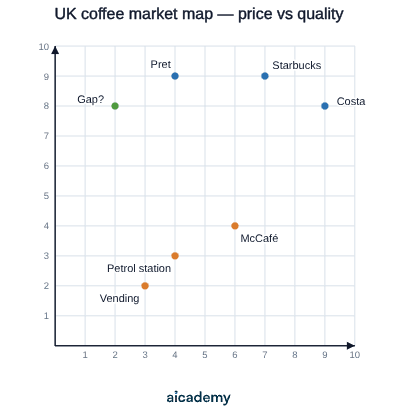
From this map, a new entrant might identify a gap: high quality, low price. No major chain currently occupies that position convincingly. A brand offering barista-made coffee at £2 (vs Starbucks at £4–£5) could fill it.

Market mapping also reveals:

  • Clusters (where multiple competitors fight for the same position — high competition)
  • Gaps (unserved or underserved areas — potential opportunity)
  • Where a business currently sits and whether it should reposition

Key term — market map: a visual tool plotting products or businesses on two axes to show their relative positions and reveal gaps in the market.

Analysing the Competitive Environment

The competitive environment describes the landscape of rivals a business faces. To make informed decisions, businesses must assess competitors' strengths and weaknesses across five dimensions identified in the spec:

DimensionQuestions to askWhy it matters
PriceAre they cheaper or more expensive?Determines whether you can compete on cost or must differentiate
QualityDo customers rate their product higher or lower?Quality perception drives brand loyalty and premium pricing
LocationAre they more conveniently located?Proximity and accessibility affect footfall and online reach
Product rangeDo they offer more or fewer products?A wider range may attract more customers; a narrower range can signal specialism
Customer serviceDo they receive better or worse reviews for service?Poor customer service is a weakness a rival can exploit

Worked example — A new gym opening near PureGym:

A new independent gym assessing PureGym as a competitor might find:

  • Price — PureGym's strength: £20–£25/month with no contract
  • Quality of equipment — moderate; large chains standardise equipment
  • Location — strong; PureGym sites are in city centres
  • Product range — limited; few classes included in base price
  • Customer service — weakness; minimal staffing to keep costs down

The new gym's response: compete on personal service and classes rather than price, targeting customers who want more support than a budget chain provides.

Worth saving these ideas?

Turn what you've read into instant revision cards. Free to get started.

Make flashcards

How Competition Shapes Business Decisions

Awareness of competitors does not just tell a business where it stands — it drives active decision-making. The spec requires you to understand the impact of competition on business decision making.

Pricing decisions: when a competitor cuts prices, a business must decide whether to match the cut (protecting sales volume but squeezing margins), hold its price (betting on quality or loyalty), or compete on a different dimension altogether.

Product development decisions: if a rival launches a new feature or product, a business may need to innovate to stay relevant. Samsung's rapid response to Apple product launches is a textbook example of competitor-driven product decisions.

Marketing decisions: a strong competitor campaign may force a business to increase advertising spend or change messaging to emphasise its own strengths.

Location decisions: a business may choose to locate close to a competitor (clustering — common in fast food) or specifically away from one (differentiation through exclusivity).

Exam tip: for a 6-mark "justify" question about competition, argue both sides. Competition can be a threat (it takes your customers) and an opportunity (it proves there is a market, raises consumer awareness, and pushes you to improve). Conclude by linking to the specific business context.

Worked Example: Applying Segmentation to a Business Decision

Scenario: TuneBox is a new music streaming service entering the UK market in 2025. Spotify and Apple Music dominate. TuneBox is considering three target segments: (A) teenagers aged 13–17, (B) working professionals aged 30–50, (C) retired music fans aged 60+.

Step 1 — Assess each segment:

SegmentSizeSpending powerEase of reachingGap in market?
Teenagers (A)LargeLow (rely on parents)High via social mediaCrowded: Spotify targets this heavily
Professionals (B)LargeHighModerate (podcast/LinkedIn ads)Moderate: both main rivals serve this segment
Retired fans (C)Growing (ageing population)High (disposable income)Lower (less social media)Potential gap: neither rival markets to this group clearly

Step 2 — Select a target segment:

TuneBox chooses segment C. Although it is harder to reach digitally, retired consumers have disposable income, are an underserved group, and often respond well to nostalgia-themed curation (classic rock, jazz, Motown). The competitive gap is real.

Step 3 — Adapt the offering:

TuneBox builds curated playlists by decade, offers a large-print interface, and runs ads on Radio 2. The product is differentiated from Spotify by focusing on this segment's specific needs (familiarity, ease of use).

This example shows segmentation, gap identification, and competitive response working together — exactly the level of analysis Edexcel rewards in 6-mark questions.

Exam Technique: Customer Needs and Segmentation

1. Name the correct four customer needs

The spec lists: price, quality, choice, and convenience. Do not add "reliability" or "safety" as separate needs — if relevant, fold them into quality.

2. Label your segmentation type

When asked how a business segments its market, name the type (location, demographic, lifestyle, income, age). "They target young people" scores less than "they segment by age, targeting 18–25-year-olds who value low price over brand prestige."

3. Draw market maps with labelled axes

If asked to use a market map, label both axes clearly and place at least three named businesses on it. An unlabelled map scores no marks for the mapping element.

4. Distinguish competition as threat vs opportunity in 6-mark questions

Students who only argue that competition is a threat leave marks on the table. Competition proves a market exists, forces businesses to improve, and can drive down prices for consumers. A balanced answer followed by a context-specific conclusion is required for full marks.

5. Link decisions back to the business in the question

Every competitive response decision (price cut, new product, new location) must be linked back to the specific business in the question. Generic statements about "businesses" gain no application marks.

Key terms

Market segmentation
The process of dividing a total market into distinct groups of customers who share similar characteristics, so marketing can be targeted effectively.
Market map
A visual tool that plots products or businesses on two axes to show their relative positions and reveal gaps or clusters in the market.
Competitive environment
The landscape of rival businesses a firm faces, assessed across dimensions such as price, quality, location, product range, and customer service.

Frequently asked questions

The Edexcel spec identifies price, quality, choice, and convenience. Each describes a different reason why a customer selects one product over another. Do not add reliability or safety as separate needs — these fold into quality if relevant.

Market segmentation divides the total market into groups of customers with similar characteristics. Businesses use it to focus marketing spend on customers most likely to buy, adapt products to suit each group, and identify gaps where competitors are weak.

A market map plots competing brands on two axes (e.g. price vs quality). Gaps on the map show positions no existing competitor occupies convincingly, which a new entrant or repositioning business could target.

Generate revision on any topic you study

Type any topic you're studying and Aicademy generates a complete lesson, quiz, and flashcard set, personalised to your level.

Lessons on anything

Structured, level-matched lessons on any topic you study

Practice quizzes

Find out what you actually know before the exam does

Flashcard sets

Lock in key concepts with instant revision cards

Ask Aica

Stuck on something? Get a clear explanation, any time

Prev

Enterprise and Entrepreneurship

Next

Market Research

Related lessons

8 min

Lesson

Enterprise and Entrepreneurship

GCSE Business · Pearson Edexcel 1BS0

1 month ago

9 min

Lesson

Market Research

GCSE Business · Pearson Edexcel 1BS0

1 month ago

Top students don’t revise more. They revise what counts.

Start revising free

Free to start. No card needed.