St Mark's Gospel: The Final Days and Resurrection

Aligned to the AQA 8062 specification
- Topic
- Thematic studies
- Level
- Advanced
- Reading time
- 12 min
- Published
- 14 June 2026
- Updated
- 16 August 2026
On this page
- 1.The Last Supper (14:12–26)
- 2.Gethsemane and the Arrest (14:32–52)
- 3.The Trials: Jewish Authorities and Pilate (14:53, 57–65; 15:1–15)
- 4.The Crucifixion and Burial (15:21–47)
- 5.The Empty Tomb (16:1–8) and Different Explanations
- 6.The Authority of Mark's Gospel: Religious and Secular Sources
- 7.Common Exam Mistakes
Key takeaways
- Mark's account of the Last Supper contains Jesus' words of institution ('This is my body'; 'This is my blood of the covenant') but does NOT include the phrase 'Do this in remembrance of me' -- that phrase appears in Luke and Paul, not Mark.
- At the trial before the high priest, Jesus gives his most unambiguous self-declaration in Mark's Gospel when asked if he is the Messiah: 'I am' -- echoing God's self-identification in Exodus and quoting Daniel 7:13 and Psalm 110:1.
- The Roman centurion at the crucifixion is the first human in Mark's Gospel to clearly confess Jesus' identity ('Surely this man was the Son of God') -- a Gentile soldier, not a disciple, makes this confession.
- Mark's Gospel ends abruptly at 16:8 in the earliest manuscripts -- this is deliberate, not accidental; later scribes added verses 9-20. Do not treat the abrupt ending as an error.
- Atonement theories interpret the significance of Jesus' death differently: substitutionary atonement (Jesus takes humanity's punishment), Christus Victor (Jesus defeats sin and death), moral influence (Jesus' death inspires repentance), and ransom theory (Mark 10:45 -- a ransom for many).
How much of this have you taken in?
Quiz yourself on this section, free, no card needed.
The Empty Tomb (16:1–8) and Different Explanations
The empty tomb (16:1–8): On the first day of the week, three women — Mary Magdalene, Mary the mother of James, and Salome — bring spices to anoint Jesus' body. They wonder who will roll away the stone, but find it already rolled back. Inside the tomb they see a young man dressed in white who tells them: "Don't be alarmed. You are looking for Jesus the Nazarene, who was crucified. He is risen! He is not here. See the place where they laid him. But go, tell his disciples and Peter, he is going ahead of you into Galilee." The women flee "trembling and bewildered" and "said nothing to anyone, because they were afraid."
Mark's Gospel ends here at 16:8 in the earliest manuscripts — an abrupt, open ending.
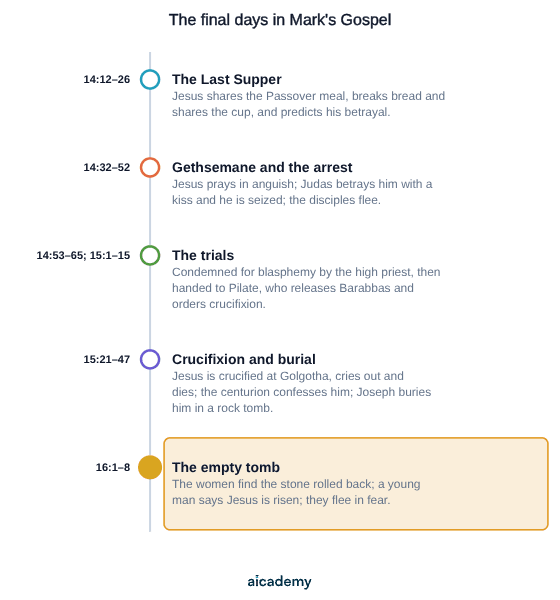
The timeline below sets the final days in order, with the Mark references you should cite. Use it to keep the sequence of events straight when answering questions on the passion narrative.
Different explanations for the empty tomb:
| Explanation | Details |
|---|---|
| Physical resurrection | God raised Jesus bodily from death; the tomb was genuinely empty because he rose. Held by orthodox Christians across traditions. |
| Spiritual resurrection | Jesus was raised in a transformed, spiritual body, not a resuscitated corpse. Paul's teaching in 1 Corinthians 15 speaks of a "spiritual body." |
| Stolen body | Disciples stole the body and fabricated the resurrection. The chief priests spread this account according to Matthew 28:11–15. |
| Wrong tomb | The women went to the wrong tomb in the pre-dawn dark. The young man said "see the place where they laid him" — but they were looking in the wrong place. |
| Hallucination / grief vision | The resurrection appearances were grief-induced visions, not physical events. |
Differing beliefs about the significance of Jesus' death:
| Atonement theory | What it holds |
|---|---|
| Substitutionary atonement | Jesus died in place of sinful humanity, taking the punishment humans deserved; God's justice is satisfied |
| Moral influence theory | Jesus' death demonstrates the depth of God's love, inspiring humans to repent and change |
| Christus Victor | Through death and resurrection, Jesus defeats the powers of sin, death, and the devil |
| Ransom theory | Jesus' life is given as a ransom (10:45) — paying the cost to free humanity from sin's enslaving power |
Key terms
- transubstantiation
- The Roman Catholic teaching that bread and wine literally become the body and blood of Christ at consecration, with substance changing while outward appearance remains.
- consubstantiation
- The Lutheran teaching that Christ is truly present in, with, and under the bread and wine, which remain bread and wine; also called real presence.
- substitutionary atonement
- The belief that Jesus died in place of sinful humanity, taking the punishment humans deserved so that God's justice is satisfied.
- Christus Victor
- The atonement theory that through death and resurrection Jesus defeats the powers of sin, death, and the devil, liberating humanity.
- ransom theory
- The atonement theory drawn from Mark 10:45 that Jesus' life is given as a ransom to free humanity from the enslaving power of sin.
- passion narrative
- The account of Jesus' arrest, trials, crucifixion, and burial; covers Mark chapters 14 and 15.
- Barabbas
- A murderer and insurrectionist whom Pilate released instead of Jesus at the crowd's demand during the Passover custom of releasing one prisoner.
- Gethsemane
- The garden where Jesus prayed in anguish before his arrest, asking 'Abba, Father, take this cup from me. Yet not what I will, but what you will' (14:36).
- blasphemy
- In the Jewish trial, the charge declared by the high priest after Jesus claimed to be the Messiah and Son of God; punishable by death under Jewish law.
- Golgotha
- Aramaic for Place of the Skull; the site outside Jerusalem where Jesus was crucified according to Mark 15:22.
Frequently asked questions
Roman Catholics hold transubstantiation: bread and wine literally become Christ's body and blood. Lutherans hold real presence: Christ is present in, with, and under the elements. Reformed traditions hold spiritual presence: Christ is spiritually present when believers gather. Baptists hold the memorial view: the Supper is an act of remembrance only.
The centurion declares 'Surely this man was the Son of God' (15:39) -- making a Roman Gentile soldier the first human in Mark to clearly confess Jesus' identity. This is significant because throughout Mark demons and God himself recognise Jesus, but his human followers largely fail to understand him until this moment.
Christians holding physical resurrection believe God raised Jesus bodily. Spiritual resurrection holds that Jesus rose in a transformed body. The stolen body theory suggests disciples fabricated the resurrection. The wrong tomb theory suggests the women went to the wrong location. Hallucination or grief vision theories explain appearances as psychological events.
Generate revision on any topic you study
Type any topic you're studying and Aicademy generates a complete lesson, quiz, and flashcard set, personalised to your level.
Lessons on anything
Structured, level-matched lessons on any topic you study
Practice quizzes
Find out what you actually know before the exam does
Flashcard sets
Lock in key concepts with instant revision cards
Ask Aica
Stuck on something? Get a clear explanation, any time
St Mark's Gospel: The Ministry of Jesus
St Mark's Gospel: The Kingdom of God
Related lessons
11 min
12 min
10 min