Track progress, take quizzes and save notes on this lesson.

Free forever · no card needed

Start free
Intermediate

Buddhism: Key Beliefs

3.1.1.1 Key Beliefs

Aligned to the AQA 8062 specification

Level
Intermediate
Reading time
9 min
Published
14 June 2026
Updated
1 July 2026
On this page
  1. 1.The Dhamma and Dependent Arising
  2. 2.The Three Marks of Existence
  3. 3.Human Personality and Destiny — Theravada and Mahayana
  4. 4.The Life of the Buddha
  5. 5.The Four Noble Truths
  6. 6.The Eightfold Path and the Threefold Way
  7. 7.Common Exam Mistakes

Key takeaways

  • The Three Marks of Existence are anicca (impermanence), anatta (no fixed self), and dukkha (unsatisfactoriness) — universal features of all conditioned phenomena according to Buddhist teaching.
  • The Four Noble Truths teach that suffering exists, arises from craving rooted in the Three Poisons (ignorance, greed, hate), can cease, and that the Eightfold Path is the route to that cessation.
  • Theravada Buddhism holds the Arhat ideal (personal liberation through the Five Aggregates framework); Mahayana holds the Bodhisattva ideal (universal liberation) and teaches sunyata (emptiness) and Buddha-nature.
  • Nibbana is not death or annihilation — it is the cessation of craving and conditioned existence. Describing it as going to heaven or as nothingness is a common exam error to avoid.
  • The Eightfold Path is grouped into three divisions: Ethics (sila), Meditation (samadhi), and Wisdom (panna) — mutually supporting factors, not sequential steps.

The Dhamma and Dependent Arising

The Dhamma (Sanskrit: Dharma) is the body of teaching attributed to the Buddha — the truth about the nature of existence and the path to liberation. Buddhists regard the Dhamma as one of the Three Jewels (alongside the Buddha and the Sangha), and taking refuge in it is a foundational act of Buddhist commitment.

Central to the Dhamma is dependent arising (paticcasamupada): the principle that all phenomena arise in dependence on conditions — nothing exists independently or by itself. This 12-link chain describes how ignorance gives rise to mental formations, which give rise to consciousness, and so on, ultimately producing suffering. (Extra context — the 12 links of dependent arising are not required by AQA 8062, but help explain how the chain operates in practice.) When the conditions cease, the phenomenon ceases. This principle underpins the Buddhist understanding that there is no permanent, independent self.

Dependent arising (paticcasamupada): all things arise in dependence on causes and conditions; nothing has independent, permanent existence.

Understanding dependent arising is the foundation for understanding why the Three Marks of Existence are unavoidable features of all conditioned things.

The Three Marks of Existence

The Three Marks of Existence describe the universal characteristics of all conditioned phenomena. Recognising them clearly is essential to Buddhist practice.

MarkPali termMeaning
ImpermanenceaniccaEverything that arises will cease; nothing lasts
No fixed selfanattaThere is no permanent, unchanging self or soul
UnsatisfactorinessdukkhaLife as ordinarily lived is permeated by suffering and dissatisfaction

Anicca applies to all physical and mental phenomena — the body ages, feelings pass, thoughts come and go. Clinging to things as permanent is the root of suffering.

Anatta means the apparent "self" is a constantly changing flow of processes rather than a fixed entity. This distinguishes Buddhism from traditions that posit an eternal soul (atman).

Dukkha has three dimensions: (1) obvious physical and mental pain; (2) the suffering of change — even pleasant experiences end; (3) existential unsatisfactoriness — the pervasive sense that conditioned existence cannot provide ultimate fulfilment.

Exam note: these three terms appear in 1-mark identification questions. Know the Pali spelling and meaning of each.

Human Personality and Destiny — Theravada and Mahayana

The two main Buddhist traditions interpret human nature differently, with consequences for their understanding of the spiritual goal.

Theravada — the Five Aggregates (skandhas)

Theravada teaches that what appears to be a "person" is in fact five constantly changing aggregates (khandhas): (1) form (the physical body), (2) sensation (pleasant, unpleasant or neutral feeling), (3) perception (recognition of objects), (4) mental formations (volitions, emotions, intentions), (5) consciousness (awareness). There is no self beyond these five — only their interaction.

The Theravada ideal is the Arhat ("worthy one" or "perfected person") — someone who has eradicated all defilements through personal effort and will attain final nibbana at death.

Mahayana — sunyata and Buddhahood

Mahayana extends the concept of anatta to sunyata ("emptiness"): not only is the self empty of inherent existence, all phenomena are empty of fixed, independent nature. This opens the possibility of Buddha-nature — the potential for Buddhahood that exists within every sentient being.

The Mahayana ideal is the Bodhisattva — a being who vows to attain Buddhahood not for personal liberation but to save all sentient beings. Mahayana also includes the Pure Land tradition, in which practitioners aspire to rebirth in a heavenly realm (the Pure Land) where conditions are perfect for attaining Buddhahood.

TraditionView of selfSpiritual ideal
TheravadaFive Aggregates; no selfArhat (personal liberation)
MahayanaSunyata; Buddha-natureBodhisattva → Buddhahood

The Life of the Buddha

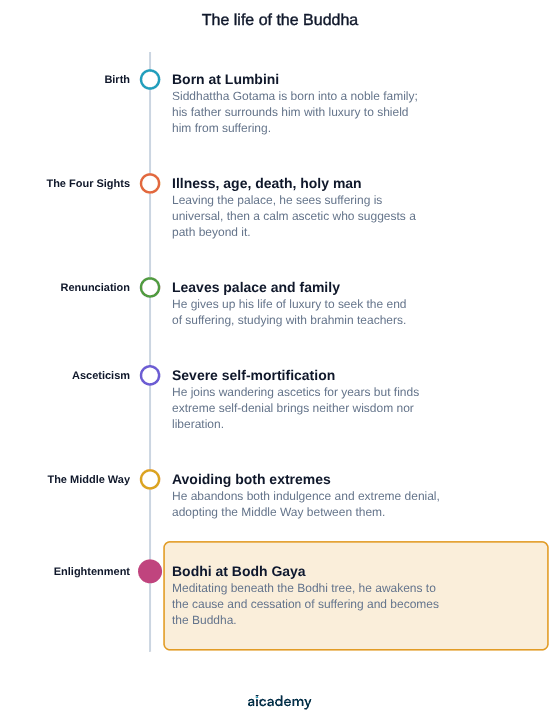
Siddhattha Gotama (Sanskrit: Siddhartha Gautama) was born into a noble family in Lumbini (in present-day Nepal) around the fifth century BCE. His father, wishing to protect him from suffering, surrounded him with luxury, pleasure and beauty.

The Four Sights (Jataka 075) transformed Siddhattha's understanding of life. Leaving the palace grounds, he encountered:

  1. A person suffering from illness
  2. An old man broken by age
  3. A corpse being carried to cremation
  4. A holy man (ascetic) who appeared calm and serene despite having nothing

The first three revealed that suffering is universal and unavoidable. The fourth suggested that a path beyond ordinary suffering existed. Siddhattha left his family and life of luxury to seek it.

He first studied with brahmin teachers, then joined a group of wandering ascetics, practising severe self-mortification for several years. Finding that extreme asceticism neither brought wisdom nor ended suffering, he adopted the Middle Way — avoiding both indulgence and extreme denial.

Sitting beneath a Bodhi tree at Bodh Gaya, Siddhattha entered deep meditation. He attained Enlightenment (Bodhi), understanding the nature of existence, the cause and cessation of suffering, and the path to liberation. He became the Buddha — "the Awakened One".

The timeline below traces this journey from birth to Enlightenment, the sequence a 4- or 6-mark question on the Buddha's life expects you to recount.
Want more lessons like this one?

Generate lessons on anything you study. Free account, no card needed.

Start generating

The Four Noble Truths

The Four Noble Truths form the core of the Buddha's teaching, delivered in the Deer Park at Sarnath (the First Sermon):

1. Dukkha — suffering/unsatisfactoriness

Life involves suffering: birth, aging, illness, death, separation from what we love, not getting what we want, and a deeper existential unsatisfactoriness. The Buddha identified multiple types: physical pain, the suffering of change, and the suffering inherent in conditioned existence.

2. Samudaya — the origin of suffering

Suffering arises from craving (tanha — "thirst") rooted in the Three Poisons:

PoisonDescription
Ignorance (moha)Not seeing reality as it is; the root of all defilements
Greed (lobha)Craving for pleasure, possessions, existence
Hate (dosa)Aversion, anger, ill-will

3. Nirodha — the cessation of suffering

Craving can be brought to an end. The complete cessation of craving is nibbana (Sanskrit: nirvana) — liberation, the end of the cycle of rebirth. Nibbana is sometimes described as the "blowing out" of the three poisons; it is not annihilation but the cessation of conditioned existence. Interpretations vary: some describe it as a transcendent state, others as simply the absence of defilements.

4. Magga — the path

There is a path to the cessation of suffering: the Eightfold Path.

The Eightfold Path and the Threefold Way

The Eightfold Path (magga) is the fourth Noble Truth — the practical route to the end of suffering. Its eight factors are grouped into the Threefold Way:

GroupPali termPath factors
EthicssilaRight Speech, Right Action, Right Livelihood
MeditationsamadhiRight Effort, Right Mindfulness, Right Concentration
WisdompannaRight Understanding, Right Intention

These are not sequential steps but mutually supporting factors: ethical conduct supports meditation; meditation cultivates wisdom; wisdom deepens ethics.

"He who has gone for refuge to the Buddha, the Dhamma and the Sangha, sees with right wisdom the four noble truths — suffering, the arising of suffering, the overcoming of suffering, and the noble eightfold path leading to the ending of suffering." — Dhammapada 190–191

The Eightfold Path is the Buddha's Middle Way in practice — neither indulgence nor extreme asceticism. Theravada emphasises following the path individually to reach the Arhat ideal; Mahayana situates it within the Bodhisattva's commitment to universal liberation.

Common Exam Mistakes

1. Confusing Theravada and Mahayana terms

Sunyata belongs to Mahayana, not Theravada. The Five Aggregates (skandhas) are the Theravada analysis of personality. The Bodhisattva ideal is Mahayana; the Arhat ideal is Theravada. Mixed-up attributions lose marks on 4- and 6-mark questions.

2. Misidentifying the Three Poisons

The Three Poisons are ignorance, greed and hate — not "sin, temptation and pride". Ignorance (moha) is listed first because it is the root from which greed and hate arise.

3. Treating nibbana as death or nothingness

Nibbana is not annihilation. It is the cessation of craving and conditioned existence. Describing it as "death" or "going to heaven" is unlikely to earn credit on a 6-mark question, which expects engagement with the Buddhist concept of liberation.

4. Forgetting the Dhammapada citation

The spec requires Dhammapada 190–191. A 6-mark or 12-mark question on the Four Noble Truths or the Eightfold Path expects at least one textual reference. Know this passage.

5. Misspelling key Pali terms

Common errors: anicca (not "annica"), anatta (not "anata"), paticcasamupada (not "paticasamupada"). On 1-mark questions, spelling must be close enough to be unambiguous.

Key terms

Dhamma
The body of teaching attributed to the Buddha — the truth about existence and the path to liberation; one of the Three Jewels of Buddhism.
Paticcasamupada
Dependent arising: the principle that all phenomena arise in dependence on conditions and cease when those conditions cease; nothing has independent existence.
Anicca
Impermanence: the teaching that everything that arises will eventually cease; one of the Three Marks of Existence.
Anatta
No fixed self: the teaching that there is no permanent, unchanging self or soul; the apparent self is a constantly changing flow of processes.
Dukkha
Unsatisfactoriness or suffering: includes obvious pain, the suffering of change, and the existential sense that conditioned existence cannot provide ultimate fulfilment.
Nibbana
Liberation — the cessation of craving and the end of the cycle of rebirth; not annihilation, but the blowing out of the three poisons. Called nirvana in Sanskrit.
Sunyata
Emptiness: a Mahayana teaching that not only the self but all phenomena are empty of fixed, independent nature.
Skandhas
The Five Aggregates in Theravada Buddhism: form, sensation, perception, mental formations, and consciousness — the components mistaken for a self.
Bodhisattva
The Mahayana ideal: a being who vows to attain Buddhahood not for personal liberation but to save all sentient beings from suffering.
Arhat
The Theravada spiritual ideal: a perfected person who has eradicated all defilements through personal effort and will attain final nibbana at death.
Tanha
Craving or thirst: the origin of suffering according to the Second Noble Truth; rooted in the three poisons of ignorance, greed, and hate.
Magga
The Eightfold Path: the Fourth Noble Truth and the Buddhist route to the cessation of suffering, grouped into ethics (sila), meditation (samadhi), and wisdom (panna).

Frequently asked questions

The Three Marks are anicca (impermanence — everything that arises will cease), anatta (no fixed self — the apparent self is a changing flow of processes), and dukkha (unsatisfactoriness — conditioned existence cannot provide ultimate fulfilment).

The Arhat ideal belongs to Theravada Buddhism: the individual attains personal liberation through their own effort. The Bodhisattva ideal is Mahayana: the practitioner vows to attain Buddhahood in order to liberate all sentient beings, not for personal gain alone.

Leaving the palace, Siddhattha encountered illness, old age, and a corpse — showing suffering is universal — then a calm holy man, suggesting a path beyond suffering existed. This prompted him to renounce his life of luxury and seek enlightenment.

Generate revision on any topic you study

Type any topic you're studying and Aicademy generates a complete lesson, quiz, and flashcard set, personalised to your level.

Lessons on anything

Structured, level-matched lessons on any topic you study

Practice quizzes

Find out what you actually know before the exam does

Flashcard sets

Lock in key concepts with instant revision cards

Ask Aica

Stuck on something? Get a clear explanation, any time

Next

Buddhism: Worship, Ethics and Festivals

Related lessons

Top students don’t revise more. They revise what counts.

Start revising free

Free to start. No card needed.