Stopping Distances and Braking

Aligned to the AQA 8463 specification
- Topic
- Forces
- Level
- Intermediate
- Reading time
- 8 min
- Published
- 2 July 2026
- Updated
- 16 August 2026
On this page
Key takeaways
- Stopping distance = thinking distance + braking distance. Thinking distance is how far the vehicle travels during the driver's reaction time; braking distance is how far it travels once the brakes are applied.
- A typical reaction time is 0.2 to 0.9 s. It is increased by tiredness, alcohol, drugs and distractions such as using a phone, all of which lengthen the thinking distance.
- Braking distance is increased by wet or icy roads, worn tyres and worn brakes. These reduce the friction available, so the vehicle travels further before stopping.
- When the brakes are applied, work done by friction reduces the car's kinetic energy and raises the temperature of the brakes.
- Braking distance increases sharply with speed: to stop in a given distance a faster car needs a greater braking force, giving a greater deceleration and a risk of overheating brakes or skidding.
Something not quite clicking?
Ask Aica to explain any part of this differently. Free, takes 30 seconds.
Energy: Where the Kinetic Energy Goes
Braking is an energy transfer. When the brakes are applied, the work done by friction reduces the kinetic energy of the vehicle and raises the temperature of the brakes. The kinetic energy of the moving car is transferred to thermal energy in the brakes, pads and surrounding air.
The work done by the braking force equals the kinetic energy removed:
Because kinetic energy depends on the square of the speed, doubling the speed gives four times the kinetic energy. To remove four times the energy over the same braking force, you need roughly four times the braking distance. This is why braking distance rises so steeply with speed while thinking distance only rises in proportion.
(Separate Physics only) You should be able to estimate how the stopping distance for a vehicle varies with different speeds and interpret speed–stopping-distance graphs. The graph of braking distance against speed curves upward because braking distance grows with speed squared.
The steep, curved rise of braking distance against speed is the shape examiners expect on a speed–stopping-distance graph:
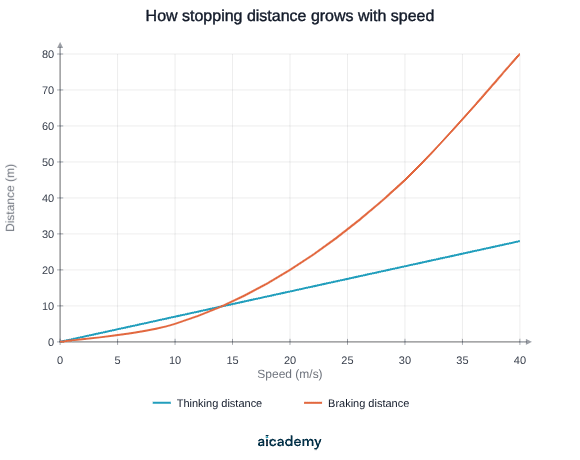
Thinking distance rises as a straight line (proportional to speed); braking distance curves upward (proportional to speed squared).
Key terms
- Stopping distance
- The total distance a vehicle travels from when the driver first sees a hazard to when the vehicle stops; the sum of thinking distance and braking distance.
- Thinking distance
- The distance a vehicle travels during the driver's reaction time, before the brakes are applied.
- Braking distance
- The distance a vehicle travels under the braking force after the brakes are applied, until it stops.
- Reaction time
- The time between a driver seeing a hazard and starting to act, typically 0.2 to 0.9 s.
Frequently asked questions
Thinking distance is how far the vehicle travels while the driver reacts, before touching the brakes. Braking distance is how far it travels after the brakes are applied, while it is decelerating. Adding them gives the total stopping distance.
Kinetic energy depends on speed squared, so doubling the speed gives four times the kinetic energy the brakes must remove. With the same braking force this needs about four times the braking distance.
Reaction time, typically 0.2 to 0.9 s, is increased by tiredness, alcohol, drugs and distractions such as using a phone or the radio. A longer reaction time means a longer thinking distance.
Generate revision on any topic you study
Type any topic you're studying and Aicademy generates a complete lesson, quiz, and flashcard set, personalised to your level.
Lessons on anything
Structured, level-matched lessons on any topic you study
Practice quizzes
Find out what you actually know before the exam does
Flashcard sets
Lock in key concepts with instant revision cards
Ask Aica
Stuck on something? Get a clear explanation, any time
Newton's Laws of Motion
Momentum
Related lessons
6 min
5 min
7 min