Track progress, take quizzes and save notes on this lesson.

Free forever · no card needed

Start free
Advanced

Lenses

4.6.2.5 Lenses

Aligned to the AQA 8463 specification

Topic
Waves
Level
Advanced
Reading time
6 min
Published
2 July 2026
On this page
  1. 1.How a Lens Forms an Image
  2. 2.Principal Focus and Focal Length
  3. 3.Ray Diagram for a Convex Lens
  4. 4.Real Images, Virtual Images and the Magnifying Glass
  5. 5.Calculating Magnification
  6. 6.Common Exam Mistakes

Key takeaways

  • (Separate Physics only) A lens forms an image by refracting light; a convex (converging) lens brings parallel rays together at the principal focus, and a concave (diverging) lens spreads them out.
  • (Separate Physics only) The focal length is the distance from the lens to the principal focus; a more powerful lens has a shorter focal length.
  • (Separate Physics only) A convex lens can form a real image (rays actually meet, can be projected) or a virtual image; a concave lens always forms a virtual image.
  • (Separate Physics only) Magnification = image height ÷ object height; it is a ratio with no units, and the two heights must be in the same unit.
  • (Separate Physics only) Ray diagrams are drawn using standard rays: one parallel to the axis that refracts through the principal focus, and one straight through the centre of the lens.

How a Lens Forms an Image

(Separate Physics only) This whole topic is assessed only in the separate GCSE Physics course, not in Combined Science.

A lens is a shaped piece of transparent material that forms an image by refracting (bending) light. There are two types, defined by their shape and by what they do to parallel rays of light.

A convex lens is thicker in the middle than at the edges. It is also called a converging lens because it brings parallel rays of light together to a point.

A concave lens is thinner in the middle than at the edges. It is also called a diverging lens because it spreads parallel rays of light apart.

Lens typeShapeEffect on parallel raysStandard symbol
Convex (converging)Thicker in the middleRays converge to a pointAn upright line with an arrowhead at each end pointing outward
Concave (diverging)Thinner in the middleRays diverge apartAn upright line with an arrowhead at each end pointing inward

Every image in this topic is produced by the refraction of light as it passes into and out of the lens.

Principal Focus and Focal Length

(Separate Physics only)

When rays travelling parallel to the principal axis (the horizontal line through the centre of the lens) pass through a convex lens, they are refracted so that they all meet at a single point on the axis. This point is the principal focus (or focal point).

For a concave lens, the parallel rays are spread apart. If you trace the diverging rays straight backwards, they appear to come from a single point on the axis in front of the lens. That point is the principal focus of a concave lens.

Focal length is the distance from the centre of the lens to the principal focus.

A lens has a principal focus on both sides, the same distance from the lens, because light can enter from either direction.

The more strongly a lens bends light, the closer to the lens the rays meet, so a more powerful lens has a shorter focal length. A fat convex lens has a short focal length; a thin one has a long focal length.

The focal length is fixed by the lens itself. It does not depend on where you put the object.

Ray Diagram for a Convex Lens

(Separate Physics only)

To find where a convex lens forms an image, draw two rays from the top of the object and see where they cross. Two standard rays are enough:

  1. A ray from the top of the object travelling parallel to the axis, which refracts through the principal focus on the far side.
  2. A ray from the top of the object passing straight through the centre of the lens without bending.

Where these two rays cross is the top of the image. For an object placed beyond twice the focal length, the rays cross on the far side, forming a real, inverted, smaller image, which is how a camera works.
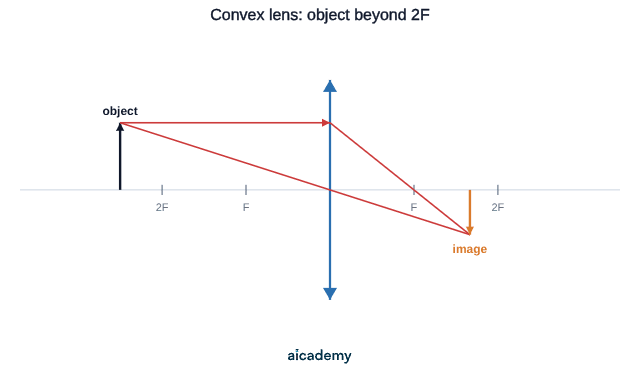
The image here is real because the two rays actually meet: you could place a screen there and see the image projected. It is upside down (inverted) compared with the object. Moving the object closer to the lens moves the image and changes its size.

Draw the ray from the tip of the object, mark the two principal foci at equal distances, and use a ruler. The image top sits where the rays cross.

Real Images, Virtual Images and the Magnifying Glass

(Separate Physics only)

Whether an image is real or virtual depends on the lens and, for a convex lens, on where the object is.

A real image forms where light rays actually meet. It can be projected onto a screen and is always inverted. A virtual image forms where rays only appear to come from; the rays never really meet, so it cannot be projected and is always upright.

  • A convex lens forms a real image when the object is beyond the principal focus. When the object is closer than the focal length, the lens acts as a magnifying glass and forms a virtual, upright, enlarged image on the same side as the object.
  • A concave lens always forms a virtual, upright, smaller image, whatever the object distance.
LensObject positionImage type
ConvexBeyond principal focusReal, inverted
ConvexCloser than principal focusVirtual, upright, enlarged (magnifying glass)
ConcaveAny positionVirtual, upright, smaller

For a virtual image on a ray diagram, the refracted rays are traced backwards as dashed lines to the point they seem to come from.

Worth saving these ideas?

Turn what you've read into instant revision cards. Free to get started.

Make flashcards

Calculating Magnification

(Separate Physics only)

Magnification tells you how much larger or smaller the image is than the object.

This equation is given on the Physics equation sheet. Magnification is a ratio, so it has no units. The image height and object height must both be in the same unit (both in mm, or both in cm).

A magnification greater than 1 means the image is larger than the object; less than 1 means it is smaller.

Worked example 1. An object is 5 mm tall. A convex lens forms an image 15 mm tall. Find the magnification.

The image is 3 times the height of the object.

Worked example 2. An object 8 cm tall gives an image 2 cm tall through a concave lens. Find the magnification, and find the image height for a different 6 cm object at the same magnification.

The magnification is 0.25, so the image is a quarter the size (the image is smaller, as expected for a concave lens). Rearranging, image height = magnification × object height:

Common Exam Mistakes

1. Confusing convex and concave

A convex lens is thicker in the middle and converges light; a concave lens is thinner in the middle and diverges light. Link the shape to the effect so the two do not get swapped.

2. Giving magnification a unit

Magnification is image height divided by object height, so the units cancel and it has no units. Writing "×3 cm" or "3 m" is wrong; the answer is just a number.

3. Mixing the two heights' units

Both heights must be in the same unit before dividing. If the object is in cm and the image is in mm, convert one first, or the ratio is meaningless.

4. Saying a concave lens can form a real image

A concave (diverging) lens always forms a virtual, upright, diminished image. Only a convex lens can form a real image, and only when the object is beyond the principal focus.

5. Forgetting to trace virtual-image rays backwards

For a virtual image, the refracted rays diverge and never meet in front of the lens. Extend them backwards as dashed lines to find where the image appears; do not look for a crossing point on the far side.

Key terms

Principal focus
The point on the axis where rays parallel to the axis converge (convex lens) or appear to diverge from (concave lens) after passing through the lens.
Focal length
The distance from the centre of the lens to the principal focus.
Real image
An image formed where light rays actually meet, which can be projected onto a screen and is inverted.
Virtual image
An image formed where rays only appear to come from; it cannot be projected onto a screen and is upright.
Magnification
The ratio image height ÷ object height, describing how much larger or smaller the image is than the object.

Frequently asked questions

A convex (converging) lens is thicker in the middle and brings parallel rays of light together at the principal focus. A concave (diverging) lens is thinner in the middle and spreads parallel rays apart so they appear to come from the principal focus.

Magnification = image height ÷ object height. It is a ratio, so it has no units, and both heights must be measured in the same unit. A magnification greater than 1 means the image is larger than the object; less than 1 means it is smaller.

A real image forms where light rays actually meet, so it can be projected onto a screen and is inverted. A virtual image forms where rays only appear to come from; it cannot be projected and is the right way up. A concave lens always gives a virtual image.

Generate revision on any topic you study

Type any topic you're studying and Aicademy generates a complete lesson, quiz, and flashcard set, personalised to your level.

Lessons on anything

Structured, level-matched lessons on any topic you study

Practice quizzes

Find out what you actually know before the exam does

Flashcard sets

Lock in key concepts with instant revision cards

Ask Aica

Stuck on something? Get a clear explanation, any time

Prev

Uses of Electromagnetic Waves

Next

Visible Light and Colour

Related lessons

7 min

7 min

Lesson

Visible Light and Colour

AQA GCSE Physics · AQA 8463

19 days ago

Top students don’t revise more. They revise what counts.

Start revising free

Free to start. No card needed.