The Outbreak of War: Sarajevo and the July Crisis

Aligned to the AQA 8145 specification
- Level
- Intermediate
- Reading time
- 7 min
- Published
- 6 July 2026
- Updated
- 16 August 2026
On this page
Key takeaways
- Archduke Franz Ferdinand, heir to Austria-Hungary, was assassinated in Sarajevo on 28 June 1914 by Gavrilo Princip, a Bosnian Serb linked to the Black Hand.
- Germany gave Austria-Hungary a 'blank cheque' of unconditional support on 5-6 July 1914, encouraging it to crush Serbia.
- Austria's harsh ultimatum (23 July) and its declaration of war on Serbia (28 July 1914) set off a chain reaction through the alliance system.
- Inflexible mobilisation timetables, especially Russia's and Germany's, turned a Balkan quarrel into a general war within days.
- Germany declared war on Russia (1 August) and France (3 August), invaded neutral Belgium on 4 August, and Britain declared war on Germany the same day.
The July Crisis Step by Step
The five weeks between the assassination and the outbreak of war are known as the July Crisis. Once the mobilisations began, events moved faster than the leaders could control.
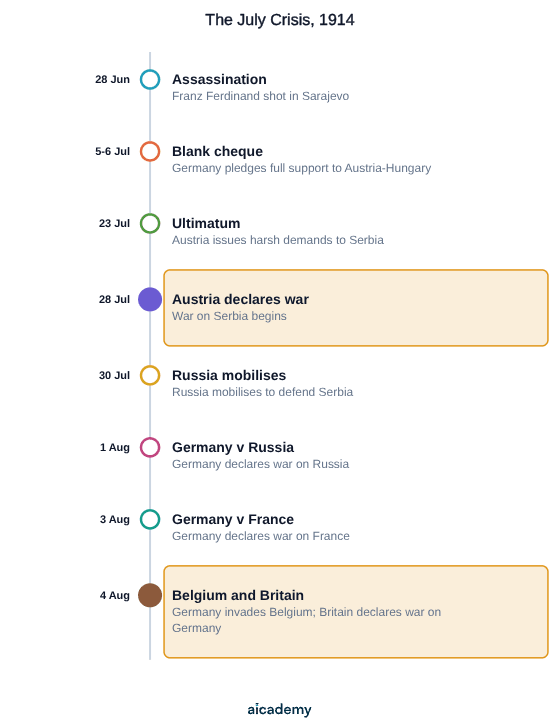
Austria's ultimatum of 23 July was deliberately harsh, designed to be rejected. Serbia accepted nearly all of it, but Austria declared war anyway on 28 July 1914.
How much of this have you taken in?
Quiz yourself on this section, free, no card needed.
Key terms
- Assassination
- The murder of an important political figure, often for a political motive.
- Ultimatum
- A final set of demands issued to another country, with the threat of war or other action if they are refused.
- The Black Hand
- A secret Serbian nationalist group that trained and armed the assassins of Franz Ferdinand.
- Blank cheque
- Germany's promise of unconditional support to Austria-Hungary in July 1914, whatever action it took against Serbia.
- Mobilisation
- The process of calling up and organising a country's armed forces ready for war.
- Slav nationalism
- The desire of Slav peoples in the Balkans, such as the Serbs, to unite and be free of Austro-Hungarian rule.
Frequently asked questions
The assassination on 28 June 1914 was the trigger, not the whole cause. Austria-Hungary used it as an excuse to punish Serbia, and the alliance system, the 'blank cheque' from Germany, and rigid mobilisation plans then dragged the great powers into a general war.
The July Crisis was the five weeks between the assassination on 28 June and Britain's declaration of war on 4 August 1914. During it, Austria's ultimatum to Serbia, a series of mobilisations, and the alliance chain escalated a local dispute into a European war.
The 'blank cheque' was Germany's promise on 5-6 July 1914 to support Austria-Hungary whatever it decided to do about Serbia. This unconditional backing made Austria confident enough to risk war and is seen as a key escalation step.
Generate revision on any topic you study
Type any topic you're studying and Aicademy generates a complete lesson, quiz, and flashcard set, personalised to your level.
Lessons on anything
Structured, level-matched lessons on any topic you study
Practice quizzes
Find out what you actually know before the exam does
Flashcard sets
Lock in key concepts with instant revision cards
Ask Aica
Stuck on something? Get a clear explanation, any time
The Causes of WWI: Alliances and Rivalry
The Schlieffen Plan and the Race to Stalemate
Related lessons
7 min
6 min
6 min