Track progress, take quizzes and save notes on this lesson.

Free forever · no card needed

Start free
Intermediate

The End of WWI: 1918 and Germany's Defeat

WW Conflict and tension: WWI 1894–1918

Aligned to the AQA 8145 specification

Level
Intermediate
Reading time
8 min
Published
6 July 2026
On this page
  1. 1.Why 1918 Was the Decisive Year
  2. 2.Russia Leaves, America Joins
  3. 3.The Ludendorff Spring Offensive, 1918
  4. 4.The Hundred Days: Breaking the German Army
  5. 5.Germany Surrenders: Blockade, Abdication, Armistice
  6. 6.Haig and Foch: The Allied Commanders
  7. 7.Common Exam Mistakes

Why 1918 Was the Decisive Year

For three years the Western Front had been locked in stalemate. In 1918 the deadlock finally broke — and Germany, which began the year with real hopes of victory, ended it defeated.

Two huge changes to the Allied forces set the year up: Russia left the war, freeing German troops, while the USA joined, promising the Allies fresh strength. Everything else in 1918 flows from this shift in the balance of manpower and resources.

The exam story of 1918 is a race against time. Germany had to win before American troops arrived in overwhelming numbers. When its last gamble failed, defeat followed quickly.

This lesson covers the changes in the Allied forces, the military developments of 1918, and how Germany was finally forced to surrender — the three angles the AQA specification names for Part 3.

Russia Leaves, America Joins

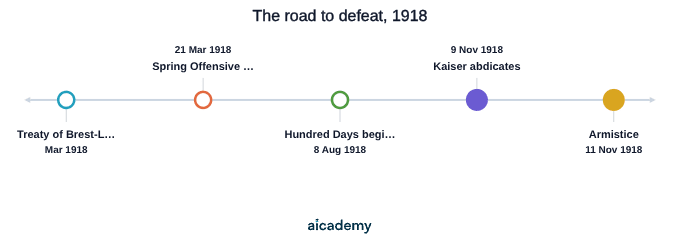
Russia's withdrawal. In 1917 the Bolshevik Revolution brought Lenin to power in Russia, and the new government wanted out of the war. In the Treaty of Brest-Litovsk (March 1918), Russia made peace with Germany on harsh terms.

  • Consequence for Germany: the Eastern Front closed, so Germany could move around a million troops west. For a short window, Germany had more soldiers on the Western Front than the Allies.

America's entry. The USA declared war on Germany in April 1917. Its reasons included Germany's unrestricted submarine warfare (sinking US ships) and the Zimmermann Telegram, in which Germany secretly urged Mexico to attack the USA.

  • Consequence for the Allies: the USA brought vast fresh manpower, industry and money. American troops (the "doughboys") arrived slowly at first but in ever-growing numbers through 1918.
ChangeDateEffect on the war
Russia's withdrawal (Brest-Litovsk)March 1918German troops freed to move to the Western Front
US entryApril 1917Fresh Allied troops, resources and money on the way

This is why 1918 became a race: Germany's numerical advantage was temporary, so it had to strike before the Americans arrived in force.

The Ludendorff Spring Offensive, 1918

Facing this closing window, General Erich Ludendorff launched Germany's last great gamble: the Spring Offensive (Operation Michael and later attacks), beginning on 21 March 1918.

Reasons. Ludendorff wanted to smash the Allied lines and win the war before the US Army was ready. He used his newly freed eastern troops for one massive push.

New tactics. The Germans used stormtroopers: elite, lightly equipped soldiers who infiltrated in small groups to bypass strongpoints, supported by short, intense hurricane bombardments.

Events. At first it worked spectacularly. The Germans broke through and advanced up to 60 km — the largest gains on the Western Front since 1914.

Why it failed.

Reason for failureExplanation
Overstretched supply linesAdvancing troops outran their food, ammunition and artillery
Exhaustion and lossesGermany's best stormtroopers were killed in huge numbers and could not be replaced
No strategic knockoutThe advance took ground but did not capture a vital objective or destroy the Allied armies
Allied unityThe Allies appointed Marshal Ferdinand Foch as overall commander to coordinate the response

By July 1918 the offensive had stalled. Germany had used up its last reserves for a gain it could not hold.

The Hundred Days: Breaking the German Army

With the German offensive spent, the Allies counter-attacked in the Hundred Days Offensive, from 8 August to 11 November 1918.

Reasons and conditions. The German army was now exhausted, short of supplies and demoralised, while the Allies were reinforced by growing numbers of fresh American troops.

New tactics and technology. The Allies used combined arms: tanks, aircraft, artillery firing accurate creeping barrages, and coordinated infantry all working together. The opening blow at Amiens (8 August 1918) was called "the black day of the German Army" by Ludendorff himself.

Events. The Allies drove the Germans back across France and Belgium, breaking through the Hindenburg Line — Germany's strongest defences — by late September 1918.

The Hundred Days shows how the stalemate was finally broken: not by one wonder-weapon, but by wider circumstances (an exhausted enemy, American reinforcements) combined with better tactics and technology used together.

For an essay on why the war ended, the Hundred Days is the military engine of victory — but it worked because Germany had already been weakened by blockade and the failed Spring Offensive.

Studying this for an exam?

Generate a personalised learning path for this subject. Free to get started.

Create a learning path

Germany Surrenders: Blockade, Abdication, Armistice

Germany's collapse in autumn 1918 came from the home front as well as the battlefield.

The blockade. The British naval blockade had cut off food and raw materials for years. The winter of 1916–17 was so severe it became known as the "turnip winter", when Germans survived largely on turnips, and by 1918 shortages, hunger and low morale had shattered both civilian and military will to fight.

Revolution and abdication. In late 1918 sailors of the German navy mutinied at Kiel rather than sail on a final suicide mission, and revolution spread across Germany. With the country collapsing, Kaiser Wilhelm II abdicated on 9 November 1918 and fled to the Netherlands.

Armistice. A new German government signed the armistice, and the fighting stopped at 11 a.m. on 11 November 1918.

Here is how the final year fits together:
Haig and Foch: The Allied Commanders

The AQA specification asks about the roles of Field Marshal Sir Douglas Haig (British Commander) and Marshal Ferdinand Foch (Allied Supreme Commander) in Germany's defeat.

CommanderContribution
FochAs Allied Supreme Commander from spring 1918, he coordinated British, French and American forces into a single, unified counter-attack during the Hundred Days
HaigCommanded the British armies through the war-winning battles of the Hundred Days, breaking the Hindenburg Line in 1918

Their reputations are debated interpretations. Some historians praise Haig and Foch for delivering victory in 1918; others blame Haig for the huge casualties of the Somme and Passchendaele. A strong answer weighs both views rather than simply praising or condemning.

Common Exam Mistakes

1. Saying only one factor won the war

Germany's defeat was a combination: US entry, the failed Spring Offensive, the Hundred Days and the blockade all mattered. A top essay weighs several factors and reaches a judgement.

2. Confusing the two 1918 offensives

The Spring Offensive (March 1918) was the German attack; the Hundred Days (August–November 1918) was the Allied counter-attack. Keep them clearly apart.

3. Getting the November dates wrong

The Kaiser abdicated on 9 November 1918; the armistice took effect on 11 November 1918. Do not merge these two dates.

4. Thinking Germany was invaded

Germany surrendered while its army was still on French and Belgian soil. This fed the later "stab in the back" myth that the army was betrayed at home rather than beaten in the field. Note this as context, not as fact.

5. Treating Haig and Foch as settled heroes or villains

Their contribution is a matter of historical interpretation. Present the debate and judge it, rather than asserting one side as obvious truth.

Generate revision on any topic you study

Type any topic you're studying and Aicademy generates a complete lesson, quiz, and flashcard set, personalised to your level.

Lessons on anything

Structured, level-matched lessons on any topic you study

Practice quizzes

Find out what you actually know before the exam does

Flashcard sets

Lock in key concepts with instant revision cards

Ask Aica

Stuck on something? Get a clear explanation, any time

Prev

The Wider War: Gallipoli and the War at Sea

Next

Origins of the Cold War: Yalta and Potsdam

Related lessons

Top students don’t revise more. They revise what counts.

Start revising free

Free to start. No card needed.