Tectonic Hazards: Plate Tectonics and Processes

Aligned to the AQA 8035 specification
- Level
- Intermediate
- Reading time
- 13 min
- Published
- 10 June 2026
- Updated
- 25 August 2026
On this page
Key takeaways
- Plates move because of convection currents in the mantle, driven by heat from radioactive decay: hot material rises and drags the plates, then cools and sinks, moving plates at 2-5 cm per year.
- Oceanic crust subducts because it is denser than continental crust, not because it is heavier: always use the term density in exam answers.
- At constructive margins plates diverge and new crust is created, giving gentle eruptions and shallow earthquakes; at destructive margins plates converge and crust is destroyed, giving explosive eruptions and quakes.
- Conservative margins produce earthquakes only and no volcanoes, because there is no subduction, so no melting and no magma.
- Earthquakes and volcanoes cluster at plate margins: the Pacific Ring of Fire alone has about 75% of the world's volcanoes and about 90% of earthquakes.
Global Distribution of Tectonic Hazards
Earthquakes and volcanoes are not randomly distributed — they cluster in predictable zones that correspond to plate margins.
The "Ring of Fire": A horseshoe-shaped belt encircling the Pacific Ocean. It accounts for roughly 75% of the world's volcanoes and approximately 90% of the world's earthquakes. The Pacific Plate is subducting beneath surrounding plates along much of this margin.
The Alpine-Himalayan belt: Running from southern Europe through Turkey, Iran, Pakistan, and into Southeast Asia. This is a zone of ongoing continental collision between the African, Eurasian, and Indian plates — responsible for earthquakes in Turkey, Iran, Pakistan, and Nepal.
Mid-ocean ridges: Largely underwater constructive margins running through every ocean. Iceland is a rare example of a mid-ocean ridge rising above sea level, making it regularly volcanically active.
The map below shows how earthquakes and volcanoes trace plate margins: the Pacific Ring of Fire, the Alpine-Himalayan collision belt, and the Mid-Atlantic Ridge.
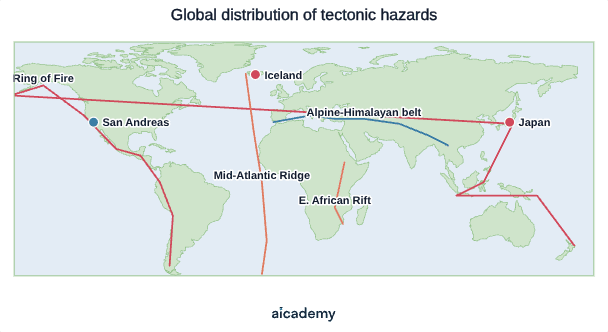
In a map question, describe distribution using compass directions and specific locations, not just country names: "Earthquakes cluster in a belt running from western North America, around the Pacific Ocean to East Asia and into Southeast Asia." Vague answers ("they are found in many places") are unlikely to score marks.
Studying this for an exam?
Generate a personalised learning path for this subject. Free to get started.
Destructive Plate Margins
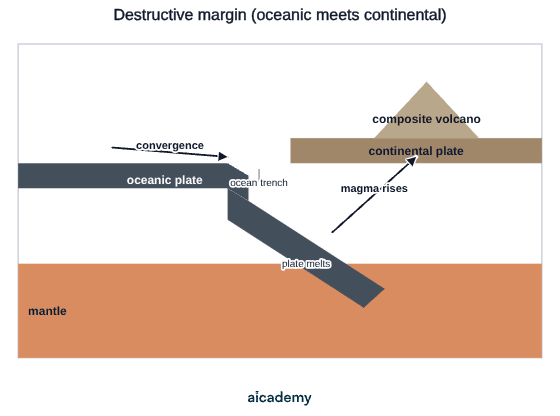
At a destructive margin, two plates converge — move toward each other. When oceanic crust meets continental crust, the denser oceanic plate is forced down beneath the lighter continental plate in a process called subduction.
Process:
- Oceanic plate descends at the subduction zone, forming a deep ocean trench
- Heat and pressure melt the descending plate, forming magma
- Magma is less dense than surrounding rock → rises through the crust
- Erupts at the surface as a composite volcano (also called a stratovolcano) — steep-sided, built from alternating layers of lava and ash
The cross-section below shows subduction at a destructive margin: the dense oceanic plate descending beneath the continental plate, the ocean trench, and magma rising to feed a composite volcano.
Hazards produced:
- Explosive volcanic eruptions: high silica content makes magma viscous, trapping gases; pressure builds and eruptions can be catastrophic
- Earthquakes: generated at all depths as the plate descends; include some of the world's most powerful earthquakes
Landforms: ocean trenches, fold mountains, composite volcanoes, island arcs
Examples:
- Nazca Plate subducting beneath South America → the Andes mountain chain, Chilean volcanoes, devastating earthquakes in Chile, Peru, and Ecuador
- Pacific Plate subducting beneath Japan → the Japanese archipelago itself is a chain of volcanic islands; Japan experiences ~1,500 earthquakes per year
Where two oceanic plates converge, one subducts beneath the other, creating chains of volcanic islands called island arcs — Japan, the Philippines, and the Caribbean islands formed this way.
Key terms
- Lithosphere
- The rigid outer shell of the Earth made of the crust and uppermost mantle, fractured into about 15 major tectonic plates and several smaller ones.
- Convection currents
- Circulation in the mantle driven by heat from radioactive decay, where hot material rises and drags the plates before cooling and sinking; the mechanism that moves plates.
- Plate margin
- A boundary where tectonic plates interact, where the vast majority of earthquakes and volcanic eruptions occur.
- Subduction
- The process at a destructive margin where the denser oceanic plate is forced down beneath the lighter continental plate.
- Constructive margin
- A boundary where two plates diverge, creating new oceanic crust, with effusive eruptions and shallow earthquakes.
- Destructive margin
- A boundary where two plates converge and crust is destroyed by subduction, producing explosive composite volcanoes and powerful earthquakes.
- Conservative margin
- A boundary where two plates slide past each other horizontally, producing powerful shallow earthquakes but no volcanic activity.
- Composite volcano
- A steep-sided volcano (stratovolcano) built from alternating layers of lava and ash at a destructive margin.
- Ring of Fire
- A horseshoe-shaped belt around the Pacific Ocean accounting for roughly 75% of the world's volcanoes and about 90% of earthquakes.
- Island arc
- A chain of volcanic islands formed where two oceanic plates converge and one subducts beneath the other, such as Japan and the Philippines.
Frequently asked questions
Oceanic crust sinks because it is more dense than continental crust, not because it is heavier. Oceanic crust is thin, dense basalt while continental crust is thicker, less dense granite, so at a destructive margin the denser oceanic plate is forced down beneath the continental plate in a process called subduction.
Conservative margins have no volcanoes because the two plates simply slide past each other horizontally, with no subduction. With no subduction there is no melting, so no magma is formed. Conservative margins produce earthquakes only, which are often very powerful and shallow.
At a constructive margin plates move apart and new crust is created, giving mild eruptions and shallow, low-to-moderate earthquakes. At a destructive margin plates move together and old crust is destroyed by subduction, giving explosive eruptions from composite volcanoes and some very powerful earthquakes.
Generate revision on any topic you study
Type any topic you're studying and Aicademy generates a complete lesson, quiz, and flashcard set, personalised to your level.
Lessons on anything
Structured, level-matched lessons on any topic you study
Practice quizzes
Find out what you actually know before the exam does
Flashcard sets
Lock in key concepts with instant revision cards
Ask Aica
Stuck on something? Get a clear explanation, any time
Natural Hazards: Definition, Types and Risk
Tectonic Hazards: Effects, Responses and Management
Related lessons
8 min
10 min