Addition and Condensation Polymers

Aligned to the AQA 8462 specification
- Topic
- Organic chemistry
- Level
- Intermediate
- Reading time
- 7 min
- Published
- 2 July 2026
- Updated
- 16 August 2026
On this page
Key takeaways
- In addition polymerisation, many small alkene monomers with a C=C double bond join to form one long polymer, and no other molecule is produced; poly(ethene) is made from ethene.
- The repeating unit of an addition polymer has the same atoms as the monomer, with the double bond opened to a single bond and a bond extending from each carbon on both sides.
- (Higher Tier) In condensation polymerisation, monomers with two functional groups join and a small molecule such as water is lost each time; ethanediol and hexanedioic acid make a polyester.
- (Higher Tier) Amino acids have two different functional groups and join by condensation to form polypeptides; glycine is H₂NCH₂COOH and different amino acids in a chain make proteins.
- DNA is made of two polymer chains of monomers called nucleotides twisted into a double helix; other natural polymers are proteins (from amino acids), and starch and cellulose (from sugars).
How much of this have you taken in?
Quiz yourself on this section, free, no card needed.
DNA and Other Natural Polymers
Not all polymers are man-made. Several polymers essential for life occur naturally, and you must be able to name the monomers they are built from.
DNA (deoxyribonucleic acid) is a large molecule that carries the genetic instructions for the development and functioning of living organisms. Most DNA molecules are two polymer chains made from four different monomers called nucleotides, and the two chains are wound around each other in the shape of a double helix.
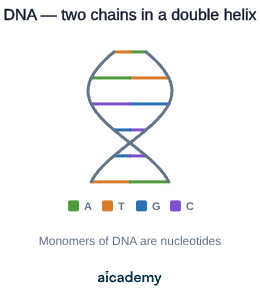
The other naturally occurring polymers you must know, with their monomers:
| Natural polymer | Monomers |
|---|---|
| DNA | Nucleotides |
| Proteins | Amino acids |
| Starch | Sugars |
| Cellulose | Sugars |
Both starch and cellulose are built from sugar monomers. Proteins, as covered above, are built from amino acids.
Key terms
- Monomer
- A small molecule that joins with many others of the same or different kind to form a polymer.
- Polymer
- A very large molecule made of many small monomer units joined together in a long chain.
- Addition polymerisation
- A reaction in which many alkene monomers with a C=C bond join to form a single polymer, with no other molecule produced.
- Repeating unit
- The section of a polymer that repeats; for an addition polymer it has the same atoms as the monomer with the double bond opened.
- Condensation polymerisation
- A reaction in which monomers with two functional groups join and lose a small molecule, such as water, each time (Higher Tier).
- Nucleotide
- The monomer unit from which the polymer DNA is built; DNA has four different nucleotides.
Frequently asked questions
Addition polymerisation joins alkene monomers with a C=C double bond into one polymer with no other product. Condensation polymerisation (Higher Tier) joins monomers that each have two functional groups and loses a small molecule, such as water, every time two monomers link.
Take the monomer, change the C=C double bond into a single C–C bond, and draw a bond leaving each of those two carbons on the left and right. Put the repeating unit in brackets with the letter n outside to show it repeats many times.
DNA is made from monomers called nucleotides. Proteins are made from amino acids. Starch and cellulose are both made from sugars. Naming these monomers is a Separate Chemistry requirement.
Generate revision on any topic you study
Type any topic you're studying and Aicademy generates a complete lesson, quiz, and flashcard set, personalised to your level.
Lessons on anything
Structured, level-matched lessons on any topic you study
Practice quizzes
Find out what you actually know before the exam does
Flashcard sets
Lock in key concepts with instant revision cards
Ask Aica
Stuck on something? Get a clear explanation, any time
Carboxylic Acids
Purity and Formulations
Related lessons
6 min
6 min
6 min
9 min