Track progress, take quizzes and save notes on this lesson.

Free forever · no card needed

Start free
Intermediate

Life Cycle Assessment and Recycling

4.10.2.1 Life cycle assessment·4.10.2.2 Ways of reducing the use of resources

Aligned to the AQA 8462 specification

Level
Intermediate
Reading time
7 min
Published
2 July 2026
On this page
  1. 1.What a Life Cycle Assessment Measures
  2. 2.The Four Stages as a Sequence
  3. 3.Why an LCA Is Not Fully Objective
  4. 4.Reduce, Reuse, Recycle
  5. 5.Recycling Metals and Glass
  6. 6.Comparing Plastic and Paper Shopping Bags
  7. 7.Common Exam Mistakes

Key takeaways

  • A life cycle assessment (LCA) works out the environmental impact of a product across four stages: extracting and processing raw materials, manufacturing and packaging, use and operation, and disposal.
  • Some impacts, such as water use, resource use and energy use, can be measured fairly easily, but giving a value to pollution requires value judgements, so an LCA is not fully objective.
  • Selective or abbreviated LCAs can be misused to support a chosen conclusion, for example in advertising, so LCAs should be checked carefully.
  • Reducing, reusing and recycling materials cuts the use of limited raw materials, energy, waste and environmental impacts.
  • Metals are recycled by melting and recasting; glass bottles can be reused, or crushed and melted to make new glass products.

What a Life Cycle Assessment Measures

A life cycle assessment (LCA) works out the total environmental impact of a product over its whole life, not just when it is being made or used. It follows the product from the raw materials that go into it all the way to how it is thrown away.

An LCA is carried out in four stages. Transport and distribution add impact throughout all of them.

StageWhat is assessed
1. Extracting and processing raw materialsMining, quarrying and refining the materials the product is made from
2. Manufacturing and packagingEnergy and materials used to make and package the product
3. Use and operationImpact while the product is used over its lifetime
4. DisposalWhat happens at the end of life: landfill, incineration or recycling

Looking at the whole life stops us from being misled by a single stage. A product that seems clean in use might have caused heavy pollution when its raw materials were extracted.

An LCA covers the full life: raw materials → manufacture and packaging → use → disposal. Transport counts at every stage.

The Four Stages as a Sequence

The four stages flow one into the next, and this order is what an LCA follows. The diagram below shows the life of a product from the raw materials extracted from the Earth to its disposal at the end of use.
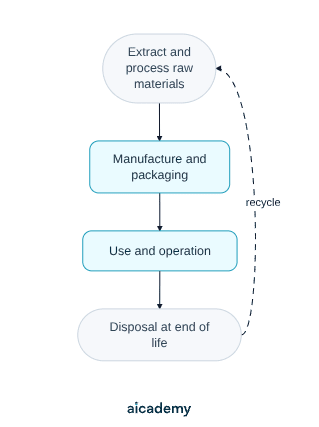
At each stage the LCA records things like the water used, the resources used, the energy used and the wastes produced. The dashed arrow shows recycling: instead of ending in disposal, materials can re-enter the cycle as raw materials for a new product, which cuts the impact of the first stage.

Recycling short-circuits the life cycle: recovered material re-enters as a raw material, so less new material has to be extracted.

Why an LCA Is Not Fully Objective

You might expect an LCA to give a single scientific "score", but it cannot, and the exam tests why.

Some impacts can be measured fairly easily because they are quantities:

  • the mass of raw materials and resources used
  • the volume of water used
  • the amount of energy used
  • the mass of some wastes produced

Other impacts are much harder. Allocating a value to the effect of pollutants is not straightforward: how do you compare air pollution against water pollution, or against using up a resource? This requires value judgements (decisions based on opinion), so an LCA is not a purely objective process.

Numbers like energy and water use are measurable. Putting a value on pollution needs a judgement, so two honest LCAs of the same product can reach different conclusions.

This subjectivity has a consequence. Selective or abbreviated LCAs that only include certain stages or certain impacts can be produced to support a conclusion that was chosen in advance, for example in advertising where a company wants its product to look green. Always check what an LCA has included and left out.

Reduce, Reuse, Recycle

Metals, glass, building materials, clay ceramics and most plastics are made from limited raw materials. Getting those materials by quarrying and mining causes environmental problems, and processing them uses energy. Three actions cut this impact.

ActionMeaningBenefit
ReduceUse less material in the first placeLess raw material extracted, less waste produced
ReuseUse the product again without reprocessing itNo energy needed to remake it
RecycleProcess the used material to make new productsSaves raw materials and usually saves energy

Reducing, reusing and recycling all cut the use of limited resources, the amount of energy used, the amount of waste and the environmental impact of extracting and processing new materials.

Reuse beats recycle where it is possible: reusing a bottle skips the energy of melting it down, so it saves even more than recycling.

How much of this have you taken in?

Quiz yourself on this section, free, no card needed.

Test myself

Recycling Metals and Glass

Different materials are recycled in different ways, and how much separation is needed depends on the material and on the properties the new product must have.

Glass can often be reused: glass bottles can be collected, washed and refilled. Glass can also be recycled by crushing it and melting it, then shaping the molten glass into new products.

Metals are recycled by melting them and then recasting or reforming them into new shapes. The amount of sorting needed depends on the metal and its use:

  • Some uses need the metal separated carefully by type to keep it pure.
  • Other uses tolerate mixtures. For example, scrap steel can be added to iron from a blast furnace when making new steel, because a small amount of mixed metal does not spoil the product.
MaterialReuse?Recycling method
GlassYes: wash and refill bottlesCrush and melt to make new glass products
MetalsSometimesMelt and recast or reform into new items

Recycling metals saves the energy and environmental damage of extracting new metal from its ore, and it conserves the finite ore supply.

Comparing Plastic and Paper Shopping Bags

The specification expects you to carry out a simple comparative LCA for shopping bags made from plastic and from paper. The comparison shows why there is no single "greener" answer.

StagePlastic bagPaper bag
Raw materialsMade from crude oil, a finite resourceMade from trees, which can be replanted (renewable)
ManufactureUses less energy and water to produceUses more energy and water to produce
UseStrong, waterproof, can be reused several timesWeaker, tears when wet, fewer reuses
DisposalTakes a very long time to break down; can harm wildlifeBreaks down more quickly; biodegradable

Neither bag wins on every stage. A paper bag looks better on raw materials and disposal, but worse on the energy and water used to make it. A plastic bag is cheaper to make and can be reused many times, but persists in the environment for a long time. Which is "better" depends on which impacts you weigh most heavily, which is exactly the value judgement that makes LCAs subjective.

Reusing whichever bag you already have, as many times as possible, usually reduces the overall impact more than switching material.

Common Exam Mistakes

1. Missing a stage of the LCA

All four stages score: raw materials, manufacture and packaging, use, and disposal. Answers that jump straight from making to throwing away miss marks for the use and raw-material stages.

2. Calling an LCA fully objective

Water, energy and resource use are measurable, but valuing pollution needs a value judgement, so an LCA is not purely objective. State this clearly when asked why LCAs can disagree.

3. Forgetting that LCAs can be misused

Selective or abbreviated LCAs can be written to reach a chosen conclusion, such as in advertising. Mention this when a question asks why you should be cautious about a company's LCA.

4. Confusing reuse and recycle

Reuse means using the item again as it is; recycle means reprocessing the material into something new. A refilled glass bottle is reused; a melted-down bottle is recycled.

5. Declaring one shopping bag simply "better"

For plastic versus paper, each is better at some stages and worse at others. A full-mark answer weighs both across the stages rather than picking a winner without reasons.

Key terms

Life cycle assessment (LCA)
An assessment of the environmental impact of a product across its whole life, from raw materials to disposal.
Value judgement
A decision that depends on opinion rather than measurement, such as how much weight to give a type of pollution in an LCA.
Reuse
Using a product again for the same or a different purpose without reprocessing it, such as refilling a glass bottle.
Recycle
Processing a used material, such as melting scrap metal or glass, to make new products.

Frequently asked questions

The four stages are: extracting and processing raw materials; manufacturing and packaging; use and operation during the product's lifetime; and disposal at the end of life. Transport and distribution are included throughout.

Because giving a numerical value to pollutant effects requires value judgements, unlike water, energy and resource use which can be measured. Selective LCAs can also be produced to support a chosen conclusion, such as in advertising.

It depends on the stage you weigh most. Paper uses more energy and water to make and produces more waste in manufacture, but plastic is made from crude oil and takes far longer to break down. An LCA compares both across all four stages.

Generate revision on any topic you study

Type any topic you're studying and Aicademy generates a complete lesson, quiz, and flashcard set, personalised to your level.

Lessons on anything

Structured, level-matched lessons on any topic you study

Practice quizzes

Find out what you actually know before the exam does

Flashcard sets

Lock in key concepts with instant revision cards

Ask Aica

Stuck on something? Get a clear explanation, any time

Prev

Alternative Methods of Extracting Metals

Next

Energy Stores and Systems

Related lessons

Top students don’t revise more. They revise what counts.

Start revising free

Free to start. No card needed.