Giant Covalent Structures, Metals and Alloys

Aligned to the AQA 8462 specification
- Level
- Intermediate
- Reading time
- 12 min
- Published
- 2 July 2026
- Updated
- 16 August 2026
On this page
Key takeaways
- Giant covalent structures have very high melting points because every atom is joined by strong covalent bonds and melting means breaking those bonds; examples are diamond, silicon dioxide and graphite.
- Metals are giant structures held together by strong metallic bonding, so they have high melting and boiling points.
- Pure metals are made of layers of atoms that can slide over each other, so they are soft and easily shaped; alloys are harder because the different-sized atoms distort the layers and stop them sliding.
- Metals are good conductors of electricity because delocalised electrons are free to move through the structure and carry charge.
- Metals are good conductors of thermal energy because delocalised electrons transfer energy through the structure.
Metals Are Giant Structures
A metal is also a giant structure, but it is held together by metallic bonding rather than covalent bonds. The outer-shell electrons of the metal atoms become delocalised, meaning they are no longer attached to any one atom and are free to move throughout the whole structure. This leaves the atoms as positive ions arranged in a regular pattern, surrounded by a "sea" of delocalised electrons.
The metallic bond is the strong electrostatic attraction between the positive ions and the sea of delocalised electrons. Because this attraction acts throughout the giant structure, metals have high melting and boiling points: a large amount of energy is needed to overcome the metallic bonding and separate the ions.
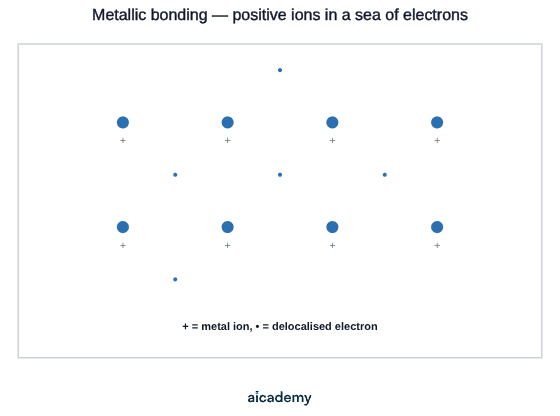
The positive ions and the shared electrons stay locked in this arrangement, which is why a metal is a strong, dense solid at room temperature.
Why Pure Metals Are Soft and Can Be Shaped
The atoms in a pure metal are all the same size and are arranged in layers. Because the layers are made of identical atoms, they can slide over one another when a force is applied, without the metallic bonding breaking apart. This is why pure metals are relatively soft and can be bent, hammered and drawn into shapes.
This property is called being malleable (can be hammered into shape) and ductile (can be pulled into wires). Both come from the same cause: layers of atoms sliding past each other.
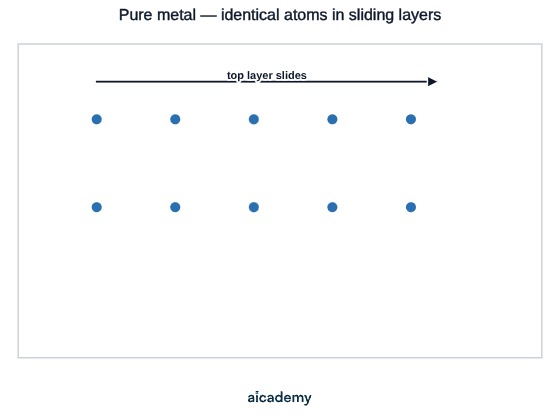
Pure metals are often too soft for a job that needs strength or hardness, such as a bridge girder or a knife blade. To make them harder, they are turned into alloys.
The regular layers are what make a pure metal easy to shape, and, as the next slide shows, disrupting those layers is exactly how an alloy is made harder.
Want more lessons like this one?
Generate lessons on anything you study. Free account, no card needed.
Why Alloys Are Harder Than Pure Metals
An alloy is a mixture of a metal with one or more other elements. Alloys are harder than the pure metal they are based on, and the reason is exactly what examiners want stated in full.
The added atoms are usually a different size from the original metal atoms. When they sit in the structure they distort the layers, so the layers can no longer slide over each other easily. Because sliding is what let the pure metal deform, disrupting it makes the alloy harder and more rigid.
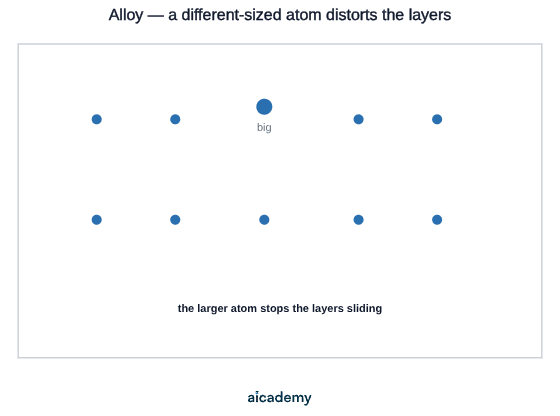
A full mark-scheme answer to "explain why alloys are harder than pure metals" contains two linked ideas:
- The alloy contains atoms of different sizes.
- These distort the layers so they cannot slide over each other as easily.
State both and the marks follow.
Key terms
- Giant covalent structure
- A structure in which a very large number of atoms are joined by strong covalent bonds in a continuous network, with no small separate molecules.
- Metallic bonding
- The strong attraction between positive metal ions and a sea of shared delocalised electrons that holds a metal's giant structure together.
- Delocalised electron
- An outer-shell electron that is not held to one atom and is free to move throughout the whole metallic structure.
- Alloy
- A mixture of a metal with one or more other elements, usually harder than the pure metal because different-sized atoms distort the layers.
Frequently asked questions
Because every atom is joined to its neighbours by strong covalent bonds, forming one huge network. Melting or boiling means breaking a very large number of these strong bonds, which needs a great deal of energy, so the melting point is very high.
In a pure metal the atoms are the same size and sit in layers that slide over each other easily. An alloy mixes in atoms of a different size, which distort the layers so they can no longer slide easily, making the alloy harder.
Metals have delocalised (free) electrons that can move through the whole structure. These electrons carry electrical charge, so metals conduct electricity, and they also transfer thermal energy, so metals conduct heat well.
Generate revision on any topic you study
Type any topic you're studying and Aicademy generates a complete lesson, quiz, and flashcard set, personalised to your level.
Lessons on anything
Structured, level-matched lessons on any topic you study
Practice quizzes
Find out what you actually know before the exam does
Flashcard sets
Lock in key concepts with instant revision cards
Ask Aica
Stuck on something? Get a clear explanation, any time
Properties of Ionic and Molecular Substances
Allotropes of Carbon: Diamond, Graphite, Graphene and Fullerenes
Related lessons
8 min
6 min
8 min
Allotropes of Carbon: Diamond, Graphite, Graphene and Fullerenes
AQA GCSE Chemistry · AQA 8462
4 months ago
9 min