Track progress, take quizzes and save notes on this lesson.

Free forever · no card needed

Start free
Advanced

Explanations for Nicotine and Gambling Addiction

4.3.10 Addiction

Aligned to the AQA 7182 specification

Level
Advanced
Reading time
9 min
Published
1 July 2026
On this page
  1. 1.Nicotine Neurochemistry: The Role of Dopamine
  2. 2.Learning Theory: Cue Reactivity in Nicotine Addiction
  3. 3.Gambling: Partial and Variable Reinforcement
  4. 4.Gambling: Cognitive Theory and Cognitive Bias
  5. 5.Evaluating the Explanations (AO3)
  6. 6.Common Exam Mistakes

Key takeaways

  • Nicotine stimulates dopamine release in the brain's mesolimbic reward pathway, positively reinforcing smoking; tolerance and withdrawal then add negative reinforcement as the smoker smokes to relieve withdrawal.
  • Cue reactivity is classical conditioning: stimuli repeatedly paired with smoking become conditioned cues that later trigger cravings and physiological arousal, prompting relapse.
  • Gambling is reinforced on a partial, variable-ratio schedule, so wins are unpredictable; this makes the behaviour highly persistent and very resistant to extinction.
  • The cognitive explanation of gambling focuses on cognitive biases such as the gambler's fallacy, the illusion of control and the near-miss effect, which sustain gambling despite losses.
  • The gambler's fallacy is the belief that a win is 'due' after losses; the illusion of control is the belief that skill or ritual can influence a chance outcome. They are distinct biases.

Nicotine Neurochemistry: The Role of Dopamine

Nicotine is absorbed through the lungs and reaches the brain within seconds. There it binds to nicotinic acetylcholine receptors and stimulates the release of dopamine in the brain's mesolimbic reward pathway, a circuit that runs from the ventral tegmental area to the nucleus accumbens.

Dopamine in this pathway produces feelings of pleasure and reward. Because smoking causes that reward, it is positively reinforced: the behaviour is repeated because it is followed by a pleasant consequence. This is the core of the nicotine-regulation model of addiction.

The effect does not stay constant. With repeated use the brain down-regulates, reducing its own dopamine activity and receptor sensitivity to compensate for the constant nicotine. This adaptation produces two things:

ConsequenceWhat it means
ToleranceMore nicotine is needed to get the same reward, because the brain has adapted
WithdrawalWithout nicotine, dopamine activity drops below normal, causing unpleasant symptoms

Once withdrawal exists, a second learning process kicks in. The smoker now smokes to relieve the unpleasant withdrawal state, which is negative reinforcement (removing something aversive). So nicotine addiction is maintained by positive reinforcement (the reward) and negative reinforcement (escaping withdrawal).

Nicotine addiction is driven by dopamine in the mesolimbic reward pathway: the initial reward positively reinforces smoking, while tolerance and withdrawal add negative reinforcement.

Learning Theory: Cue Reactivity in Nicotine Addiction

The learning explanation of nicotine addiction adds classical conditioning to the reward story. A smoker does not smoke in a vacuum. Cigarettes are repeatedly paired with particular stimuli: the sight and smell of the packet, a morning coffee, a specific place, a stressful mood, or the end of a meal.

Through repeated pairing, these neutral stimuli become conditioned cues. Later, exposure to a cue on its own triggers cravings and physiological arousal even when no cigarette is present. This learned reaction is called cue reactivity, and it is a major reason people relapse: an ex-smoker who has quit for weeks can be tipped back into smoking simply by walking into a bar or smelling smoke.

Operant conditioning works alongside this. Every cigarette delivers reward (dopamine) and relief from withdrawal, so the behaviour is reinforced each time it is performed.
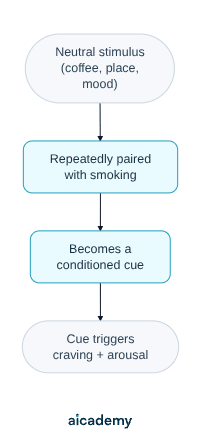
Cue reactivity is classically conditioned: cues paired with smoking come to trigger cravings by themselves. This is why cue-exposure treatments try to break the learned association.

Gambling: Partial and Variable Reinforcement

The learning explanation of gambling starts with operant conditioning: a win is a reward that positively reinforces gambling. But the key insight is how often the reward arrives.

Gambling does not pay out every time. Wins come on a partial reinforcement schedule (only some responses are rewarded), and specifically a variable-ratio schedule (the number of bets between wins is unpredictable). This combination is critical.

Behaviour learned under variable-ratio reinforcement is the most persistent and the most resistant to extinction of any schedule. Because the gambler can never predict when the next win is coming, a long run of losses does not signal that reward has stopped, so they keep going.

Reinforcement scheduleWhen reward arrivesEffect on behaviour
ContinuousAfter every responseLearned fast, but extinguishes fast
Fixed ratioAfter a set number of responsesPersistent, but a pause after each reward
Variable ratioAfter an unpredictable numberVery high, steady rate; very hard to extinguish

Near misses also reinforce gambling. Two cherries and a blank on a fruit machine feels like almost winning, which sustains play even though a near miss pays nothing. Cues such as flashing lights and sounds add further conditioned reinforcement.

Gambling is reinforced on a variable-ratio schedule, so wins are unpredictable. This is the specific reason gambling is so persistent and so resistant to extinction.

Gambling: Cognitive Theory and Cognitive Bias

The cognitive explanation argues that gamblers hold irrational beliefs and cognitive distortions that sustain gambling despite losing overall. These biases distort how the gambler processes information about wins, losses and probability.

The main distortions you should be able to name and distinguish:

Cognitive biasThe irrational belief
Gambler's fallacyA win is "due" after a run of losses, as if chance events had a memory
Illusion of controlPersonal skill, choices or rituals can influence a purely chance outcome
Near-miss effectA near miss is treated as almost a win, encouraging continued play
Recall biasWins are remembered vividly while losses are forgotten or minimised

Griffiths (1994) investigated this with a "thinking aloud" method: regular and occasional fruit-machine gamblers verbalised their thoughts while playing. Regular gamblers made far more irrational verbalisations (for example, treating the machine as if it had intentions) than occasional gamblers, supporting the idea that distorted cognition characterises problem gambling.

A key exam distinction: the gambler's fallacy is about chance outcomes being "due"; the illusion of control is about the gambler's own influence over a random event. They are separate biases and should never be merged.

Want more lessons like this one?

Generate lessons on anything you study. Free account, no card needed.

Start generating

Evaluating the Explanations (AO3)

A strong exam answer does not just describe these explanations; it weighs them. Below are developed evaluation points, each stating a strength or limitation and then explaining why it matters.

Nicotine neurochemistry has strong research support. The role of the dopamine reward pathway is well evidenced, and drugs act as the model predicts: agonists and antagonists that alter dopamine or nicotinic receptors change craving in the expected direction. This gives the explanation a solid biological basis. However, it is reductionist: by explaining addiction purely at the level of neurochemistry, it downplays social and cognitive factors and cannot easily explain why, given very similar biology, some people become addicted and others exposed to nicotine do not.

Cue reactivity is well supported and treatment-useful. Studies show cues reliably trigger cravings and predict relapse, and this understanding underpins cue-exposure therapy. The limitation is shared with learning theory generally: it struggles to explain individual differences, because most people exposed to the same smoking cues never become addicted, so conditioning alone is not the whole story.

The variable-reinforcement account elegantly explains persistence in gambling, capturing why gamblers continue through heavy losses better than a simple "they enjoy winning" account. But on its own it is incomplete: it does not capture the cognitive side, the distorted thinking that the gambler is actively engaged in, so it needs the cognitive explanation to complete the picture.

Cognitive theory has research support and clinical value. Griffiths' fruit-machine study and similar work show problem gamblers produce more distortions, and this underpins CBT for gambling, which targets those beliefs. A weakness is that much of the evidence is correlational: showing that gamblers hold more biases does not prove the biases cause the gambling rather than developing as a result of it.

Best-answer move: pair each explanation with its counterpart. Note that nicotine and gambling are both partly explained by learning, but each needs an additional level, neurochemistry for nicotine and cognition for gambling, to be complete.

Common Exam Mistakes

1. Describing nicotine's reward as only positive reinforcement

Nicotine is maintained by both kinds of operant reinforcement. The dopamine reward is positive reinforcement, but once tolerance and withdrawal develop, smoking to relieve withdrawal is negative reinforcement. Answers that mention only the reward miss half the explanation.

2. Confusing cue reactivity with the reward pathway

Cue reactivity is classical conditioning: a learned cue triggers a craving. The dopamine reward pathway is the neurochemical basis of the reward itself. They are different explanations at different levels. Do not describe cues as "releasing dopamine directly" as if they were the same mechanism.

3. Misdescribing the gambling reinforcement schedule

Gambling is reinforced on a partial, variable-ratio schedule, not a continuous or fixed one. This specific schedule is the reason gambling is so persistent and resistant to extinction. Vaguely writing "gambling is rewarding" without naming the variable-ratio schedule loses the analytical mark.

4. Treating the gambler's fallacy and the illusion of control as the same thing

These are two distinct cognitive biases. The gambler's fallacy is believing a chance outcome is "due" based on past results. The illusion of control is believing your own skill or ritual can influence a random event. Using them interchangeably shows the biases are not properly understood.

5. Name-dropping Griffiths without the finding

If you cite Griffiths' "thinking aloud" study, state the result: regular gamblers produced far more irrational verbalisations than occasional gamblers. A named study with no findings adds little evaluative weight.

Key terms

Dopamine reward system
The mesolimbic pathway (including the nucleus accumbens) where dopamine release produces feelings of pleasure and reward, reinforcing the behaviour that caused it.
Cue reactivity
The cravings and physiological arousal produced when an addict is exposed to stimuli previously associated with their addictive behaviour.
Partial reinforcement
A schedule in which a behaviour is reinforced only some of the time rather than on every occasion, producing behaviour that is highly resistant to extinction.
Variable reinforcement
Reinforcement delivered after an unpredictable number of responses (a variable-ratio schedule), so the reward cannot be anticipated.
Cognitive bias
A systematic error in thinking, such as an irrational belief or distortion, that influences judgements and decisions.
Gambler's fallacy
The mistaken belief that a particular outcome in a chance event is more likely because of previous outcomes, e.g. that a win is 'due' after a run of losses.

Frequently asked questions

Nicotine triggers dopamine release that produces pleasure, positively reinforcing smoking. With repeated use the brain down-regulates, causing tolerance and withdrawal, so the smoker then smokes to relieve withdrawal, which is negative reinforcement.

Gambling pays out on a variable-ratio schedule, so wins are unpredictable and come only some of the time. Behaviour reinforced this way is very persistent and resistant to extinction, so gamblers keep playing through long losing runs.

The gambler's fallacy is believing a chance outcome is 'due' after a run of the opposite result. The illusion of control is believing your own skill, choices or rituals can influence a random outcome. They are two separate cognitive biases.

Generate revision on any topic you study

Type any topic you're studying and Aicademy generates a complete lesson, quiz, and flashcard set, personalised to your level.

Lessons on anything

Structured, level-matched lessons on any topic you study

Practice quizzes

Find out what you actually know before the exam does

Flashcard sets

Lock in key concepts with instant revision cards

Ask Aica

Stuck on something? Get a clear explanation, any time

Prev

Describing Addiction and Risk Factors

Next

Reducing Addiction

Related lessons

10 min

Lesson

Reducing Addiction

A-Level Psychology · AQA 7182

20 days ago

Top students don’t revise more. They revise what counts.

Start revising free

Free to start. No card needed.