Track progress, take quizzes and save notes on this lesson.

Free forever · no card needed

Start free
Intermediate

Asch's Research and Variables Affecting Conformity

4.1.1 Social influence

Aligned to the AQA 7182 specification

Level
Intermediate
Reading time
9 min
Published
1 July 2026
On this page
  1. 1.What Asch Set Out to Study
  2. 2.The Baseline Procedure
  3. 3.The Baseline Findings
  4. 4.Variable 1: Group Size
  5. 5.Variable 2: Unanimity
  6. 6.Variable 3: Task Difficulty
  7. 7.Evaluation (AO3)
  8. 8.Common Exam Mistakes

Key takeaways

  • In Asch's baseline study the mean conformity rate on the critical trials was 36.8%; 75% of participants conformed at least once and 25% never conformed.
  • A control group with no confederates made errors on under 1% of trials, showing the line task itself was unambiguous and the errors were caused by group pressure.
  • Conformity rose with group size but levelled off: about 31.8% with three confederates, with little further increase beyond that.
  • When one confederate dissented, breaking unanimity, conformity fell to roughly a quarter of its baseline level, whether the dissenter was right or wrong.
  • Making the task harder and more ambiguous increased conformity, which points to informational social influence operating when people are unsure.

What Asch Set Out to Study

Conformity is a change in a person's behaviour or opinions as a result of real or imagined group pressure. Solomon Asch wanted to know whether people would conform even when the group was clearly wrong and the correct answer was obvious.

Earlier work by Sherif had used the autokinetic effect, where a stationary spot of light appears to move. Because that task was genuinely ambiguous, any conformity could be explained away as people simply not knowing the answer. Asch's insight was to strip out the ambiguity. If the correct answer is unmistakable and people still go along with a wrong majority, then the pressure of the group must be doing the work.

Asch designed an unambiguous task on purpose. That is what makes his findings powerful: participants conformed to answers they could plainly see were wrong.

This slide sets up the whole topic. First we cover the baseline procedure and findings, then the three variables Asch manipulated to see what makes conformity rise or fall, and finally how the research is evaluated in the exam.

The Baseline Procedure

Asch (1951) tested 123 male American college students. Each naive participant was placed in a group with 6 to 8 confederates — people who looked like ordinary participants but were secretly following Asch's instructions.

The group was shown a standard line and three comparison lines (A, B, C). Everyone stated aloud which comparison line matched the standard. The match was always obvious.
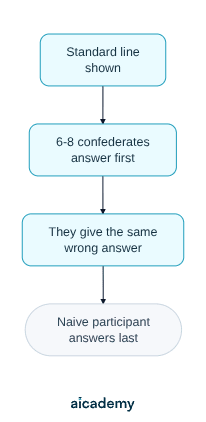
The naive participant always answered last, or second to last, so they heard the confederates first. On 12 of the 18 trials — the critical trials — the confederates all gave the same wrong answer. The other 6 trials were neutral, with correct answers, so the set-up was not obvious.

The key design feature: the real participant is the last to speak, so they are already boxed in by a unanimous, confident, and wrong majority before they answer.

The Baseline Findings

On the critical trials, the mean conformity rate was 36.8% — roughly 37% of the responses that a wrong majority could influence went along with that wrong answer.

Two further figures matter, and they are frequently confused:

MeasureResultWhat it means
Mean conformity on critical trials36.8%Average rate of conforming responses across the wrong trials
Conformed at least once75%Three quarters of participants gave in on at least one trial
Never conformed25%One quarter resisted the majority on every single trial
Control group error rateunder 1%With no confederates, people got the task right almost every time

The control group — participants who judged the lines alone, with no confederates — made mistakes on under 1% of trials. This comparison is crucial: it proves the task itself was easy, so the 36.8% error under group conditions was caused by the majority, not by genuine difficulty.

Afterwards, many participants said they had answered wrongly to avoid being ridiculed or standing out, even though they privately knew the right answer. This points to normative social influence (NSI): conforming to be accepted and avoid disapproval.

High conformity occurred even when the answer was obvious. Because participants privately disagreed but publicly went along, the baseline is best explained by NSI, a form of compliance.

Variable 1: Group Size

Asch varied the number of confederates to see how the size of the majority changed conformity. The relationship was not simply "bigger majority, more conformity".

  • With one confederate against the participant, conformity was very low — one voice is easy to dismiss.
  • With two confederates it rose noticeably.
  • With three confederates conformity reached about 31.8%.
  • Adding more confederates beyond three made little further difference — conformity had largely levelled off.
Confederates (majority size)Approximate conformity
1Very low
2Moderate
3About 31.8%
More than 3Little further rise

The lesson is that a small majority is not enough to exert strong pressure, but you do not need a very large majority either. Three people is close to the ceiling of the effect.

Once a majority reaches about three, adding more people adds little. This is a favourite exam point: do not claim conformity keeps climbing as the group grows.

Want more lessons like this one?

Generate lessons on anything you study. Free account, no card needed.

Start generating

Variable 2: Unanimity

In the baseline the majority was unanimous — every confederate gave the same wrong answer. Asch tested what happened when he broke that agreement by adding a dissenter: one confederate who did not go along with the rest.

He ran two versions of the dissenter:

  • The dissenter gave the correct answer (agreeing with the participant).
  • The dissenter gave a different wrong answer (disagreeing with both the participant and the majority).

In both cases, conformity dropped sharply — to roughly a quarter of its baseline level. The presence of the dissenter reduced conformity by about three quarters.

The important detail is that it did not matter whether the dissenter was right. Simply breaking the unanimity of the majority freed the naive participant to act more independently. It seems the power of a majority depends heavily on everyone speaking with one voice.

Breaking unanimity, not being correct, is what matters. Even a dissenter who is also wrong sharply reduces conformity, because the majority is no longer united.

Variable 3: Task Difficulty

Asch made the task harder by making the comparison lines more similar in length to the standard, so the correct answer was no longer obvious. This increased the ambiguity of the judgement.

Under these harder conditions, conformity increased. When people are genuinely unsure of the answer, they look to others for guidance on what is likely to be correct.

This points to a different mechanism from the baseline. Where the easy baseline was driven by NSI (fitting in), the harder task brings in informational social influence (ISI): conforming because you believe others may be right and you want to be right too.

VariableChange Asch madeEffect on conformityBest-fit explanation
Group sizeIncreased number of confederatesRose, then levelled offNSI (majority pressure)
UnanimityAdded a dissenter (right or wrong)Fell sharply, to about a quarterBreaks NSI pressure
Task difficultyMade comparison lines more similarIncreasedISI (uncertainty)

Link the variables to the right explanation. An easy, unanimous task is about NSI; a difficult, ambiguous task brings in ISI. Getting this pairing right is a common source of marks.

Evaluation (AO3)

The exam rewards evaluation as much as description. Learn these developed points and use them to argue, not just to list.

The task and situation were artificial. Judging lines is trivial and unlike the conformity that matters in real life, such as going along with a group's risky decision. Participants knew they were in a study, so they may have shown demand characteristics, guessing the aim and playing along. This lowers ecological validity, and as Fiske put it, "Asch's groups were not very groupy" — they lacked the bonds of real social groups.

The sample was limited. Only male American students took part. Findings may not generalise to women or to other cultures, so the research can be criticised as androcentric and culturally biased (ethnocentric). Bond and Smith found conformity tended to be higher in collectivist cultures, where fitting in with the group is valued more, suggesting the baseline rate is not universal.

It may be "a child of its time". Perrin and Spencer (1980) repeated the study with UK engineering students and found conformity on only 1 out of 396 trials. This suggests conformity levels are not fixed but can depend on the social and historical context, and the 1950s USA — a conformist, anti-communist era — may have produced unusually high rates.

There were ethical issues. Participants were deceived: they did not know the other group members were confederates or that the task measured conformity, so they could not give fully informed consent. This has to be weighed against the strong scientific value of the paradigm, which has generated decades of controlled research into majority influence.

A strong answer weighs points rather than listing them. The artificial task limits real-world application, but the tightly controlled lab method is exactly what let Asch isolate group pressure as the cause.

Common Exam Mistakes

1. Confusing the 37% and 75% figures

The 36.8% figure is the mean conformity rate on the critical trials. The 75% figure is the proportion of participants who conformed at least once. They measure different things. Quoting one as if it were the other loses marks.

2. Forgetting the control-group comparison

The control group, tested with no confederates, erred on under 1% of trials. Without this comparison you cannot show the task was unambiguous, which is the whole point of the study. Mention it to prove the conformity was caused by the group.

3. Assuming more confederates always means more conformity

Conformity levelled off at about three confederates. A majority larger than three adds little. Do not describe conformity as rising steadily with every extra group member.

4. Mixing up which variable links to ISI and which to NSI

The easy, unanimous baseline is best explained by NSI. The harder, more ambiguous task brings in ISI, because uncertainty makes people look to others for the right answer. Do not attach ISI to the easy task.

5. Saying the dissenter had to be correct

Breaking unanimity is what reduces conformity, not being right. A dissenter who gave a different wrong answer still cut conformity sharply, because the majority was no longer united.

Key terms

Unanimity
The extent to which all members of a majority agree; a unanimous majority all give the same answer, and breaking this agreement sharply reduces conformity.
Task difficulty
How hard or ambiguous a judgement is; harder tasks increase conformity because people are less sure of their own answer and look to others.
Majority influence
A form of social influence in which a larger group changes the behaviour or opinion of a smaller number of people or an individual, as studied by Asch.
Confederate
A person who appears to be a genuine participant but is secretly working for the researcher and follows instructions, such as giving a pre-agreed wrong answer.
Baseline
The standard version of a study against which variations are compared; in Asch's research the baseline conformity rate on critical trials was 36.8%.

Frequently asked questions

In the baseline study the mean conformity rate on the critical trials was 36.8% (about 37%). Separately, 75% of participants conformed to the wrong answer at least once, and 25% never conformed at all. These two figures are different and are often confused.

Group size, unanimity and task difficulty. Conformity rose with group size then levelled off, dropped sharply when a dissenter broke unanimity, and increased when the task was made harder and more ambiguous.

A dissenter breaks the unanimity of the majority. Once even one other person gives a different answer, the naive participant feels freer to act independently, so conformity fell to about a quarter of its baseline level, even if the dissenter was also wrong.

Generate revision on any topic you study

Type any topic you're studying and Aicademy generates a complete lesson, quiz, and flashcard set, personalised to your level.

Lessons on anything

Structured, level-matched lessons on any topic you study

Practice quizzes

Find out what you actually know before the exam does

Flashcard sets

Lock in key concepts with instant revision cards

Ask Aica

Stuck on something? Get a clear explanation, any time

Prev

Conformity: Types and Explanations

Next

Obedience: Milgram and Situational Variables

Related lessons

Top students don’t revise more. They revise what counts.

Start revising free

Free to start. No card needed.