Track progress, take quizzes and save notes on this lesson.

Free forever · no card needed

Start free
Intermediate

Ethological and Evolutionary Explanations of Aggression

4.3.8 Aggression

Aligned to the AQA 7182 specification

Level
Intermediate
Reading time
9 min
Published
1 July 2026
On this page
  1. 1.The Ethological Explanation: Aggression as Adaptive
  2. 2.Innate Releasing Mechanisms and Sign Stimuli
  3. 3.Fixed Action Patterns
  4. 4.Tinbergen's Stickleback Study
  5. 5.Evolutionary Explanations of Human Aggression
  6. 6.Evaluation (AO3)
  7. 7.Common Exam Mistakes

Key takeaways

  • The ethological explanation treats aggression as innate and adaptive: it spreads a species out over territory and establishes dominance hierarchies that reduce future conflict.
  • An innate releasing mechanism (IRM) is a neural circuit that, when triggered by a specific sign stimulus, activates a fixed action pattern (FAP).
  • A fixed action pattern is stereotyped, universal, innate, ballistic, single-purpose, and triggered by a specific sign stimulus, as shown by Tinbergen's stickleback study.
  • Evolutionary explanations argue aggression was adaptive for ancestors because it secured resources, status and mates, and reduced paternity uncertainty through sexual jealousy and mate retention.
  • Both explanations are criticised for downplaying learning, culture and free will, and for generalising from animal behaviour to flexible human aggression.

The Ethological Explanation: Aggression as Adaptive

Ethology is the study of animal behaviour in its natural environment. Ethologists such as Konrad Lorenz argued that aggression is innate (present from birth, not learned) and adaptive (it improves survival), so it must have been favoured by natural selection.

Why would aggression help an animal survive? Two reasons dominate the exam answer:

Adaptive functionHow aggression helps
Spreading over territoryAggression forces animals apart so a wider area's resources support the species
Dominance hierarchiesFighting establishes rank, giving dominant animals priority access to mates

Establishing a dominance hierarchy is itself adaptive: once rank is settled, animals waste less energy on future disputes and dominant individuals gain reproductive advantages. Aggression, on this view, is not a malfunction but a behavioural adaptation shaped over evolutionary time.

The ethological claim is that aggression is innate and adaptive. It benefits the species by distributing members across territory and by settling dominance without repeated, costly conflict.

Innate Releasing Mechanisms and Sign Stimuli

Ethologists explain how an innate behaviour is switched on using two linked ideas: the innate releasing mechanism and the sign stimulus.

An innate releasing mechanism (IRM) is a built-in neural "circuit" or network in the brain. It stays dormant until it detects a specific environmental trigger. That trigger is called a sign stimulus (or releaser). When the sign stimulus is present, the IRM "fires" and activates a fixed sequence of behaviour.

The logic runs in a fixed order:
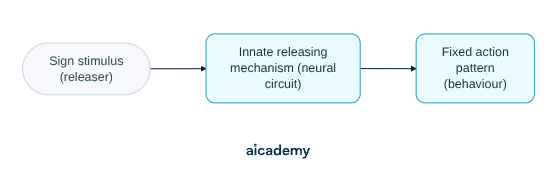
The distinction that earns marks is this: the IRM is the internal mechanism that detects and responds; the behaviour it releases is a separate thing. Keeping the trigger (sign stimulus), the mechanism (IRM), and the action (fixed action pattern) as three distinct stages is what a strong answer does.

An IRM is the neural mechanism, not the behaviour. It is switched on by a specific sign stimulus, and only then does it release the fixed action pattern.

Fixed Action Patterns

A fixed action pattern (FAP) is a stereotyped, innate sequence of behaviour triggered by a sign stimulus. Lorenz identified a set of defining characteristics that you should be able to list and explain.

CharacteristicMeaning
StereotypedThe behaviour is performed the same way each time
UniversalIt appears in all members of the same species
InnateIt is unlearned and present from birth
BallisticOnce started, it runs to completion and cannot be stopped
Specific triggerIt is set off only by a particular sign stimulus
Single-purposeThe behaviour serves one function and occurs in that context

The ballistic feature is important and often tested: a fixed action pattern is like firing an arrow. Once released, the sequence carries on to the end even if the sign stimulus disappears partway through. The animal cannot modify or abandon it mid-action.

Lorenz also argued that intra-species aggression (aggression between members of the same species) is often ritualistic rather than fatal. Fights involve threat displays, and losing animals produce appeasement or submission signals that stop the aggressor. This was seen as adaptive because it settles disputes without members of the species killing each other.

A FAP is stereotyped, universal, innate, ballistic, single-purpose, and released by a specific sign stimulus. "Ballistic" means that once the sequence begins it runs to completion.

Tinbergen's Stickleback Study

The classic evidence for fixed action patterns comes from Niko Tinbergen's work on the three-spined stickleback. During mating season, male sticklebacks develop a red underside and become highly territorial.

Tinbergen presented males with a series of wooden models:

  • Models with a red underside — even crude, unrealistic shapes — reliably triggered an aggressive display from the male.
  • A realistic model of a stickleback that lacked the red underside did not trigger aggression.

This shows the aggression was released by one specific feature, the red sign stimulus, not by the overall appearance of a rival. Once triggered, the aggressive display followed the same fixed sequence every time and ran to completion, matching the ballistic and stereotyped features of a FAP.

The study is used as evidence that aggression can be an innate fixed action pattern controlled by an IRM responding to a particular releaser.

The red underside is the sign stimulus. That a fake red-bellied model provokes attack while a realistic model without red does not is strong support for a stimulus-specific fixed action pattern.

Something not quite clicking?

Ask Aica to explain any part of this differently. Free, takes 30 seconds.

Ask Aica

Evolutionary Explanations of Human Aggression

Evolutionary explanations extend the idea that aggression is adaptive to humans. They argue aggression evolved because it helped our ancestors solve survival and reproductive problems: securing and defending resources, status and mates, and deterring rivals. Genes linked to successful aggressive strategies were passed on.

A central strand is sexual jealousy and mate retention. Because fertilisation happens inside the female, a male can never be fully certain he is the father of a partner's child. This paternity uncertainty creates a risk of investing resources in another male's offspring.

Wilson and Daly argued that men evolved mate retention strategies to reduce this risk, some of which involve aggression:

StrategyExample behaviour
Direct guardingRestricting a partner's freedom, checking on them, monitoring
Negative inducementsThreats of violence to deter a partner from leaving or being unfaithful

Aggression is also explained as a route to status and dominance: displays of aggression could deter rivals and raise a man's standing, which improved access to mates. Even bullying has been framed as an adaptive strategy, allowing the bully to gain resources and appear dominant and desirable, which would historically have been reproductively advantageous.

Evolutionary explanations argue aggression was selected for because it secured resources, status and mates. Sexual jealousy and mate retention reduced paternity uncertainty, passing on genes for aggressive strategies.

Evaluation (AO3)

A strong essay develops several evaluation points rather than listing many briefly.

Ethological evidence comes largely from animals. Much of the support (sticklebacks, geese) is from non-human species, yet human aggression is far more flexible and learned than a rigid fixed action pattern allows. Generalising from a stickleback's stereotyped display to human conflict is therefore problematic. The idea of a truly "fixed" pattern has itself been challenged, as researchers found these behaviours vary more between individuals and situations than Lorenz claimed, which weakens the concept.

Lorenz's claim that aggression is rarely fatal is contradicted. Human warfare, genocide and homicide show that same-species aggression is frequently lethal, so the ritualistic, non-fatal account does not transfer well to humans and undermines the ethological explanation of human aggression.

Evolutionary explanations account for consistent patterns. They fit robust findings such as the gender difference in physical aggression and the prevalence of male sexual jealousy, which a purely learning-based account struggles to explain as neatly. This is a genuine strength.

But evolutionary explanations struggle with cultural variation. Some societies, such as the !Kung San of the Kalahari, show very low levels of aggression, and rates of violence differ widely between cultures. A purely evolutionary account cannot easily explain why aggression is so muted in some groups if it is a universal adaptation, suggesting learning and culture matter.

Evolutionary explanations can be speculative and deterministic. Because they reason backwards from present behaviour to a supposed ancestral advantage, they risk being post-hoc ("just-so") stories that are hard to falsify. They are also biologically deterministic, downplaying free will and the roles of learning, choice and social context in aggression.

Common Exam Mistakes

1. Confusing the IRM with the fixed action pattern

The innate releasing mechanism is the internal neural circuit; the fixed action pattern is the behaviour it releases. Describing the IRM as if it were the behaviour, or vice versa, loses marks. Keep the trigger, the mechanism, and the action as three separate stages.

2. Forgetting to name the sign stimulus

Answers on Tinbergen's study must identify the red underside as the sign stimulus that releases the aggressive display. Saying only that the fish "attacks models" misses the point that one specific feature is the trigger.

3. Saying a FAP can be learned or modified mid-sequence

Fixed action patterns are innate and ballistic. Once started they run to completion and cannot be altered partway through. Writing that an animal "learns" a FAP or changes it during the action contradicts its defining features.

4. Treating evolutionary explanations as able to explain all cultural differences

Evolutionary accounts predict broadly universal behaviour, so they struggle to explain low-aggression societies such as the !Kung San. Do not claim the explanation neatly accounts for cultural variation; this is a limitation to raise, not a strength to assert.

5. Describing Lorenz's aggression as always non-fatal in humans

Lorenz argued intra-species aggression is often ritualistic in animals, but this does not hold for humans. Presenting human aggression as rarely fatal ignores warfare and homicide, and misapplies the animal-based claim.

Key terms

Ethology
The study of animal behaviour in its natural environment, often used to explain aggression as innate and adaptive.
Innate releasing mechanism
A built-in neural circuit that, when triggered by a specific sign stimulus, activates a fixed action pattern.
Fixed action pattern
A stereotyped, innate sequence of behaviour triggered by a sign stimulus that, once started, runs to completion.
Sign stimulus
A specific environmental trigger, also called a releaser, that activates an innate releasing mechanism.
Evolutionary explanation
An account arguing that a behaviour became widespread because it was adaptive and improved ancestors' chances of survival and reproduction.

Frequently asked questions

An innate releasing mechanism (IRM) is the internal neural circuit that detects a sign stimulus; a fixed action pattern (FAP) is the stereotyped behaviour the IRM then releases. The IRM is the trigger mechanism, the FAP is the resulting action.

They argue aggression was adaptive for ancestors because it helped secure resources, status and mates. Sexual jealousy and mate retention reduced paternity uncertainty, so genes for aggressive strategies were passed on.

Human aggression is far more flexible and learned than a rigid FAP allows, so generalising from animals like sticklebacks is problematic. Lorenz's claim that aggression is rarely fatal is also contradicted by human warfare and homicide.

Generate revision on any topic you study

Type any topic you're studying and Aicademy generates a complete lesson, quiz, and flashcard set, personalised to your level.

Lessons on anything

Structured, level-matched lessons on any topic you study

Practice quizzes

Find out what you actually know before the exam does

Flashcard sets

Lock in key concepts with instant revision cards

Ask Aica

Stuck on something? Get a clear explanation, any time

Prev

Neural, Hormonal and Genetic Explanations of Aggression

Next

Social Psychological Explanations of Aggression

Related lessons

Top students don’t revise more. They revise what counts.

Start revising free

Free to start. No card needed.