Entity-Relationship Modelling and Relational Databases

Aligned to the AQA 7517 specification
- Level
- Intermediate
- Reading time
- 6 min
- Published
- 13 June 2026
- Updated
- 16 August 2026
On this page
Key takeaways
- To model from requirements, identify nouns as candidate entities, their properties as attributes, and verbs connecting entities as relationships, then determine each relationship's cardinality (1:1, 1:N, or M:N).
- Many-to-many relationships cannot be directly implemented in a relational database and must be resolved into two one-to-many relationships via a junction (linking) table.
- A foreign key is an attribute that references the primary key of another table and is how relational databases implement relationships between tables.
- Referential integrity requires a foreign key value to either match an existing primary key in the referenced table or be NULL.
- In AQA entity notation, the primary key is underlined and a foreign key is marked with a `*` suffix; omitting foreign key notation loses marks.
Entity-Relationship Diagrams
An ER diagram visually represents entities, their attributes, and their relationships.
Notation:
- Rectangles represent entities
- Ovals (or listed columns) represent attributes; underlined = key attribute
- Lines between entities represent relationships; labels describe the relationship
- Crow's foot or numbers indicate cardinality
Relationship cardinalities:
| Type | Notation | Meaning | Example |
|---|---|---|---|
| One-to-one (1:1) | 1 ── 1 | Each entity instance relates to exactly one of the other | Person ─── Passport |
| One-to-many (1:N) | 1 ──< N | One instance relates to many of the other | Customer ─── Orders |
| Many-to-many (M:N) | M >──< N | Many instances relate to many of the other | Student ─── Courses |
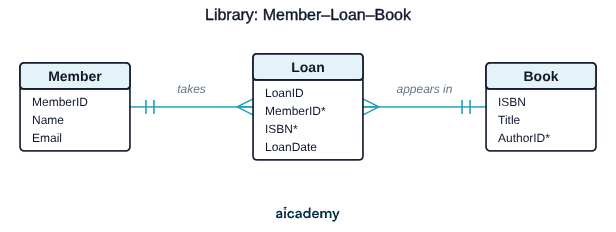
Many-to-many relationships cannot be directly implemented in a relational database. They must be resolved into two one-to-many relationships via a junction (linking) table. The library example below resolves the many-to-many between Member and Book using a Loan junction entity:
How much of this have you taken in?
Quiz yourself on this section, free, no card needed.
Key terms
- Entity
- A thing the system needs to store data about; identified from nouns in the requirements and shown as a rectangle in an ER diagram.
- Attribute
- A property of an entity; a column in a table, such as Email or Name.
- Relationship
- A connection between entities, identified from verbs in the requirements and shown as a labelled line in an ER diagram.
- Cardinality
- The type of a relationship: one-to-one (1:1), one-to-many (1:N), or many-to-many (M:N).
- ER diagram
- A diagram that visually represents entities, their attributes, and the relationships between them.
- Junction (linking) table
- A table that resolves a many-to-many relationship into two one-to-many relationships by holding foreign keys to both entities.
- Relational database
- A database that organises data into tables (relations), each storing data about one entity.
- Primary key
- An attribute or set of attributes that uniquely identifies each row in a table and cannot be NULL.
- Composite primary key
- A primary key formed from two or more attributes together, such as (StudentID, CourseCode) in a junction table.
- Foreign key
- An attribute that references the primary key of another table, implementing a relationship between tables; marked with a `*` suffix in AQA notation.
- Referential integrity
- The rule that a foreign key value must either match an existing primary key in the referenced table or be NULL.
Frequently asked questions
A many-to-many relationship cannot be directly represented in a relational database, so it must be resolved into two one-to-many relationships using a junction (linking) table that holds foreign keys to both entities. For example, a Loan junction table resolves the many-to-many between Member and Book.
A foreign key is an attribute that references the primary key of another table, and it is how relational databases implement relationships between tables. Referential integrity requires a foreign key value to either match an existing primary key in the referenced table or be NULL, so a Loan cannot point to a MemberID that does not exist.
A primary key uniquely identifies rows, cannot be NULL, and a table can have only one. Other attributes may also be unique, such as an email, but are not the primary key unless specifically designated as such.
Generate revision on any topic you study
Type any topic you're studying and Aicademy generates a complete lesson, quiz, and flashcard set, personalised to your level.
Lessons on anything
Structured, level-matched lessons on any topic you study
Practice quizzes
Find out what you actually know before the exam does
Flashcard sets
Lock in key concepts with instant revision cards
Ask Aica
Stuck on something? Get a clear explanation, any time
Web Technologies and Client Models
Database Normalisation
Related lessons
5 min
5 min