Comparison
Is Save My Exams free? Free vs Premium compared
A free account gets one topic question and five revision notes a month, and past papers are free outright. Here is exactly where the wall falls, what the two paid tiers add, and whether you need them.

The Aicademy Team
Study team, Aicademy
9 min read
If you have just hit a paywall halfway through a revision session, here is the number. A free Save My Exams account gets you one topic question and five revision notes a month. That is the whole allowance, and it is Save My Exams’ own published figure rather than an estimate.
There is one large exception in your favour, and it is the best thing on the site: past papers and mark schemes are free, unlimited, and do not need an account at all.
This is a plain account of where the wall actually falls, what the two paid tiers differ on, what they cost, how to get a year of Premium for nothing, and what to use tonight if you are not going to pay. Everything here comes from Save My Exams’ own pricing screens, support pages, scholarship page and terms of service, all linked at the end, and from walking the live site to check it holds.
Is Save My Exams free?
Partly, and the answer has a real number attached to it. In Save My Exams’ own words:
“Free monthly allowances include: One topic question per month. Five revision notes per month. Full access to Learning Hub articles.”
That allowance resets every month. Five revision notes is roughly one topic covered. One topic question is not enough to practise with, and the model answer to it is paywalled as well, so you cannot even check the one you get. A free account lets you look at the material rather than work with it.
The exception is the one worth knowing: past papers and mark schemes are free, unlimited, and do not need an account. That is real revision material at no cost, and it is the reason not to reach for your card the moment you hit the first paywall.
The free plan in numbers
Here is the whole free tier in one place.
| Resource | What a free account gets |
|---|---|
| Revision notes | 5 a month |
| Topic questions | 1 a month |
| Past papers and mark schemes | Unlimited, and no account needed |
| Learning Hub articles | Unlimited |
| Model answers | Paid only |
| Flashcards | Paid only |
| Mock exams | Paid only |
| Target Test (auto-built practice) | Paid only |
| SmartMark (AI marking) | Paid only |
| Downloading notes and questions | Paid only |
Compiled from Save My Exams’ support pages, scholarship page and live site.
One thing to watch for if you go looking yourself. Save My Exams has an older free-versus-paid comparison table, and two of its rows undersell the free tier, which is the direction that costs you money: read them and you would upgrade to get something you already have.
- It calls free past-paper access “a small range”. The papers and mark schemes actually open and download in full, with no account, so there is no need to pay for past papers.
- It says free unlocks “one or two subjects”. The real limit is the monthly allowance above, and it applies inside a subject rather than locking whole subjects off, so revising three subjects instead of one costs you nothing extra.
It is not really a free plan with limits
This is the thing to understand before you read any “limited access” claim about Save My Exams. Only two things on the platform are actually rationed: revision notes, at five a month, and topic questions, at one. Past papers are free and unlimited. Everything else is not rationed at all, it is simply paid. Model answers, mock exams, Target Test, SmartMark, flashcards and downloads are not a bigger allowance you work through, they are features a free account never touches.
That distinction has one consequence worth planning around. Model answers are a paid feature, so the single free topic question arrives without its answer: you can attempt it, but you cannot mark it. A free account is therefore a way to read the material, not a way to practise with it. Five notes a month makes it a reference sample; past papers make it a genuinely useful free source of real questions. It is not a revision strategy on its own.
What is actually behind the paywall
Four things, and they are the four worth understanding before you decide whether to pay.
- The full question bank with model answers. The free plan gives you one question a month and none of the answers; paying unlocks the bank with teacher-written model answers and mark schemes. This is the core of what a subscription buys.
- Full-length mock exams, timed, with mark schemes. Not available free at all.
- SmartMark, which marks your written answers against exam-board criteria and tells you where the marks went. This is the most genuinely useful thing on the platform and the hardest to replicate for free.
- Target Test, which builds quizzes automatically from the topics you are weakest on, plus the strengths and weaknesses tracker and the teacher and parent dashboards.
The notes themselves are written by teachers and examiners, follow each specification closely, and are genuinely concise. That is the platform’s real asset, and it is what you are paying for.
Essential vs Premium: which one are you buying?
There are two paid tiers, not one, and Premium is roughly double Essential on every billing period. Which one you want depends on a single question: do you need the content, or do you need someone to tell you whether your answer was any good?
Essential is the library plus the questions: revision notes, exam questions, mock exams, and Smart Chat, their revision helper chatbot. If what you want is the content, Essential has all of it.
Premium adds five things: downloading notes and questions, a strengths and weaknesses tracker, instant feedback on your answers, the ability to build your own practice tests, and adaptive smart lessons. Four of those five concern what happens after you have written something, which is the real split between the tiers. If you have ever finished a past paper and had no idea whether your answer would have scored, Premium is the tier aimed at you, and it is roughly double the price on every billing basis.
Their AI features are split across the two, which is easy to miss. Smart Chat is on Essential, but instant feedback on your written answers and the adaptive lessons are Premium only. If you are comparing Save My Exams against an AI tutor, compare against the right tier.
What Save My Exams costs
| Billing period | Essential | Premium |
|---|---|---|
| Rolling monthly | £12 / month | £25 / month |
| 3 months | £10 / month (£30 up front) | £20 / month (£60 up front) |
| 12 months | £4 / month (£48 a year) | £8 / month (£96 a year) |
| Free trial | No | 7 days, annual plan only |
Save My Exams pricing taken from its live paywall, September 2026. Prices vary by account type and location and change over time; confirm on savemyexams.com before subscribing.
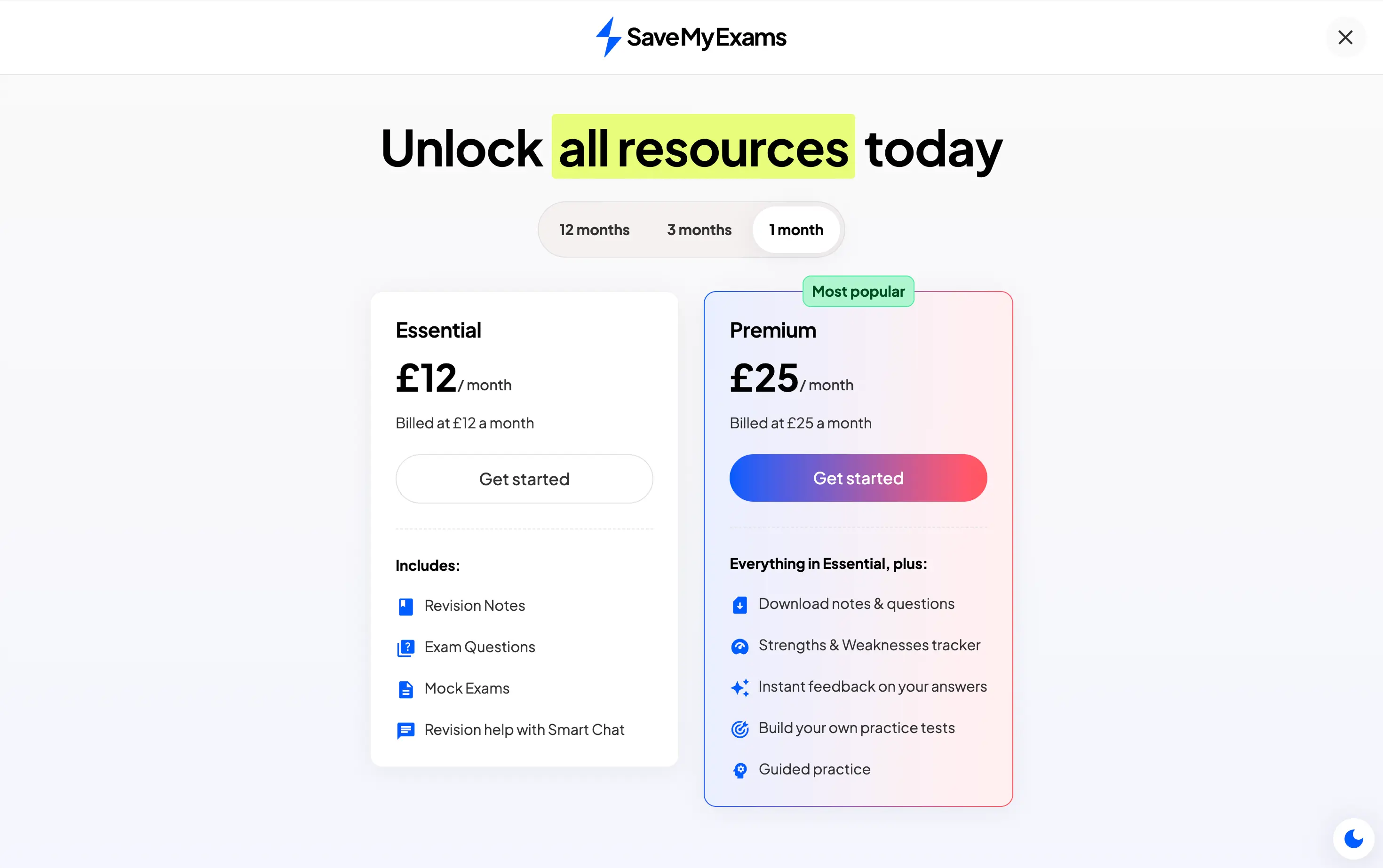
Paying a year up front is a real saving, and the “save 68%” badge is not inflated:
- Essential: £48 for the year, against £144 if you pay £12 monthly for twelve months. That is 67% off.
- Premium: £96 for the year, against £300 monthly. That is 68% off, which is where the badge figure comes from.
- The 3-month plans save far less: £120 a year on Essential and £240 on Premium, so 17% and 20% respectively.
The catch is the trial. The 7-day free trial only appears on Premium annual. Every other cell is a straight sign-up, so if you were planning to try it for a week before committing, the only door in is the one that bills you £96 for the year if you forget to cancel.
A few of the terms matter before you subscribe, and several of them are in your favour:
- In your favour. Save My Exams gives 30 days’ notice of any price change affecting a renewal and sends a reminder before auto-renewal, you keep access to the end of the period if you cancel early, and there is a 14-day cooling-off period under the Consumer Contracts Regulations.
- Against you. One free trial per person, ever, however you sign up. One device at a time, with a limit of five devices in 30 days. Account sharing is monitored and is grounds for termination, so splitting a subscription with friends is not a plan.
One more thing their terms make explicit: Save My Exams has no affiliation with any exam board, and its model answers are its own interpretation rather than the definitive one. Worth remembering before you learn a model answer word for word.
Is Save My Exams worth paying for?
It depends on which stage you are at, not on how good the platform is.
Worth paying for if all three of these are true:
- You already know the content and are dropping marks on how you answer rather than on what you know.
- Your subject and board are covered in depth. Check yours specifically, because depth varies.
- You will use it across a term, not a weekend.
At £4 a month on the annual plan it is one of the cheaper things a student can buy, and if SmartMark stops you repeating the same structural mistake for six months it has paid for itself. If you are at that stage, Premium rather than Essential is the one that earns the money, because the feedback is the point.
Not worth paying for in three fairly common situations:
- You mainly want past papers. They are already free on Save My Exams, from your exam board and from Physics & Maths Tutor. Paying for something you can currently have for nothing is the easiest money to waste here.
- You are still learning the content. A free interactive course will take you further than a reference library when the problem is understanding rather than practice.
- You sit a smaller subject. Depth varies a lot by board, and one free question a month is not enough to audit the coverage before you commit. Check your specific specification is covered properly before you pay for a year.
For a straight head-to-head on the learning-versus-practising split, we compare two of the usual candidates in Seneca vs Save My Exams, and the free-past-papers question specifically in Save My Exams vs Physics & Maths Tutor.
How to get Save My Exams Premium for free
If cost is the reason you are reading this, start here. Save My Exams runs a scholarship that gives away 10 Premium accounts every month, each worth a full year of access. It says it works with over 120 active scholars.
- Deadline: midnight GMT on the last day of each month. Anything later rolls into the next month’s draw, so a late application is not a wasted one.
- Winners announced: the first week of the following month.
- Eligibility: you must have registered with Save My Exams and opted into its mailing list, show a commitment to academic progress, and show that the cost of a subscription is a barrier for you.
- On grades: the criteria say explicitly that they are not looking for the highest grades, but for evidence that you are working at it. Do not rule yourself out on results.
Applications go through the scholarship page. If you were about to ask a parent for £96, spend ten minutes on this first.
If you cannot pay: what to use instead
Work out which job you were about to pay for, then take the free route to it. In rough order of how often it helps:
- Past papers and mark schemes: Save My Exams itself, your exam board, or Physics & Maths Tutor. All three are free. Physics & Maths Tutor needs no account and is organised by board and by topic, which makes it fast to find a specific paper. Your exam board publishes the originals.
- Learning a topic from scratch: BBC Bitesize. Free, no login, every subject, and written to be understood the first time. It will not get you to a grade 9 on its own, but it covers a lot of ground for nothing.
- Active revision and recall: Seneca’s free courses. Free and unlimited on the core tier with no trial clock, mapped to the exam boards, and better than Save My Exams for the part where you are trying to get facts to stick.
Between the scholarship and those three, most of what people pay Save My Exams for is available at no cost. None of them will ask you for a card, and none of them expires.
If you want more than a fixed library
Every option above hands you a fixed catalogue, so you are limited to the topics somebody has already written a page for. Aicademy has a free library covering GCSE and A-level subjects across AQA, Edexcel and OCR, readable without an account. It can also generate its own: enter a topic or upload your own class notes, and it builds a learning path to work through, with lessons, quizzes and flashcards along the way. There is a built-in tutor to ask follow-up questions as you go.
How it lines up against the tiers above:
- Free: the whole lesson library, no account needed. A free account adds 10 creation credits a month, which you can use across learning paths, lessons, quizzes, flashcards and document uploads, plus 10 tutor messages a day.
- Pro, £9.99 a month: unlimited creation, and less than either Save My Exams tier, where Essential is £12 a month and Premium £25 a month.
- Pro annual, £5.00 a month (£59.99 a year): the same Pro plan, 50% cheaper. Paying up front also fixes that price for twelve months.
- What it does not have: past papers and mock exams. It generates its own practice quizzes instead, so for real papers you still want your exam board or Physics & Maths Tutor.
If you want the wider view, we keep a running list in the best Save My Exams alternatives and a price survey of the whole UK market in what revision sites actually cost. For free tools specifically, see the best free GCSE revision apps.
For transparency: Aicademy, the app mentioned in the last section, is ours. We have taken Save My Exams on its own terms, used its own published figures rather than characterising them, walked the live site to check they hold, and linked every source so you can check the lot. You can try Aicademy free if generating material for a topic you are stuck on sounds useful.
Frequently asked questions
Partly, and there is a published number. Save My Exams states that a free account gets you one topic question and five revision notes per month, plus unlimited access to its Learning Hub articles. Past papers and their mark schemes are also free and unlimited, with no account needed. Everything else needs a paid membership, including model answers, full-length mock exams, Target Tests and SmartMark, its AI marking of your written answers.
One a month, and it comes without its model answer. Model answers are a paid feature rather than a rationed one, so on a free account you can attempt your single topic question but cannot mark it. The figure is Save My Exams' own, and it matches the live site: the next question you open returns an 'Unlock all exam questions' prompt.
Yes. Save My Exams states that its past papers are free to access including the official mark schemes, with no payment needed, and that holds up on the live site: the paper PDFs open and download without hitting an upgrade prompt. This is the most useful free thing on the platform.
There are two tiers and three billing periods. Essential is £12 a month rolling, £10 a month on a 3-month plan (£30 up front), or £4 a month billed annually (£48 a year). Premium is £25 a month rolling, £20 a month on a 3-month plan (£60 up front), or £8 a month billed annually (£96 a year). Prices checked September 2026; confirm on savemyexams.com before subscribing.
Essential gives you the revision notes, exam questions, mock exams and the Smart Chat revision helper. Premium adds downloading notes and questions, a strengths and weaknesses tracker, instant feedback on your written answers, the ability to build your own practice tests, and adaptive smart lessons. If you want AI marking of your own answers, that sits in Premium, and it is the main reason to pick Premium over Essential.
Yes, on the Premium annual plan, and only there. The monthly and 3-month plans, on both tiers, show a plain sign-up button instead, so the only way into the trial is the plan that bills you £96 for the year if you forget to cancel. Save My Exams' terms also state you get one free trial per person, ever, however you sign up.
Yes, through its scholarship. Save My Exams gives away 10 Premium accounts every month, each worth a full year of access. Applications close at midnight GMT on the last day of each month and winners are announced in the first week of the following month. To be eligible you must have registered with Save My Exams and opted into its mailing list, show a commitment to academic progress (it says explicitly that it is not looking for the highest grades) and show that cost is a barrier for you.
Work out which job you actually needed it for. Past papers and mark schemes are already free on Save My Exams itself, and on Physics & Maths Tutor and your exam board's own site. For learning a topic from scratch, BBC Bitesize and Seneca's free courses cover most GCSE and A-level specifications at no cost. Apply for the scholarship if cost is the blocker. And for a specific topic you keep getting stuck on, Aicademy generates a learning path, lessons and quizzes for it, free to start.
It is worth it if three things are true: you already know the content and are losing marks on exam technique, your subject and exam board are covered in depth, and you will use it across a term rather than a weekend. It is poor value if you only need past papers, which are free on Save My Exams itself, or if you are still trying to understand the content, where a free interactive course will take you further.
Sources
- Save My Exams — is Save My Exams free? (savemyexams.com)
- Save My Exams — why pay for Save My Exams? Free vs Premium (savemyexams.com)
- Save My Exams — scholarship: apply for a free account
- Save My Exams — membership and pricing (savemyexams.com/join)
- Save My Exams — past papers (savemyexams.com)
- Save My Exams — terms of service (savemyexams.com)
- Physics & Maths Tutor (physicsandmathstutor.com)
- Seneca Learning (senecalearning.com)
- BBC Bitesize (bbc.co.uk/bitesize)
Prices and features were checked as of the date shown and can change. Where a figure could not be confirmed from a primary source, we say so in the text.
The Aicademy Team
Study team, Aicademy
These guides are written and edited by the Aicademy team, drawing on the study-technique and exam-prep research behind the product. We cite our sources so you can check everything yourself.
Disclosure: Aicademy is the study app made by the team that publishes this blog. We compare it fairly against other tools and cite our sources so you can check everything yourself.
Keep reading
What revision websites cost in 2026 (every tier compared)
A dated, sourced price comparison of the UK revision tools students actually use, including what each free tier really gives you and the billing traps to watch for.
The 7 best Save My Exams alternatives in 2026
The best Save My Exams alternatives in 2026: free notes and past papers, AI tutors and generative study tools, compared on what each does better.
Save My Exams vs Physics & Maths Tutor: which is better in 2026?
Save My Exams vs Physics & Maths Tutor compared for GCSE and A-level: paid examiner notes and marking versus a free past-paper library, on price and what each does best.
Study with more than flashcards
Aicademy generates personalised lessons, quizzes and flashcards from any topic or your own notes, with spaced-repetition revision and an AI tutor.
Lessons on anything
Structured, level-matched lessons on any topic you study
Practice quizzes
Find out what you actually know before the exam does
Flashcard sets
Lock in key concepts with instant revision cards
Ask Aica
Stuck on something? Get a clear explanation, any time
Upgrade to Pro whenever you're ready