Track progress, take quizzes and save notes on this lesson.

Free forever · no card needed

Start free
Advanced

Resultant Forces and Free Body Diagrams

4.5.1.4

Aligned to the AQA 8463 specification

Topic
Forces
Level
Advanced
Reading time
6 min
Published
2 July 2026
On this page
  1. 1.What a Resultant Force Is
  2. 2.Resultant of Forces in a Straight Line
  3. 3.Balanced Forces and Equilibrium
  4. 4.Free Body Diagrams (Higher Tier)
  5. 5.Resolving a Force into Components (Higher Tier)
  6. 6.Using a Scale Diagram to Find a Resultant (Higher Tier)
  7. 7.Common Exam Mistakes

Key takeaways

  • A resultant force is the single force that has the same effect as all the forces acting on an object combined.
  • For forces acting in a straight line, add forces in the same direction and subtract forces in opposite directions to find the resultant.
  • If the resultant force on an object is zero, the forces are balanced and the object stays at rest or moves at constant velocity.
  • A free body diagram shows a single object with all the forces acting on it drawn as labelled arrows from a central point (Higher Tier).
  • A single force can be resolved into two perpendicular components, and a scale diagram can find a resultant's magnitude and direction (Higher Tier).

What a Resultant Force Is

Most objects have several forces acting on them at once. Rather than track each one separately, physics combines them into a single equivalent force.

A resultant force is the single force that has the same effect on an object as all the individual forces acting on it added together.

Think of a stationary car being pushed by two people from behind. If each pushes with 200 N in the same direction, the car behaves exactly as if one person pushed with 400 N. That 400 N is the resultant force.

The resultant matters because it decides what happens to an object's motion:

  • A non-zero resultant force changes an object's motion (it speeds up, slows down or changes direction).
  • A zero resultant force means the forces are balanced, and the object stays at rest or keeps moving at constant velocity.

Because force is a vector, combining forces means taking direction into account, not just adding sizes.

Resultant of Forces in a Straight Line

When forces act along the same straight line, finding the resultant is straightforward: add forces pointing the same way and subtract forces pointing the opposite way.

Worked example — a sledge is pulled forwards with a force of 50 N while friction of 30 N acts backwards. Find the resultant force.

The forces are in opposite directions, so subtract:

The resultant force is 20 N in the forwards direction, so the sledge accelerates forwards.

Worked example — two dogs pull a sledge forwards, one with 120 N and one with 90 N, both in the same direction. A friction force of 40 N acts backwards. Find the resultant force.

Add the forces in the same direction, then subtract the opposing force:

The resultant force is 170 N forwards. Always state the direction, because the resultant is a vector.

Balanced Forces and Equilibrium

A special and very common case is when the resultant force is exactly zero.

When the resultant force on an object is zero, the forces are balanced and the object stays at rest or continues at a constant velocity.

Consider a book resting on a table. Its weight (say 8 N) pulls it down, and the normal contact force from the table (8 N) pushes it up. These are equal and opposite:

The resultant is zero, so the book stays still. The same idea applies to a car cruising at a steady 30 m/s: the driving force from the engine exactly balances the resistive forces, so there is no resultant force and the velocity stays constant. This links directly to Newton's First Law.

Free Body Diagrams (Higher Tier)

(Higher Tier only) The rest of this lesson — free body diagrams and resolving forces — is required for Higher Tier papers only.

A free body diagram is a clear way to show all the forces on one object so you can find the resultant.

A free body diagram shows a single isolated object with every force acting on it drawn as a labelled arrow. The arrow's length shows the size of the force and its direction shows the way the force acts.

The object is usually drawn as a simple box or dot, and every force is drawn as an arrow starting from it. The diagram below shows a car driving along a level road at steady speed.
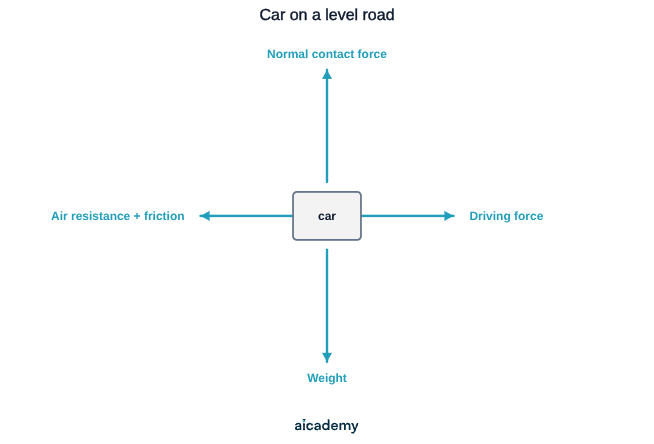
Here weight balances the normal contact force (vertical), and the driving force balances the resistive forces (horizontal). Every pair is equal and opposite, so the resultant is zero and the car travels at constant velocity.

Worth saving these ideas?

Turn what you've read into instant revision cards. Free to get started.

Make flashcards

Resolving a Force into Components (Higher Tier)

(Higher Tier only) Resolving a single force into two perpendicular components.

A single force acting at an angle can be replaced by two forces at right angles to each other that together have the same effect. These two forces are its components, usually a horizontal and a vertical one.

This is the reverse of finding a resultant. Instead of combining forces, you split one force into two perpendicular parts. It is useful when a force acts at an angle, for example a rope pulling a sledge at 30° to the ground: part of the pull drags the sledge forwards (the horizontal component) and part lifts it (the vertical component).

You can find the components using a scale (vector) diagram:

  1. Choose a scale, for example 1 cm to represent 10 N.
  2. Draw the original force as an arrow at the correct angle and correct length.
  3. Draw a rectangle with the force as its diagonal, with sides horizontal and vertical.
  4. The two sides of the rectangle are the horizontal and vertical components; measure their lengths and convert back using the scale.

The same scale-diagram method works in reverse to combine two perpendicular forces into a single resultant, reading off its magnitude and direction.

Using a Scale Diagram to Find a Resultant (Higher Tier)

(Higher Tier only) Using a vector (scale) diagram to find a resultant's magnitude and direction.

When two forces act at an angle to each other, you cannot simply add or subtract them. A scale diagram finds the resultant graphically.

Worked example — a force of 30 N acts to the east and a force of 40 N acts to the north on the same object. Find the resultant.

Draw the two forces tip to tail to scale (for example 1 cm = 10 N), then draw the resultant from the start of the first arrow to the tip of the last. Because these two forces are perpendicular, the resultant is the diagonal of a right-angled triangle, so its size can be checked:

The resultant force is 50 N, pointing north-east between the two original forces. In the exam you find both the magnitude and the direction by measuring your scale diagram with a ruler and protractor.

An object is in equilibrium when the forces on it form a closed shape on a scale diagram, meaning the resultant is zero.

Common Exam Mistakes

1. Adding forces without considering direction

Forces are vectors. Two 10 N forces give a 20 N resultant only if they point the same way. Pointing in opposite directions they give 0 N; at right angles they give about 14 N. Direction always matters.

2. Forgetting to state the direction of the resultant

A resultant force answer needs a direction as well as a size. "20 N" is incomplete; "20 N forwards" or "50 N north-east" is complete.

3. Thinking a moving object must have a resultant force

An object moving at constant velocity has a resultant force of zero. A resultant force is needed to change motion, not to keep it going.

4. Drawing forces on a free body diagram to the wrong scale

On a free body diagram the arrow lengths should reflect the force sizes. Balanced forces must be drawn the same length; a larger force must have a longer arrow.

5. Trying to add perpendicular forces arithmetically (Higher Tier)

Forces at right angles cannot simply be added. Use a scale diagram or Pythagoras: 30 N east and 40 N north give a 50 N resultant, not 70 N.

Key terms

Resultant force
The single force that has the same effect as all the forces acting on an object added together.
Balanced forces
Forces on an object that combine to give a resultant force of zero, so the object's motion does not change.
Free body diagram
A diagram showing a single isolated object with all the forces acting on it drawn as labelled arrows (Higher Tier).
Component of a force
One of two perpendicular forces that together have the same effect as a single force, found by resolving that force (Higher Tier).

Frequently asked questions

A resultant force is the single force that would have exactly the same effect on an object as all the individual forces acting on it added together. It replaces several forces with one.

Add together forces acting in the same direction, then subtract forces acting in the opposite direction. The answer's sign or a stated direction gives the direction of the resultant force.

A free body diagram (Higher Tier) shows one isolated object with every force acting on it drawn as a labelled arrow. The length of each arrow shows the size of the force and its direction shows which way the force acts.

Generate revision on any topic you study

Type any topic you're studying and Aicademy generates a complete lesson, quiz, and flashcard set, personalised to your level.

Lessons on anything

Structured, level-matched lessons on any topic you study

Practice quizzes

Find out what you actually know before the exam does

Flashcard sets

Lock in key concepts with instant revision cards

Ask Aica

Stuck on something? Get a clear explanation, any time

Prev

Weight, Mass and Gravity

Next

Work Done and Energy Transfer

Related lessons

7 min

Lesson

Scalars, Vectors and Forces

AQA GCSE Physics · AQA 8463

19 days ago

6 min

Lesson

Newton's Laws of Motion

AQA GCSE Physics · AQA 8463

19 days ago

6 min

Lesson

Weight, Mass and Gravity

AQA GCSE Physics · AQA 8463

19 days ago

Top students don’t revise more. They revise what counts.

Start revising free

Free to start. No card needed.