Motion Graphs and Acceleration

Aligned to the AQA 8463 specification
- Topic
- Forces
- Level
- Advanced
- Reading time
- 7 min
- Published
- 2 July 2026
- Updated
- 16 August 2026
On this page
Key takeaways
- On a distance–time graph the gradient equals speed; a steeper line means a faster speed and a horizontal line means the object is stationary.
- Acceleration is the change in velocity divided by the time taken, a = Δv/t, measured in m/s²; you must be able to recall and apply this.
- On a velocity–time graph the gradient equals acceleration and the area under the line equals the distance travelled.
- The equation v² − u² = 2as links velocity, acceleration and distance for uniform acceleration and is given on the equation sheet.
- Free-fall acceleration near the Earth is about 9.8 m/s²; an object falling through a fluid reaches terminal velocity when the resultant force on it is zero.
Velocity–Time Graphs
A velocity–time graph shows how an object's velocity changes with time. It carries two pieces of information at once.
On a velocity–time graph, the gradient equals the acceleration. A steeper line means a greater acceleration; a horizontal line means constant velocity.
The graph below shows an object accelerating steadily, then travelling at constant velocity, then decelerating to rest.
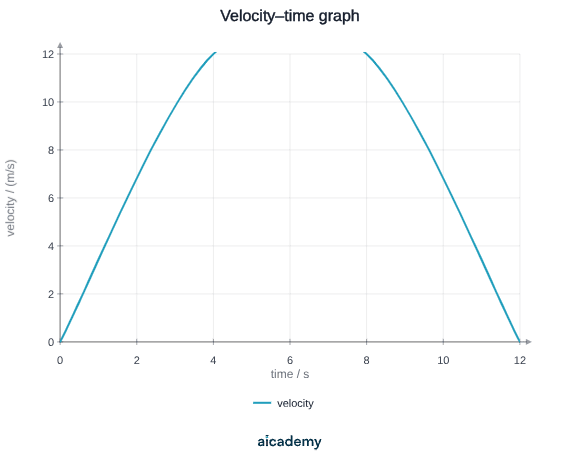
Reading the first section: the velocity rises from 0 to 12 m/s in 4 s, so the acceleration is m/s².
(Higher Tier only) The area under a velocity–time graph equals the distance travelled. Split the area into triangles and rectangles, or count squares for a curved line.
Worked example (HT) — find the total distance for the graph above by area.
- Rising triangle (0–4 s): m
- Middle rectangle (4–8 s): m
- Falling triangle (8–12 s): m
Total distance = .
Worth saving these ideas?
Turn what you've read into instant revision cards. Free to get started.
Terminal Velocity
(Separate Physics only) Drawing and interpreting the velocity–time graph for terminal velocity, and explaining it in terms of forces, is AQA GCSE Physics only.
An object falling through a fluid (a liquid or gas, such as air) does not speed up forever. It reaches a steady maximum velocity called the terminal velocity.
An object reaches terminal velocity when the resultant force on it is zero.
When a skydiver first jumps, their weight is much larger than the small air resistance, so there is a large downward resultant force and they accelerate. As they speed up, air resistance (drag) increases. Eventually the upward drag grows until it equals the weight. The resultant force is now zero, so the acceleration is zero and the velocity stays constant at the terminal velocity.
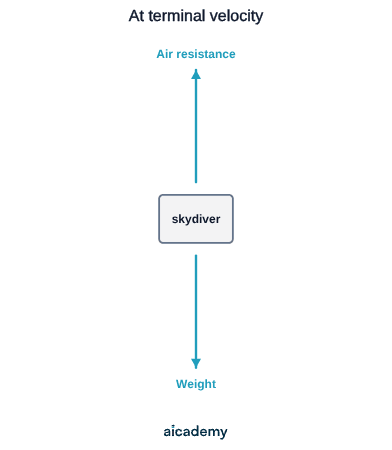
At terminal velocity the two forces are equal and opposite, as shown above. On a velocity–time graph, the object accelerates (rising curve) and then levels off to a horizontal line once terminal velocity is reached. Opening a parachute increases the air resistance sharply, so the resultant force becomes upward, the skydiver decelerates, and a new, lower terminal velocity is reached.
Key terms
- Acceleration
- The rate of change of velocity, equal to the change in velocity divided by the time taken, measured in m/s².
- Gradient
- The steepness of a line on a graph, found by dividing the change on the vertical axis by the change on the horizontal axis.
- Terminal velocity
- The steady maximum velocity of an object falling through a fluid, reached when the resultant force is zero.
- Free fall
- The motion of an object falling under gravity alone, with an acceleration near the Earth of about 9.8 m/s².
Frequently asked questions
Speed is the gradient of a distance–time graph: divide the change in distance by the change in time for a section of the line. A steeper gradient means a higher speed; a flat line means the object is stationary.
The distance travelled equals the area under the velocity–time graph. Split the area into triangles and rectangles, or count squares for a curved graph, then add the areas together. This is Higher Tier.
Terminal velocity is the steady maximum velocity of an object falling through a fluid. It is reached when the resultant force is zero, because the drag force upwards has grown to equal the weight downwards, so there is no further acceleration.
Generate revision on any topic you study
Type any topic you're studying and Aicademy generates a complete lesson, quiz, and flashcard set, personalised to your level.
Lessons on anything
Structured, level-matched lessons on any topic you study
Practice quizzes
Find out what you actually know before the exam does
Flashcard sets
Lock in key concepts with instant revision cards
Ask Aica
Stuck on something? Get a clear explanation, any time
Distance, Displacement, Speed and Velocity
Newton's Laws of Motion
Related lessons
5 min
6 min
8 min