Track progress, take quizzes and save notes on this lesson.

Free forever · no card needed

Start free
Intermediate

Atomic Structure and Isotopes

4.4.1.1 The structure of an atom·4.4.1.2 Mass number, atomic number and isotopes

Aligned to the AQA 8463 specification

Level
Intermediate
Reading time
6 min
Published
2 July 2026
On this page
  1. 1.The Size and Shape of an Atom
  2. 2.What the Nucleus Contains
  3. 3.Electrons and Energy Levels
  4. 4.Atomic Number and Mass Number
  5. 5.Why Atoms Are Neutral, and How Ions Form
  6. 6.Isotopes
  7. 7.Common Exam Mistakes

Key takeaways

  • An atom has a radius of about 1 × 10⁻¹⁰ m, with a tiny central nucleus of protons and neutrons and electrons arranged at different energy levels around it.
  • Atomic number is the number of protons; mass number is the total number of protons and neutrons. All atoms of an element have the same atomic number.
  • Isotopes are atoms of the same element with the same number of protons but different numbers of neutrons, so they share an atomic number but have different mass numbers.
  • Atoms are neutral because they have equal numbers of protons and electrons; losing outer electrons leaves a positive ion.
  • Electrons move to a higher energy level by absorbing electromagnetic radiation and drop to a lower level by emitting it.

The Size and Shape of an Atom

Atoms are astonishingly small. A typical atom has a radius of about 1 × 10⁻¹⁰ m, which is one ten-billionth of a metre. You could line up roughly ten million atoms across the width of a single grain of sand.

The radius of an atom is about m.

At the centre of every atom is a nucleus, a dense clump of positive charge. Around the nucleus, negatively charged electrons move in the space that gives the atom almost all of its volume.

The nucleus is tiny compared with the whole atom. Its radius is less than 1/10000 of the radius of the atom, yet it contains almost all of the atom's mass. If an atom were scaled up to the size of a football stadium, the nucleus would be about the size of a pea at the centre. Most of an atom is empty space.

What the Nucleus Contains

The nucleus is made of two types of particle: protons and neutrons. Together these are called nucleons.

  • Protons carry a positive charge.
  • Neutrons carry no charge (they are neutral).
  • Electrons carry a negative charge and orbit the nucleus.

The charge on a proton is equal and opposite to the charge on an electron. The table below summarises the relative charge and relative mass of each particle, using values you should recognise.

ParticleLocationRelative chargeRelative mass
ProtonNucleus+11
NeutronNucleus01
ElectronAround nucleus−1very small (about 1/2000)

Because protons and neutrons have a far greater mass than electrons, the mass of an atom is concentrated in the nucleus. The electrons contribute almost nothing to the total mass.

Electrons and Energy Levels

Electrons do not sit anywhere they like. They occupy fixed energy levels (also called shells) at different distances from the nucleus. Electrons closest to the nucleus are in the lowest energy level.

An electron can move between energy levels, but only by gaining or losing exactly the right amount of energy carried by electromagnetic (EM) radiation.

An electron absorbs EM radiation to move to a higher energy level (further from the nucleus). An electron emits EM radiation to move to a lower energy level (closer to the nucleus).

This is a two-way process. Supplying energy pushes an electron outwards; when it falls back in, that energy is released again as EM radiation. This idea of absorbing and emitting radiation to change energy level is exactly what the specification expects you to be able to describe.

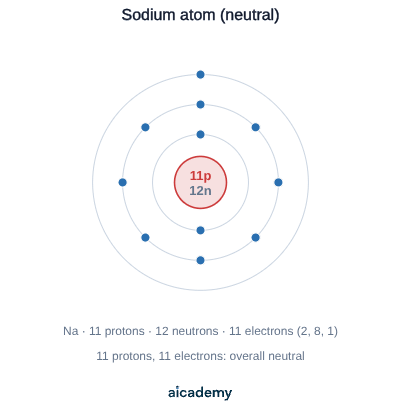
The diagram below shows the shell arrangement of a neutral sodium atom, with 11 protons in the nucleus and its 11 electrons filling the levels from the inside out.
Atomic Number and Mass Number

Two numbers describe the make-up of any nucleus. They are written around the chemical symbol.

Atomic number = the number of protons. Mass number = the number of protons + neutrons.

An atom is written in the form:

where Z is the atomic number (bottom) and A is the mass number (top).

The atomic number is what defines the element. Every carbon atom has 6 protons; every oxygen atom has 8. Change the number of protons and you change the element itself.

Since the mass number counts protons and neutrons together, you can always find the number of neutrons by subtracting:

Worked example — a lithium atom is written . How many protons, neutrons and electrons does it have?

  • Protons = atomic number = 3
  • Neutrons = mass number − atomic number = 4
  • Electrons = protons (the atom is neutral) = 3

How much of this have you taken in?

Quiz yourself on this section, free, no card needed.

Test myself

Why Atoms Are Neutral, and How Ions Form

In a complete atom the number of electrons equals the number of protons.

Atoms have no overall charge because the number of negative electrons equals the number of positive protons. The +1 and −1 charges cancel out exactly.

Atoms can become charged by losing electrons. When an atom loses one or more of its outer electrons, it is left with more protons than electrons, so it has an overall positive charge. A charged atom is called an ion.

An atom that loses one or more outer electrons becomes a positive ion, because it then has more protons than electrons.

Worked example — a sodium atom, , loses one electron to become a sodium ion, Na⁺. Describe its particles.

  • Protons = 11 (unchanged; losing an electron does not change the nucleus)
  • Neutrons = (unchanged)
  • Electrons =

With 11 protons but only 10 electrons, there is one more positive charge than negative, giving an overall charge of +1. Notice the nucleus is untouched, so the atomic number and mass number stay the same.

Isotopes

Atoms of the same element always have the same number of protons, but they do not all have to have the same number of neutrons.

Isotopes are atoms of the same element with the same number of protons but different numbers of neutrons. They therefore have the same atomic number but different mass numbers.

Carbon is the classic example. All three isotopes below have 6 protons, so they are all carbon, but they carry different numbers of neutrons.

IsotopeSymbolProtonsNeutronsElectrons
Carbon-12666
Carbon-13676
Carbon-14686

Because isotopes have the same number of electrons, they behave identically in chemical reactions. The extra neutrons change only the mass, not the element. Some isotopes are stable while others are unstable and radioactive, which is the starting point for the topic of radioactive decay.

Common Exam Mistakes

1. Mixing up atomic number and mass number

Atomic number is the number of protons only. Mass number counts protons and neutrons together. The mass number is always the larger of the two (unless the atom is hydrogen-1, where they are equal).

2. Forgetting to subtract to find neutrons

The number of neutrons is not given directly. Always calculate it as mass number minus atomic number.

3. Thinking isotopes have different numbers of protons

Isotopes of an element always have the same number of protons, so the same atomic number. Only the number of neutrons, and therefore the mass number, differs.

4. Changing the nucleus when an atom forms an ion

Ions form by gaining or losing electrons, not protons or neutrons. The atomic number and mass number of a positive ion are exactly the same as those of the neutral atom.

5. Describing electron energy levels loosely

Be precise: an electron absorbs EM radiation to move to a higher level and emits EM radiation to move to a lower level. Marks are lost for vague answers that do not link the direction of movement to absorbing or emitting radiation.

Key terms

Atomic number
The number of protons in the nucleus of an atom, which is the same for every atom of a given element.
Mass number
The total number of protons and neutrons in the nucleus of an atom.
Isotope
An atom of an element with the same number of protons but a different number of neutrons from other atoms of that element.
Ion
A charged atom formed when an atom gains or loses one or more electrons; losing electrons gives a positive ion.

Frequently asked questions

Atomic number is the number of protons in the nucleus; mass number is the number of protons plus neutrons. The number of neutrons equals mass number minus atomic number.

Isotopes are atoms of the same element with the same number of protons but different numbers of neutrons. They have the same atomic number but different mass numbers, for example carbon-12 and carbon-14.

An atom has a radius of about 1 × 10⁻¹⁰ m. The nucleus is less than 1/10000 of that radius but holds almost all of the atom's mass.

Generate revision on any topic you study

Type any topic you're studying and Aicademy generates a complete lesson, quiz, and flashcard set, personalised to your level.

Lessons on anything

Structured, level-matched lessons on any topic you study

Practice quizzes

Find out what you actually know before the exam does

Flashcard sets

Lock in key concepts with instant revision cards

Ask Aica

Stuck on something? Get a clear explanation, any time

Prev

Particle Motion and Pressure in Gases

Next

The Development of the Atomic Model

Related lessons

6 min

5 min

Lesson

Nuclear Equations

AQA GCSE Physics · AQA 8463

19 days ago

8 min

Lesson

Nuclear Fission and Fusion

AQA GCSE Physics · AQA 8463

19 days ago

Top students don’t revise more. They revise what counts.

Start revising free

Free to start. No card needed.